

Quick Answer:
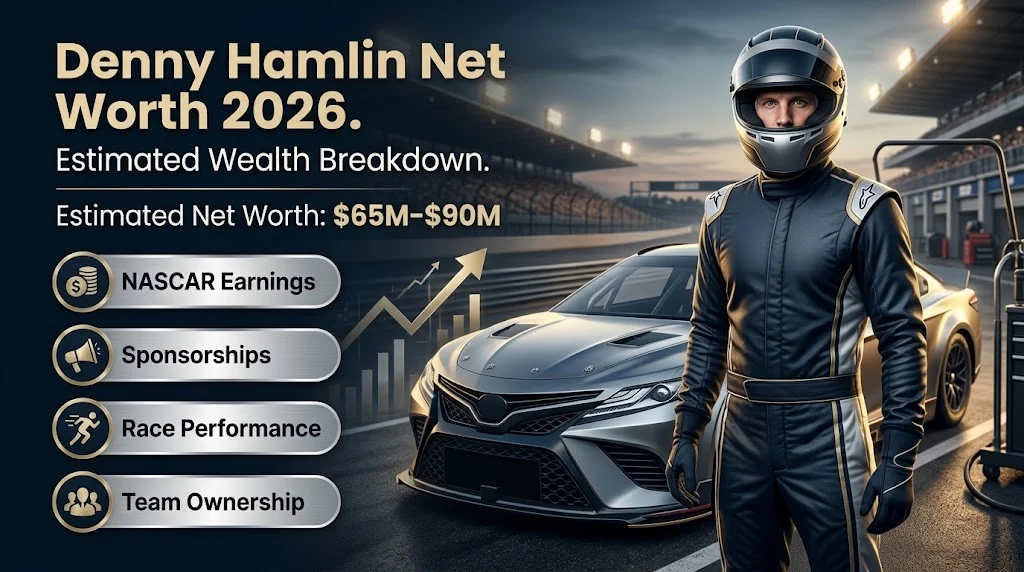
Denny Hamlin’s net worth in 2026 is estimated at approximately $65 million to $90 million, based on his NASCAR career earnings, race winnings, sponsorships, and team ownership interests, although his complete personal finances have not been publicly verified.
Denny Hamlin has built his wealth through years of competition at NASCAR’s highest level. As a long-time Cup Series driver, he has earned income from racing contracts, performance-related bonuses, commercial partnerships, and business activities connected to motorsports. His involvement in 23XI Racing, the NASCAR team he co-founded with basketball legend Michael Jordan, adds a business dimension to his financial profile.
Interest in Denny Hamlin net worth goes beyond race winnings. Fans also want to understand how a professional driver turns a long racing career into lasting wealth. However, reported career earnings are not the same as personal net worth. Taxes, agent fees, racing-related expenses, investments, liabilities, and the uncertain value of private business interests all affect the final calculation. The estimate in this article is therefore a reasoned range, not a confirmed financial statement.
Bio Data Table
| Field | Details |
|---|---|
| Full Name | James Dennis Alan Hamlin |
| Date of Birth | November 18, 1980 |
| Age as of 2026 | 45 years old |
| Place of Birth | Tampa, Florida, United States |
| Nationality | American |
| Height | Commonly reported at approximately 6 feet; exact measurement not independently verified here |
| Weight | Not publicly verified |
| Health Conditions | Not publicly verified as a complete medical profile |
| Religion | Not publicly verified |
| Education | Attended Manchester High School in Virginia; further educational details are not publicly verified here |
| Profession / Industry | NASCAR Cup Series driver and motorsports team co-owner |
| Zodiac Sign | Scorpio |
| Marriage / Relationship Status | Long-term relationship with Jordan Fish has been publicly reported; current legal marital status is not publicly verified here |
| Children | Two daughters, publicly reported |
| Net Worth | Estimated at $65 million to $90 million in 2026; not officially confirmed |
| Social Media Accounts | Public profiles on major social media platforms; account details should be checked against official verified profiles |
| Still Alive | Yes |
| Famous For | NASCAR Cup Series career, Daytona 500 victories, and co-founding 23XI Racing |
Denny Hamlin Net Worth 2026 Estimate
Denny Hamlin’s estimated net worth of $65 million to $90 million in 2026 reflects his long NASCAR career, substantial reported driving compensation, commercial partnerships, and ownership stake in 23XI Racing. The lower end aligns with a widely published third-party estimate, while the broader range allows for uncertainty around private assets and the value of his business interests. Neither figure is an officially confirmed personal balance sheet.
One of the clearest indicators of Hamlin’s earning power is his long-term position with Joe Gibbs Racing. He has competed in the NASCAR Cup Series for more than two decades and has remained a regular contender for race victories and the championship. His sustained performance has helped him maintain commercial value in a sport where results, team relationships, and sponsor exposure matter.
Public reporting in connection with the NASCAR charter litigation in 2025 included testimony about Hamlin’s driving compensation. That reported compensation offers a useful signal of his earning capacity, but a driver’s annual pay is not equivalent to net worth. His total financial position also depends on taxes, personal expenses, investments, liabilities, and any value attributable to his ownership interest in 23XI Racing.
Why 23XI Racing Matters
Hamlin co-founded 23XI Racing with Michael Jordan, and the team made its Cup Series debut in 2021. The organization created a route for Hamlin to participate in NASCAR as both a competitor and an owner. Ownership can provide financial opportunities beyond driving compensation, but it can also require significant capital and expose an owner to operating costs and commercial risks.
The value of a racing team is difficult to estimate from public information alone. Relevant factors include its racing charters, sponsorship agreements, facilities, equipment, contracts, performance, and liabilities. Even if a team becomes more valuable, an owner’s share of that value is not automatically cash available to spend. Selling an ownership stake, receiving distributions, or realizing value through a business transaction are different from holding an interest in a private company.
Why Career Earnings Are Not Net Worth
For Hamlin, several financial measures need to be kept separate:
- Gross earnings: Money generated before deductions and expenses.
- Driving compensation: Pay from a racing team under a contract, which may include salary and performance-related terms.
- Race winnings: Payments associated with race results or event-related arrangements. NASCAR does not provide a complete public accounting of what each driver personally retains.
- Sponsorship income: Compensation or other benefits from commercial partnerships, subject to contract terms.
- Business revenue: Money received by a team or business before operating costs.
- Ownership value: The estimated worth of Hamlin’s share of a business, which may be difficult to sell or convert into cash.
- Personal net worth: The value of personal assets and ownership interests minus liabilities.
A driver can earn millions over several seasons while also facing taxes, agent fees, training expenses, travel costs, and other obligations. A team owner may hold a valuable stake while the business itself must continually fund payroll, facilities, equipment, and competition. Those distinctions are essential when interpreting Denny Hamlin net worth estimates.
Net Worth Growth Timeline
Before Fame
Hamlin’s racing career began well before he became a NASCAR Cup Series star. According to his official career biography, he raced go-karts as a child and achieved considerable success in Virginia’s karting divisions. Early results helped him develop the driving skills needed to progress through more competitive forms of motorsport.
At this stage, his financial position would have been very different from that of an established professional driver. Early racing typically involves costs for vehicles, equipment, travel, maintenance, and competition entry. Drivers often rely on family support, sponsors, or racing programs to move through the development ladder. Hamlin’s exact income and personal net worth during his early years are not publicly verified.
Breakthrough Phase
Hamlin advanced through NASCAR’s lower divisions before establishing himself in the Cup Series. He made his Cup Series debut in 2005 and became a full-time driver for Joe Gibbs Racing in 2006. His first full season brought two Cup Series victories and recognition as the series’ Rookie of the Year.
That transition changed his financial prospects. A full-time seat with a leading team provides a professional platform, while strong results can increase a driver’s value to sponsors and partners. Race results also help build the reputation required to negotiate future contracts.
Hamlin’s first Daytona 500 victory in 2016 was another major career milestone. He won the race again in 2019 and 2020, establishing himself as one of its most successful modern competitors. These victories strengthened his public profile and could support his commercial appeal, although the precise financial benefit of each result is not publicly verified.
Peak and Recent Years
Hamlin continued to win races and compete near the top of NASCAR’s standings. His 2019 and 2020 seasons included multiple victories, and he remained a contender in subsequent championship campaigns. In 2025, he won six Cup Series races and finished runner-up in the championship standings, reinforcing his position as one of the sport’s leading active drivers.
His financial profile also expanded beyond the cockpit through 23XI Racing. The team debuted in 2021 and grew into a multi-car operation, adding a business interest to Hamlin’s driving career. Team ownership introduces a different kind of financial exposure: a driver’s personal income depends partly on his contract, while an owner’s potential return depends on the business’s performance and long-term value.
By 2026, Hamlin’s earnings potential rests on several connected factors: his continued Cup Series participation, race performance, commercial relationships, and ownership interest. These sources can generate substantial value, but none makes his exact net worth publicly knowable.
Main Sources of Income
1. NASCAR Driving Compensation
Hamlin’s primary professional income comes from driving for Joe Gibbs Racing in the NASCAR Cup Series. Established drivers negotiate contracts with their teams, and compensation can reflect experience, competitive results, marketability, and the driver’s importance to the organization.
Reported figures around Hamlin’s annual driving pay have placed him among NASCAR’s top earners. The precise terms of a contract, however, may include details that are not publicly disclosed. Any salary figure should be treated according to the evidence behind it rather than assumed to represent every part of his compensation.
Driving pay is also different from the overall cost of operating a race team. A NASCAR organization funds cars, engines, mechanics, engineers, transport, testing, and many other requirements. The driver’s contractual compensation is only one part of the sport’s financial structure.
2. Race Winnings and Performance Bonuses
Race results can influence a driver’s income through performance-related compensation and contractual incentives. Major victories, playoff progress, and championship contention can increase a driver’s value to a team and its commercial partners.
Hamlin’s three Daytona 500 wins and numerous other Cup Series victories demonstrate sustained competitive success. Yet NASCAR’s complete driver-specific payout details are not available as a consistent public record. Event revenue, team payments, bonuses, and the amount a driver personally receives are separate matters.
It would therefore be misleading to multiply the number of Hamlin’s wins by an assumed prize amount and describe the result as his personal earnings. His contracts may structure compensation differently, and any performance-related income must be considered alongside taxes and expenses.
3. Sponsorships and Endorsements
Sponsors are central to NASCAR’s commercial model. Brands pay for exposure through cars, uniforms, team communications, race broadcasts, hospitality programs, and other promotional opportunities. Drivers can contribute to that value through media appearances, sponsor events, and their public profiles.
Hamlin has had a long association with FedEx during much of his career, and he has been connected with other commercial partners through racing. Such relationships can enhance a driver’s earning opportunities, but the terms and payments of individual sponsorship agreements are often private.
A sponsorship contract may involve more than a direct payment to the driver. Some arrangements are made with teams, while others include promotional obligations, licensing, appearances, or performance conditions. It is therefore not appropriate to count the full value of a team sponsorship as Hamlin’s personal income.
4. 23XI Racing Ownership
Hamlin’s ownership interest in 23XI Racing is a significant part of his financial profile beyond driving compensation. He and Michael Jordan established the organization in 2020, with its first Cup Series season beginning in 2021.
A successful racing team can build value through competitive performance, sponsorship relationships, charters, facilities, and its wider commercial reputation. The growth of 23XI Racing may therefore affect Hamlin’s wealth, but the team’s exact valuation and the current market value of his individual stake are not publicly verified.
Ownership also brings risk. NASCAR teams face high operating costs, and commercial income must support personnel, engineering, vehicles, logistics, and other requirements. A private company’s estimated value is not the same as cash distributed to its owners. Any net worth calculation that assigns a precise dollar amount to Hamlin’s 23XI stake without reliable financial disclosure would be speculative.
5. Media, Appearances, and Other Commercial Activity
Hamlin has hosted the Actions Detrimental with Denny Hamlin podcast during the NASCAR season. A podcast can support audience engagement and may create opportunities involving advertising, sponsorships, or media partnerships, depending on its commercial arrangements.
He may also participate in interviews, promotional events, and motorsports-related appearances. However, the exact income from these activities is not publicly verified. They should be treated as possible supplementary sources rather than assumed to make up a specific percentage of his wealth.
6. Investments and Personal Assets
Hamlin’s financial holdings may include savings, investments, property, or other assets. Their complete value is not publicly disclosed. It would be inappropriate to assign a precise value to undisclosed holdings or assume that he owns particular investments without reliable evidence.
For a professional athlete, investment decisions can help preserve earnings after the driving career ends. They can also introduce market risk, management fees, and the possibility of losses. Hamlin’s specific investment strategy is not publicly verified, so the estimate should not rely on invented returns.
Business Strategy Behind the Wealth
Hamlin’s financial profile reflects two roles: an elite driver who generates value through competitive performance and a team co-owner who participates in the business side of NASCAR. These roles create different kinds of earning opportunities and expose him to different risks.
Building Value Through Consistent Performance
In professional motorsports, results help establish a driver’s reputation. Race victories, strong finishes, and regular championship contention can make a driver more attractive to teams and sponsors. Hamlin’s longevity with Joe Gibbs Racing has allowed him to build a recognizable profile over many seasons rather than depending on a brief period of success.
His three Daytona 500 victories are especially important to his public standing. The race is one of NASCAR’s most prominent events, and winning it multiple times strengthens a driver’s legacy. That recognition may contribute to future commercial opportunities, although the financial value of a specific victory cannot be calculated without contract information.
Expanding From Driver to Owner
Co-founding 23XI Racing gave Hamlin a role in the structure of the sport itself. Rather than earning only through driving, he became a participant in a racing organization with drivers, employees, sponsors, facilities, and long-term commercial interests.
This business model can create opportunities to build equity over time. If a team increases its value, an owner’s stake may become more valuable. However, racing teams require significant capital, and the business must manage competition costs and commercial commitments. Ownership can create wealth, but it is not a guaranteed source of profit.
Combining Racing Knowledge With Partnerships
Hamlin brings direct experience as a Cup Series driver to his work as a team owner. That knowledge can inform decisions about driver performance, competition, team development, and the demands of racing operations. His partnership with Michael Jordan also brings together motorsports expertise and a globally recognized sports-business figure.
The value of a partnership depends on execution, investment, and the ability to attract sponsors and compete effectively. It would be speculative to assign a precise financial premium to either partner’s reputation without public valuation data.
Long-Term Wealth Management
A professional racing career can be lucrative, but it is also exposed to physical demands, changing competition, and the limited length of an athlete’s peak earning years. Long-term financial planning may involve investments, business ownership, and preserving assets beyond active competition.
Hamlin’s ownership role gives him a connection to NASCAR that could continue beyond his full-time driving career. The long-term value of that role will depend on the team’s results, its finances, the commercial health of the sport, and any future ownership changes.
Awards & Achievements and Financial Impact
Hamlin’s competitive record is an important foundation for understanding his career earnings and market value. His major achievements demonstrate sustained performance in one of the most commercially visible forms of American motorsport.
Three Daytona 500 Victories
Hamlin won the Daytona 500 in 2016, 2019, and 2020. Winning the event can elevate a driver’s profile because it attracts broad media coverage and is one of the most recognized races on the NASCAR calendar.
These victories may have helped reinforce his reputation with sponsors and fans. The direct financial impact depends on contract incentives and commercial arrangements that are not fully public, so it is not possible to calculate an exact amount of additional wealth generated by the wins.
NASCAR Cup Series Rookie of the Year
Hamlin received NASCAR Cup Series Rookie of the Year recognition after his first full season in 2006. The award marked an early milestone in his transition from a developing driver to a successful competitor at the sport’s top level.
Recognition early in a career can strengthen future opportunities. For a driver, that may include stronger contract negotiations, continued access to competitive equipment, and increased sponsor interest. The award itself does not establish a specific financial payment or net worth increase.
More Than 60 Cup Series Wins
Hamlin entered the 2026 season with more than 60 career Cup Series victories and continued adding wins during the year. His official NASCAR profile reported 64 career Cup wins and four victories during the 2026 season at the time of the latest published statistics.
A record of this scale supports his standing as one of NASCAR’s most successful active drivers. Sustained performance can contribute to earning power by maintaining audience interest and commercial relevance. Still, race victories should not be treated as direct evidence of personal wealth because financial outcomes depend on contracts, expenses, and ownership arrangements.
Championship Contention
Hamlin has repeatedly competed near the top of the Cup Series standings, including runner-up finishes in the championship standings. Championship contention can increase visibility and strengthen the commercial value of a driver and team.
A championship result may affect bonuses or sponsor interest depending on contractual terms. Without access to those terms, however, the financial effect of any particular season remains an estimate rather than a verified sum.
Assets & Lifestyle
Hamlin’s professional success has attracted interest in his homes, vehicles, and personal lifestyle. However, a responsible net worth analysis should not rely on unverified claims about luxury possessions or assign precise values to assets without reliable information.
Real Estate
Public reporting has associated Hamlin with residential property in North Carolina, where many NASCAR teams and industry professionals are based. The details, current value, financing, and ownership structure of his complete property holdings are not publicly verified in a way that allows a reliable total to be calculated.
A property’s purchase price is not necessarily its current market value. Property taxes, maintenance, renovations, financing, and selling costs also affect the owner’s financial position. Real estate can be part of an athlete’s assets, but its contribution to net worth should be estimated only when there is sufficient evidence.
Cars and Luxury
As a NASCAR driver, Hamlin works in a sport built around high-performance vehicles and automotive engineering. That professional connection does not mean every racing or road vehicle associated with him is a personal asset. Race cars are typically owned or operated through teams, and the equipment used for competition should not automatically be included in a driver’s private wealth.
Specific claims about his current personal car collection, watches, or other luxury possessions should be treated cautiously unless supported by reliable reporting. The total value of such items is not publicly verified.
Racing and Business Assets
Hamlin’s most relevant business asset is his ownership interest in 23XI Racing. The organization operates within NASCAR’s competitive and commercial system and has invested in the personnel, equipment, and facilities needed to compete.
The value of a private racing team can be influenced by its charters, sponsorships, facilities, contracts, competitive performance, and liabilities. The value of Hamlin’s personal stake is not publicly confirmed, and the team’s operating assets should not be confused with assets that he personally owns outright.
Investments and Other Holdings
Hamlin may hold financial investments or other personal assets, but the full details are private. Without verified information, it is not possible to provide an accurate breakdown of cash, securities, retirement accounts, property equity, or liabilities.
The absence of public details does not mean that no such assets exist. It means that an estimate should acknowledge uncertainty rather than create an invented list of holdings.
Net Worth Comparison With Peers and the NASCAR Industry
Hamlin’s estimated net worth can be placed in context by comparing his career with other established NASCAR drivers. These comparisons should focus on similar professional backgrounds and recognize that drivers may earn money in different ways.
| NASCAR Figure | Career and Business Context | Financial Comparison |
|---|---|---|
| Denny Hamlin | Cup Series driver and 23XI Racing co-owner | Estimated wealth is linked to driving compensation, sponsorships, and team ownership. |
| Kyle Busch | Cup Series driver with a long record of race victories | Career earnings reflect racing contracts, results, and commercial partnerships. |
| Kyle Larson | Cup Series champion and high-profile driver | Earnings are associated with driving compensation, performance, and sponsor value. |
| Joey Logano | Multiple-time Cup Series champion | Long-term team contracts and commercial visibility contribute to earning potential. |
| Dale Earnhardt Jr. | Former Cup Series driver and motorsports entrepreneur | Wealth estimates also reflect media, business ventures, endorsements, and ownership interests. |
The table provides industry context rather than a precise ranking. Public net worth figures for these drivers are estimates, and their private assets and liabilities are not fully disclosed. A driver who owns a team or media business may have a different financial profile from one whose income primarily comes from a driving contract.
Hamlin’s combination of a long racing career and an ownership stake makes him more than a driver earning a salary. However, the value of that stake is difficult to establish without reliable financial disclosures. Comparing headline estimates without accounting for ownership, business expenses, and liabilities can produce a misleading impression of who is wealthier.
Controversies, Challenges & Financial Risks
Hamlin’s financial outlook is connected to the broader business challenges facing NASCAR. Racing teams operate in a demanding environment where competition, sponsorship, costs, and governance decisions can affect profitability.
NASCAR Charter and Antitrust Dispute
In 2024, 23XI Racing and Front Row Motorsports challenged NASCAR’s charter system in a high-profile antitrust dispute. The disagreement concerned the commercial structure of the sport and the terms offered to teams. Hamlin was involved in the matter as a co-owner of 23XI Racing, and the dispute became a major issue for the business side of NASCAR.
Legal proceedings can create financial uncertainty for teams and owners through legal costs, operational decisions, and potential effects on the value of racing assets. The long-term financial implications depend on legal outcomes, agreements, and changes to NASCAR’s commercial framework. It would be inaccurate to assign a specific gain or loss to Hamlin’s personal net worth without verified financial information.
High Operating Costs
A NASCAR team must fund vehicles, engines, technical staff, mechanics, engineers, transporters, facilities, and competition preparation. These costs can be substantial and continue regardless of whether a team wins a particular race.
For an owner, strong results may improve sponsorship opportunities and the team’s commercial profile, but they do not guarantee profit. Operating expenses and capital investment can offset revenue, which is why the value of a racing organization should not be calculated from race results alone.
Career Longevity and Physical Risk
Driving at the highest level requires intense concentration and carries the possibility of injury. A serious injury or reduced ability to compete could affect a driver’s contract, performance-related income, and sponsorship appeal.
Hamlin’s long career demonstrates consistency, but no athlete can eliminate the risks associated with competition. The financial effect of a future injury or retirement is uncertain and should not be presented as a prediction.
Sponsorship and Market Changes
Motorsports depends on commercial partners, broadcast exposure, audience interest, and the financial health of participating businesses. Changes in sponsorship budgets, media arrangements, or the popularity of racing can influence the resources available to teams.
A driver with a strong record may remain commercially attractive, but sponsor relationships can change over time. Hamlin’s financial outlook therefore depends partly on conditions beyond his direct control.
Philanthropy & Social Impact
Hamlin’s community work includes the Denny Hamlin Foundation, which focuses on raising awareness and funds for needs related to cystic fibrosis. The foundation’s stated mission includes supporting research, treatment advances, and quality of life for people affected by the condition.
This charitable work is a documented part of his public profile. However, the total amount Hamlin has personally donated, the value of all fundraising activity, and the complete financial details of the foundation are not publicly verified here. Fundraising totals should not be confused with personal donations, since funds may come from many contributors and events.
Hamlin’s wider influence also comes from his role in NASCAR and as a team co-owner. Through 23XI Racing, he participates in the development of a racing organization that employs people across competition, engineering, operations, and business functions. His career provides an example of how professional athletes can become involved in the ownership side of their sport while continuing to compete.
How Denny Hamlin Makes Money Outside His Core Profession
Although driving remains Hamlin’s central professional activity, his financial interests extend into team ownership and media. These activities may provide opportunities to earn money beyond his direct racing contract.
Team Ownership and Business Development
His ownership stake in 23XI Racing is the most significant publicly known business interest connected to his motorsports career. A team can potentially generate value through sponsorships, commercial partnerships, competition performance, and the growth of its racing assets.
However, team revenue is not automatically personal income for an owner. Operating expenses, reinvestment, debt, and contractual obligations must be accounted for before determining whether a business generates profit or increases an owner’s net worth.
Podcast and Media Activity
Hamlin hosts the Actions Detrimental with Denny Hamlin podcast during the NASCAR season. The show gives him a platform to discuss racing and connect with fans outside race broadcasts.
Sports media can generate income through advertising and sponsorships, depending on the show’s commercial arrangements. Hamlin’s exact podcast revenue is not publicly verified, so it should not be assigned a specific dollar value in his net worth estimate.
Appearances and Commercial Partnerships
Professional drivers may participate in sponsor events, interviews, promotional campaigns, and other appearances. Such work can complement their main racing income, although the value and terms of individual arrangements vary.
Hamlin’s specific earnings from appearances and any additional private business activities are not publicly verified. These categories may be relevant to a broader financial picture, but the clearest established drivers of his wealth remain racing compensation and 23XI Racing ownership.
Future Net Worth Projection
Denny Hamlin’s financial outlook beyond 2026 will depend on his continued performance, contract arrangements, sponsorship opportunities, and the long-term value of his ownership interest in 23XI Racing. His record of race victories and championship contention gives him a strong professional foundation, but future wealth cannot be forecast with certainty.
Continued NASCAR Earnings
As long as Hamlin remains competitive and continues racing, his driving contract and performance-related opportunities may remain important income sources. Strong results can support commercial demand, although compensation depends on contract terms and the wider economics of NASCAR.
His career is also subject to the realities of professional sport. Retirement, injury, changes in team relationships, or reduced performance could affect future income. No specific retirement date or future contract value should be assumed without verified information.
Potential Value of 23XI Racing
The long-term performance of 23XI Racing could have a meaningful effect on Hamlin’s financial position. A racing team may become more valuable through competitive success, stronger sponsorships, valuable charters, and commercial growth. Its ownership value can also be affected by operating costs, legal developments, and changes to NASCAR’s business model.
The team’s future valuation and Hamlin’s precise ownership value are not publicly verified. Any projection that assigns a fixed amount to his stake would therefore be speculative.
Sponsorships and Media Opportunities
Hamlin’s established reputation may support continued interest from sponsors and media platforms. His podcast and public presence could offer additional opportunities, but future commercial deals and their financial terms are unknown.
Overall Outlook
Hamlin’s net worth could grow if his racing income remains strong, 23XI Racing increases in value, and his investments perform well. It could also remain stable or decline if business costs rise, asset values fall, or professional income changes.
The estimated $65 million to $90 million range should be understood as an approximation for 2026, not a guaranteed starting point for future projections. His private assets, liabilities, and business valuation remain important unknowns.
Frequently Asked Questions
1. What is Denny Hamlin’s net worth in 2026?
Denny Hamlin’s net worth is estimated at approximately $65 million to $90 million in 2026. This range considers his NASCAR career, reported driving compensation, sponsorship opportunities, and ownership interest in 23XI Racing. His exact personal wealth has not been publicly verified.
2. How much does Denny Hamlin make as a NASCAR driver?
Public reporting has placed Hamlin’s annual driving compensation among NASCAR’s highest. Reports connected to the 2025 charter litigation included testimony about his Joe Gibbs Racing pay. His complete contract terms and total annual income from every source are not publicly verified.
3. Does Denny Hamlin own 23XI Racing?
Yes. Denny Hamlin co-founded and co-owns 23XI Racing with Michael Jordan. The team began competing in the NASCAR Cup Series in 2021. The current market value of Hamlin’s individual ownership stake has not been publicly confirmed.
4. How many Daytona 500 races has Denny Hamlin won?
Hamlin has won the Daytona 500 three times: in 2016, 2019, and 2020. The victories are major achievements in his racing career and have helped establish his reputation as one of the event’s most successful modern drivers.
5. Does Denny Hamlin earn money outside racing?
His publicly known activities outside driving include his ownership interest in 23XI Racing and hosting the Actions Detrimental with Denny Hamlin podcast. He may also participate in commercial partnerships and appearances, but the exact income from these activities is not publicly verified.
6. Is Denny Hamlin’s net worth officially confirmed?
No. The $65 million to $90 million estimate is not an officially confirmed financial figure. Public reporting can provide information about career earnings and business interests, but it does not reveal Hamlin’s complete assets, debts, taxes, and personal expenses.
Conclusion
Denny Hamlin net worth in 2026 is estimated at $65 million to $90 million, reflecting his long NASCAR career, reported driving compensation, sponsorship opportunities, and ownership interest in 23XI Racing. His three Daytona 500 victories, sustained Cup Series success, and involvement in a major racing organization help explain why he has become financially significant in motorsports.
Hamlin’s wealth is not simply a measure of race winnings. His professional income must be considered alongside taxes, expenses, business liabilities, investments, and the uncertain value of his ownership stake. His work with 23XI Racing adds a business dimension that could influence his long-term financial future, although the team’s valuation and his personal assets are not fully disclosed.
The range in this article is an estimate rather than a confirmed total. Hamlin’s financial position may change with his racing performance, commercial relationships, business results, and personal financial decisions.
Discover More Post:
- Trump Net Worth | How Donald Trump Built His Fortune and …
- Beyoncé Net Worth | The Billion-Dollar Journey Behind Her …
- Rihanna Net Worth, Career Milestones & Wealth | From Music Star …