

Quick answer:
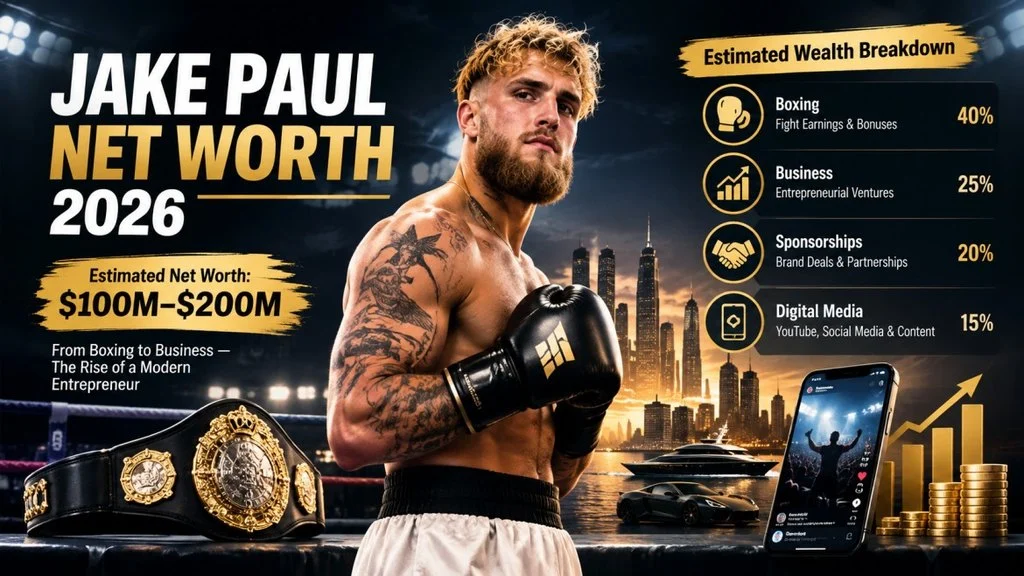
Jake Paul’s 2026 net worth can reasonably be estimated at $100 million–$200 million, based on his reported boxing and creator earnings, business interests, sponsorships and ownership positions; however, his exact personal net worth is not publicly verified, and private-company stakes make any precise figure uncertain.
Jake Paul has built an unusual financial career by combining internet fame with professional boxing and entrepreneurship. Unlike athletes whose wealth primarily comes from a team salary, Paul has created several overlapping income engines: fight earnings, digital media, sponsorships, business ownership, sports promotion and private investments.
That makes Jake Paul net worth particularly difficult to calculate. Public sources can estimate what he earns from major fights, but they cannot see his complete private-company ownership, personal investments, taxes, expenses, debt or the exact value of his equity stakes.
Forbes provides one of the clearest signals of Paul’s earning power. Its 2026 highest-paid-athletes profile estimated that Paul earned $70 million during the measurement period, including approximately $60 million from two 2025 fights. Forbes also estimated that his three fights in 2021 generated around $40 million. These are earnings estimates, not a statement of his personal net worth.
Bio Data Table
| Category | Details |
|---|---|
| Full Name | Jake Joseph Paul |
| Date of Birth | January 17, 1997 |
| Age as of 2026 | 29 |
| Place of Birth | Cleveland, Ohio, United States |
| Nationality | American |
| Height | Publicly reported at about 6 ft 1 in; exact figure is not independently verified here |
| Weight | Varies by fight; not publicly verified as a fixed personal figure |
| Health Conditions | Not publicly verified |
| Religion | Not publicly verified |
| Education | Westlake High School; further formal education not publicly verified |
| Profession | Professional boxer, entrepreneur, promoter, social-media personality |
| Industry | Boxing, combat sports, digital media and entrepreneurship |
| Zodiac Sign | Capricorn |
| Marriage / Relationship Status | Engaged to speed skater Jutta Leerdam, according to widely reported public information |
| Children | Not publicly verified |
| Estimated Net Worth | Approximately $100 million–$200 million |
| Social Media Accounts | Public accounts exist under the Jake Paul name, including YouTube and other major social platforms |
| Still Alive | Yes |
| Famous For | YouTube, Vine-era internet fame, professional boxing and Most Valuable Promotions |
Biographical sources identify Paul as an American boxer, influencer and actor born in Cleveland in 1997. Public profiles also document his transition from Vine and YouTube into boxing and business.
Who Is Jake Paul? Background & Early Life
Jake Joseph Paul was born on January 17, 1997, in Cleveland, Ohio. He is the younger brother of Logan Paul, another major figure in the creator economy.
Paul’s first major rise to fame did not come from boxing. It came from social media. He began posting videos on Vine in 2013, where his short-form comedy content attracted millions of followers and billions of views before the platform shut down.
He then moved heavily into YouTube, where he developed a personality-driven content business around vlogs, entertainment, stunts and his personal life. That audience eventually became one of his most valuable assets.
Paul also entered traditional entertainment. He appeared on Disney Channel’s Bizaardvark and took part in several other acting and media projects. His time in conventional entertainment was relatively short, but it helped establish him as a recognizable mainstream personality.
The more consequential career change came when Paul entered boxing.
His professional boxing career began in 2018, initially through celebrity and creator-driven events. Instead of treating boxing simply as a sporting activity, Paul recognized that his existing audience could be converted into a commercial audience for live combat sports.
That distinction became central to his wealth strategy.
Rather than depending entirely on boxing organizations to create his market value, Paul increasingly controlled the promotion, marketing and media narrative surrounding his fights.
In 2021, Paul and Nakisa Bidarian founded Most Valuable Promotions, commonly known as MVP. The company initially focused on boxing but later expanded into a much broader combat-sports operation.
By 2026, MVP had become significantly larger. The company announced a merger with the Professional Fighters League, bringing boxing, MMA, live events, athlete development and content distribution under the MVP banner. Paul and Bidarian became co-founders and board members of the enlarged organization.
That development is important when evaluating Paul’s wealth because it means his financial interests are no longer limited to what he earns when he personally enters the ring.
Jake Paul Net Worth Overview: 2026 Estimate
A reasonable 2026 working estimate for Jake Paul’s personal net worth is $100 million to $200 million.
This is deliberately presented as a range rather than an exact figure.
The lower end reflects the need to account for taxes, management expenses, training and fight costs, business operating expenses, investment capital and the fact that reported earnings are not automatically converted into personal wealth.
The upper end reflects the possibility that Paul has accumulated substantial value through private-company equity, business investments, sponsorships and years of high earnings.
One widely cited celebrity-wealth database currently places Paul’s net worth at $200 million. However, that figure is an outside estimate rather than an independently audited disclosure from Paul.
Forbes provides a more useful measure of his earning power. Its 2026 profile lists Paul among the highest-paid athletes, with estimated earnings of $70 million. Forbes says approximately $60 million came from his two 2025 fights, including his bout with Anthony Joshua.
Those figures should not be interpreted as saying that Paul personally added $70 million to his net worth.
Why Earnings and Net Worth Are Different
Suppose a fighter receives $20 million in gross fight-related compensation. That does not mean the fighter becomes $20 million richer.
Taxes can take a significant portion of income. Training camps cost money. Managers, attorneys, agents, trainers and other professionals may receive fees. Promotional expenses can also reduce the amount ultimately retained.
Business income creates another layer of complexity.
Revenue generated by a company belongs to the company, not automatically to its founder. Likewise, a company’s valuation is not the same thing as the founder’s personal wealth.
This is especially important for Paul because several of his businesses are privately held.
Therefore, the $100 million–$200 million range should be treated as an analytical estimate rather than an audited financial statement.
Net Worth Growth Timeline
Before Fame
Paul’s early financial foundation came from digital media.
His Vine popularity gave him an audience, but the more durable asset was his ability to move that audience to YouTube and other platforms.
During this period, his income was primarily creator-economy based. Advertising, sponsorships, merchandise and entertainment opportunities were more important than boxing.
His early wealth was therefore closely connected to audience growth.
Breakthrough Phase
The boxing transition changed the financial structure of Paul’s career.
Instead of being paid primarily for content, Paul became capable of generating large event-related earnings.
His fights against opponents such as Ben Askren, Tyron Woodley, Anderson Silva and Nate Diaz helped turn his boxing career into a commercial property.
The 2021 period was especially significant. Forbes later estimated approximately $40 million in earnings from Paul’s three fights that year.
The creation of Most Valuable Promotions added another layer because Paul became involved in the economics of promoting fights rather than merely participating as a fighter.
Peak / Recent Years
Paul’s biggest financial acceleration came from increasingly mainstream boxing events.
His 2024 fight with Mike Tyson became a major Netflix sporting event and significantly expanded Paul’s global visibility.
In 2025, Forbes estimated that Paul earned about $60 million from two fights, contributing to an estimated $70 million total earnings figure for its 2026 ranking.
His business position also expanded.
In July 2026, MVP and the Professional Fighters League announced their merger. The combined organization was designed to operate across boxing, MMA, live events, athlete development and worldwide content distribution.
That makes Paul’s recent wealth story less about individual fight purses and more about ownership, brand leverage and control of a combat-sports platform.
Main Sources of Income
Professional Boxing Earnings
Boxing is currently the clearest major source of Paul’s income.
His fights can generate revenue through purses, event economics, media arrangements and other commercial components.
Forbes estimated $60 million from his two 2025 fights, demonstrating how dramatically a major fight schedule can change annual earnings.
However, boxing income can be irregular.
A fighter might earn enormous sums in a single year and considerably less in another year if there are fewer fights.
That means annual earnings should not be confused with a fixed salary.
Sponsorships and Brand Partnerships
Paul also monetizes his enormous digital audience through sponsorships and commercial partnerships.
Forbes lists Celsius Holdings and Fanatics among his sponsors.
For a personality such as Paul, sponsorship value comes from more than follower count.
His audience spans social media, boxing and entertainment. That allows a brand to reach consumers through multiple channels.
Most Valuable Promotions
Most Valuable Promotions is one of the most important pieces of Paul’s long-term wealth strategy.
Paul co-founded MVP with Nakisa Bidarian in 2021. The company initially focused on boxing but grew into a broader combat-sports business.
The company’s business model potentially creates value through event promotion, media rights, sponsorships, fighter relationships, distribution and intellectual property.
Because MVP is privately held and Paul’s exact equity percentage has not been publicly disclosed, its value cannot responsibly be converted into a precise personal net-worth figure.
The 2026 merger with PFL makes this even more complicated.
The combined organization is backed by outside investors, meaning the company’s capital and valuation cannot simply be counted as Paul’s personal assets.
Digital Media and Creator Income
YouTube remains part of the financial foundation that made Paul’s later businesses possible.
His digital audience gives him direct distribution without requiring traditional media companies to build an audience for him.
That audience can be monetized through advertising, sponsorships, product promotion and media projects.
Forbes has repeatedly ranked Paul among high-earning creators, and its 2025 Top Creators ranking estimated his annual earnings at $50 million for that ranking period.
Business and Investment Interests
Paul has also participated in businesses outside boxing.
He co-founded Betr, a sports-media and gaming company, with Joey Levy. Exact ownership percentages are private, so the value of Paul’s stake cannot be reliably calculated from the company’s funding or valuation alone.
Paul has also been associated with Anti Fund, a venture-capital firm launched with Geoffrey Woo.
This illustrates another important net-worth principle: assets under management are not the same as the founder’s personal assets.
A venture fund can manage hundreds of millions of dollars without its founder personally owning that entire amount.
Business Strategy Behind the Wealth
Paul’s financial strategy is unusual because he has repeatedly converted attention into ownership.
A conventional influencer might build an audience and then sell advertisements.
Paul went further.
First, he built an audience.
Second, he used that audience to generate content and sponsorship income.
Third, he entered boxing and transformed his audience into ticket buyers, viewers and fight-event consumers.
Fourth, he created a promotional company that allowed him to participate in the business surrounding other fighters.
Finally, he expanded into businesses and investments outside the ring.
This is a form of vertical integration.
Paul can potentially benefit as a content creator, athlete, promoter and entrepreneur at the same time.
His personal brand also reduces customer-acquisition costs for businesses associated with him because his audience can become the initial marketing channel.
The strategy is risky, but its upside is substantial.
The 2026 MVP-PFL merger demonstrates the scale of this approach. MVP stated that its platform had reached nearly 400 athletes and audiences across more than 170 countries by its fifth anniversary.
Awards & Achievements and Financial Impact
Paul’s financial achievements are more relevant to his wealth than traditional sporting awards.
High-Paid Athlete Recognition
Forbes estimated Paul’s 2026 earnings at $70 million, placing him among the world’s highest-paid athletes for that ranking period.
This matters because high annual earnings can increase negotiating leverage with sponsors, broadcasters and event partners.
Mike Tyson Fight
Paul’s 2024 fight with Mike Tyson became one of Netflix’s major live sporting events.
Netflix reported the Paul-Tyson event as its most-streamed sporting event at the time, giving the fight enormous global exposure.
The event demonstrated Paul’s ability to turn a boxing match into a mainstream entertainment product.
Most Valuable Promotions
MVP’s growth is arguably Paul’s most important entrepreneurial achievement.
The company helped elevate women’s boxing, including the Amanda Serrano and Katie Taylor rivalry, while developing a broader combat-sports platform.
The 2026 merger with PFL represented a significant expansion beyond Paul’s own fighting career.
Assets & Lifestyle
Real Estate
Paul has been associated with expensive residential properties and real-estate activity, but the exact current value and ownership structure of all properties connected to him are not publicly verified.
For that reason, it would be misleading to add an arbitrary property figure to his net worth.
Real estate can also create costs through property taxes, maintenance, insurance, financing and management.
Cars & Luxury
Paul’s public image includes luxury travel, cars and high-end lifestyle content, but individual purchases should not automatically be counted as net-worth assets.
A vehicle depreciates, and a financed luxury purchase may represent both an asset and a liability.
Specific current vehicle holdings should therefore be treated cautiously unless supported by reliable documentation.
Business Assets
Business ownership is potentially more important to Paul’s long-term wealth than lifestyle items.
His interests in combat-sports promotion, sports media, consumer brands and investment vehicles can create equity value that is difficult for outsiders to measure.
This is one reason his net worth cannot be calculated simply by adding visible luxury assets.
Net Worth Comparison with Peers / Industry
Paul occupies an unusual position compared with traditional boxers.
A conventional boxer may build wealth primarily through fight purses, endorsements and investments.
Paul combines those income sources with creator revenue and entrepreneurial ownership.
His annual earnings have also placed him alongside major athletes despite having a relatively short professional boxing career.
Forbes estimated Paul’s 2026 earnings at $70 million, while its profile specifically identifies boxing as his source of wealth.
However, comparisons with peers should be made carefully.
Public net-worth figures for celebrities and athletes are generally estimates. They can differ substantially because one source may count business equity while another may focus primarily on liquid assets.
Paul’s situation is even more complicated because his private businesses do not publish the same level of financial information as public companies.
Therefore, comparisons with other boxers should be viewed as directional rather than precise rankings of personal wealth.
Controversies, Challenges & Financial Risks
Paul’s wealth strategy has also carried significant risks.
His public persona has generated controversy throughout his career, and his aggressive promotional style can create both attention and reputational exposure.
For a personality whose businesses depend heavily on audience engagement, reputation is financially important.
A major sponsorship dispute, platform restriction or sustained loss of audience trust could affect commercial income.
Boxing Risk
Boxing itself is inherently unpredictable.
Injuries, cancellations, opponent availability and declining audience interest can reduce earnings.
A fighter also has a relatively short peak earning window.
Business Risk
Private startups and investment companies can lose value.
Paul’s stakes in private companies may be worth more or less than outside estimates depending on future financing rounds, business performance and market conditions.
Regulatory Risk
Sports gaming and betting-related businesses face regulatory requirements that can vary by jurisdiction.
Any regulatory changes could affect businesses associated with Paul’s investment portfolio.
Tax and Operating Costs
High gross earnings also create high tax exposure.
Additionally, boxing camps, professional advisers, business employees, legal expenses, travel and event operations can consume substantial amounts of revenue.
This is why gross earnings should never be treated as disposable personal wealth.
Philanthropy & Social Impact
Paul has participated in charitable and social initiatives, including work connected to anti-bullying efforts.
His broader influence also extends into combat-sports visibility and athlete promotion.
Most Valuable Promotions has emphasized increased visibility and compensation opportunities for women and emerging fighters, making Paul’s business activities relevant beyond his personal career.
However, a complete independently verified accounting of Paul’s lifetime charitable giving is not publicly available.
Publicly verified philanthropy information is limited.
How Jake Paul Makes Money Outside Core Profession
Paul’s wealth increasingly comes from activities outside simply fighting in boxing matches.
Sports Promotion
MVP gives Paul exposure to the economics of promoting other athletes and events.
This is strategically important because it allows him to make money from the combat-sports ecosystem even when he is not fighting.
Sports Media and Gaming
Paul co-founded Betr, creating another connection between his audience, sports media and digital gaming.
Because Betr is privately held and its exact ownership structure is not fully public, its contribution to Paul’s personal net worth remains uncertain.
Venture Capital
Through Anti Fund, Paul has participated in startup investing.
The firm’s portfolio and assets under management should not be confused with Paul’s personal wealth.
His potential financial benefit comes from ownership, investments, management economics and possible future gains rather than the entire value of companies in the portfolio.
Sponsorships
Brand partnerships remain an important supplemental income source.
Paul’s ability to promote products directly to a large online audience gives him commercial leverage beyond traditional sports advertising.
Future Net Worth Projection
Paul’s future wealth will depend less on whether he wins one particular boxing match and more on whether he successfully converts his personal brand into durable business ownership.
The 2026 MVP-PFL combination could materially increase the scale of his business exposure if the combined organization successfully grows media rights, sponsorships, live events and international distribution.
MVP has already positioned itself as a combat-sports platform rather than merely a boxing promotion.
That creates significant upside, but also significant risk.
If Paul’s boxing career continues producing major events, he could maintain unusually high annual earnings.
If his personal fighting career slows, however, his businesses could become more important to his wealth.
A reasonable long-term scenario is therefore that Paul’s personal net worth continues to rise if three conditions hold:
- Major fight events continue generating substantial income.
- MVP and related businesses increase in value.
- Paul’s digital audience remains commercially powerful.
A less favorable scenario would involve reduced fight demand, business losses, regulatory pressure, declining engagement or expensive disputes.
For that reason, future projections should be treated as scenarios rather than promises.
Frequently Asked Questions
What is Jake Paul’s net worth in 2026?
Jake Paul’s 2026 net worth is reasonably estimated at $100 million–$200 million, although his exact personal wealth has not been publicly verified. Some celebrity-wealth sources report figures around $200 million, while Forbes primarily provides earnings data rather than a personal net-worth figure.
How much did Jake Paul earn in 2025?
Forbes estimated that Paul earned approximately $60 million from two fights in 2025, contributing to total estimated earnings of $70 million for its 2026 highest-paid-athletes ranking.
Is Jake Paul a billionaire?
There is no reliable public evidence establishing Jake Paul as a billionaire. Private-company interests can be difficult to value, but available public reporting does not support a confirmed billion-dollar personal net worth.
What is Jake Paul’s main source of income?
Boxing has become his most significant publicly documented income source. Forbes identifies boxing as his source of wealth and estimated $70 million in earnings for its 2026 athlete ranking. His other income sources include sponsorships, digital media and business interests.
Does Jake Paul own Most Valuable Promotions?
Jake Paul co-founded Most Valuable Promotions with Nakisa Bidarian in 2021 and remains a co-founder and board member following the 2026 merger with the Professional Fighters League. His exact ownership percentage is not publicly verified.
Is Jake Paul’s net worth confirmed?
No. Jake Paul’s exact personal net worth is not publicly audited or officially disclosed. Published figures are estimates based on earnings, reported business interests and assumptions about assets and ownership.
Conclusion
Jake Paul net worth in 2026 is best treated as an estimated $100 million–$200 million range rather than a confirmed single number. His wealth-building journey is unusual because it combines professional boxing with social-media influence, sponsorships, business ownership and combat-sports promotion.
His reported earnings show why the estimate can be substantial. Forbes estimated $70 million in earnings for its 2026 highest-paid-athletes ranking, including roughly $60 million from two fights in 2025.
But earnings are only one part of the equation.
Taxes, management expenses, training costs, business reinvestment, investment losses, private-company ownership and liabilities can significantly change the amount that ultimately becomes personal wealth.
The biggest long-term factor may be Paul’s business strategy. Through Most Valuable Promotions, he has attempted to move from being a fighter who earns money from boxing to an entrepreneur who participates in the wider economics of combat sports.
The 2026 MVP-PFL merger represents the clearest example of that transition.
Discover More Post:
- Alyssa Milano Net Worth | Career & Wealth – WorthSaga.com –
- Anderson Cooper Net Worth | Career Earnings, Wealth …