

Quick Answer:
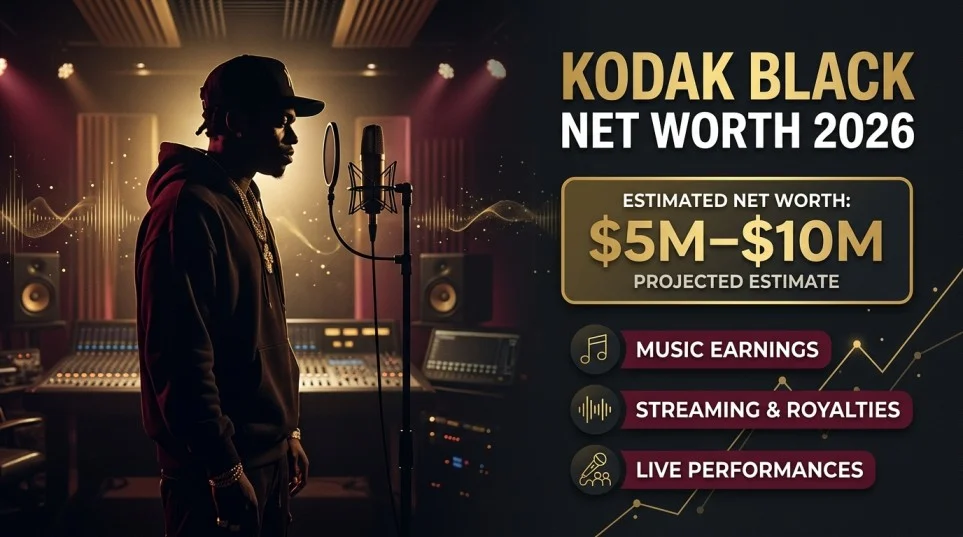
Kodak Black’s net worth in 2026 is estimated cautiously at $5 million to $10 million, based on publicly reported celebrity wealth estimates and his music career, although his personal financial records, liabilities, and recording-contract terms are not publicly verified.
Kodak Black has built a recognizable name in American hip-hop through distinctive vocal delivery, commercially successful songs, charting albums, and a career that began while he was still a teenager. From his early breakthrough with “No Flockin” to later hits such as “Tunnel Vision,” “Zeze,” and “Super Gremlin,” the Florida rapper has developed a catalog that continues to attract listeners. His music career is the primary starting point for understanding Kodak Black net worth in 2026.
However, popularity and financial wealth are not the same thing. A song can generate substantial streaming activity without delivering the same amount of money to the artist, and reported music earnings do not account for taxes, label agreements, management fees, legal expenses, personal spending, or outstanding debts. Public estimates of Kodak Black’s fortune also differ, partly because the financial details behind his recordings and other assets are private.
This article examines his background, career milestones, potential income sources, and publicly reported financial estimates. It separates documented career developments from assumptions about his personal wealth so readers can understand both his commercial success and the limitations of available financial information.
Bio Data Table
| Field | Details |
|---|---|
| Full Name | Bill Kahan Kapri, professionally known as Kodak Black |
| Birth Name | Dieuson Octave |
| Date of Birth | June 11, 1997 |
| Age in 2026 | 29 |
| Place of Birth | Pompano Beach, Florida, United States |
| Nationality | American |
| Height | Not publicly verified for this article |
| Weight | Not publicly verified |
| Health Conditions | Not publicly verified |
| Religion | Not publicly verified |
| Education | Attended school in Florida; highest completed qualification not publicly verified |
| Profession / Industry | Rapper, singer, songwriter, hip-hop |
| Zodiac Sign | Gemini |
| Marriage / Relationship Status | Current status not publicly verified |
| Children | Public reports identify him as a father; a complete, independently verified current count is not established here |
| Net Worth in 2026 | Estimated $5 million to $10 million; not confirmed |
| Social Media Accounts | Instagram: @kodakblack |
| Still Alive | Yes |
| Famous For | “No Flockin,” “Tunnel Vision,” “Zeze,” “Super Gremlin,” and charting rap albums |
Who Is Kodak Black? Background and Early Life
Kodak Black was born on June 11, 1997, in Pompano Beach, Florida. His birth name was Dieuson Octave, and he later became legally known as Bill Kahan Kapri. He grew up in South Florida, a region with a distinctive hip-hop culture that has produced artists known for regional slang, melodic delivery, and street-oriented storytelling.
His early environment and experiences became part of the background surrounding his music. Kodak began pursuing rap as a young teenager, recording songs and working to develop a recognizable style. Rather than entering the music business through a traditional entertainment career, he built attention through early recordings, online distribution, and growing interest in his local music scene.
One of his early breakthroughs was “No Flockin,” released in 2014. The song helped establish his identity among rap listeners and eventually became an important part of his rise to mainstream recognition. His early momentum demonstrated how an emerging artist could use digital music platforms and online attention to reach audiences beyond a hometown fan base.
Kodak Black’s early career also included significant legal challenges. Those events became part of the public narrative around him and sometimes interrupted his professional activity. Nevertheless, his music continued to attract attention, and he went on to release projects that expanded his reach in the American rap market.
His story illustrates both the opportunity and uncertainty associated with a career in popular music. A young artist can gain a large audience quickly, but maintaining a sustainable career requires consistent releases, effective business arrangements, audience engagement, and the ability to manage the financial pressures that accompany public success.
Kodak Black Net Worth Overview: 2026 Estimate
Kodak Black’s net worth in 2026 is not established by a publicly available personal balance sheet. Celebrity Net Worth lists an estimate of $5 million, while other online estimates have placed him at higher levels. One estimate published in 2026 suggested a range of approximately $8 million to $10 million, but its supporting financial details are not independently sufficient to confirm that valuation. These differences show why an estimate should not be treated as a verified fact. <Cite refs={[“turn251842search0″,”turn251842search13”]} />
For this article, $5 million to $10 million is used as a cautious editorial estimate rather than a confirmed measurement of his wealth. The range reflects a publicly reported lower estimate and the possibility that his total assets may differ from that figure. It does not mean that reliable public records prove his net worth falls precisely within those boundaries.
How the Estimate Is Assessed
Several factors are relevant to estimating a working musician’s personal wealth:
- Recorded music: His songs and albums may generate revenue through digital streaming, downloads, physical sales, and licensing.
- Recording agreements: The artist’s actual share depends on contract terms, ownership rights, recoupment provisions, and the division of revenue.
- Live performances: Concerts and appearances can provide income when scheduled and completed, although performance fees and booking details are often private.
- Collaborations: Featured appearances and guest verses may produce contractual payments, depending on the agreement.
- Merchandise and brand activity: These can contribute if the artist has active commercial ventures, but verified figures are limited.
- Expenses and liabilities: Taxes, legal costs, management fees, production expenses, personal spending, and debts can reduce the amount retained.
The estimate cannot be calculated simply by adding up the apparent success of his songs. A music catalog can generate revenue over many years, but the artist may own only part of the underlying rights. Likewise, gross tour revenue is not the same as the performer’s personal income.
Career Earnings Versus Personal Net Worth
These financial terms are different and should not be used interchangeably.
Gross earnings represent money generated before applicable deductions. Career earnings refer to income accumulated over time, potentially across music releases, performances, and partnerships. Business revenue is the amount a business generates before its costs and other obligations. Personal net worth, by contrast, is generally the value of an individual’s assets minus liabilities.
For a rapper, the distinction matters because record labels, distributors, producers, songwriters, publishers, managers, booking agents, and other professionals may receive portions of the money generated by a release or performance. The artist may also need to cover recording expenses, travel, staff, taxes, and other costs.
Consequently, even a successful recording career does not reveal how much money an artist currently owns. Without verified details about Kodak Black’s contracts, assets, liabilities, and investments, any net worth figure remains an estimate.
Net Worth Growth Timeline
Kodak Black’s financial development can be understood through three broad career phases. Exact annual net worth figures are not publicly verified, so the timeline focuses on career milestones and the ways those developments may have affected his earning opportunities.
Before Fame
During his early teenage years, Kodak Black was developing his musical identity and building an audience through local recordings. His early work, including “No Flockin,” helped him gain recognition before he became a mainstream recording artist.
At this stage, income was likely limited and irregular compared with the opportunities available after his breakthrough. Emerging musicians often face recording costs, limited promotional budgets, and uncertainty about whether an early song will produce sustained commercial returns. There is no reliable public accounting of Kodak’s earnings during this period.
His early recordings nevertheless created the foundation for later opportunities. Recognition can help an artist attract label interest, collaborations, bookings, and larger audiences. In the music business, that early attention can be valuable even when the original financial returns are modest.
Breakthrough Phase
Kodak Black’s profile expanded significantly in the mid-2010s. His music attracted a wider audience, and he entered a more formal stage of the recording industry through label relationships and major releases. His debut studio album, Painting Pictures, reached No. 3 on the Billboard 200, while Dying to Live later reached No. 1, according to published career summaries. <Cite refs={[“turn251842search0″,”turn251842search49”]} />
These milestones increased his commercial visibility. Charting releases can strengthen an artist’s negotiating position, encourage further collaborations, and create opportunities for live bookings. They may also extend the life of earlier songs by bringing new listeners to an artist’s catalog.
Income during this period would have depended on individual recording contracts, sales, streaming, touring, and other agreements. The exact division of revenue between Kodak, his label, distributors, producers, and other rights holders is not publicly established. Therefore, chart performance indicates commercial reach but cannot independently determine how much wealth he accumulated.
Peak and Recent Years
Kodak Black continued releasing music after his initial breakthrough, with projects and songs reaching audiences across streaming services. “Zeze,” featuring Travis Scott and Offset, and “Super Gremlin” are among the records associated with his mainstream success. His later releases have helped maintain his presence in contemporary rap.
A continuing catalog can provide a more durable source of income than a single release, especially when older songs remain popular. Streaming revenue, licensing, and renewed audience interest may continue after a song’s original promotional cycle ends. However, catalog income depends on rights ownership, royalty arrangements, listener activity, and contractual obligations.
His career has also experienced interruptions related to legal matters and incarceration. Such disruptions can affect touring schedules, promotional opportunities, collaborations, and the consistency of new releases. They do not automatically establish a particular financial loss, but they are relevant risks when assessing the long-term stability of a musician’s earnings.
For the recent period, a year-by-year net worth chart would be misleading without verified financial statements. The available evidence supports a story of commercial music success, not a precise annual calculation of his personal fortune.
Main Sources of Income
1. Core Profession Income: Music Releases
Recorded music is the central part of Kodak Black’s professional career. His income opportunities include songs, albums, featured appearances, and music distributed through digital platforms.
When listeners stream a song, revenue can flow through a chain involving streaming services, labels, distributors, publishers, and rights holders. The amount ultimately paid to an artist varies according to the agreement governing the recording and composition. There is no single universal payment rate that can be multiplied by streams to calculate a musician’s personal earnings accurately.
Kodak’s established catalog gives him a potential source of ongoing income. Songs that continue to attract listeners may generate revenue beyond their initial release dates. However, the public does not have a complete breakdown of his stream counts across all platforms, royalty statements, contractual splits, or retained rights.
2. Album Sales and Recording Agreements
Album releases can generate revenue from digital purchases, physical formats, and related distribution arrangements. Chart performance may also increase an artist’s visibility and strengthen opportunities for future projects.
Kodak’s albums have achieved notable chart positions, including Painting Pictures and Dying to Live. These accomplishments support the conclusion that he has enjoyed substantial commercial exposure. They do not establish his total earnings, because album revenue may be shared with labels and other participants, and the terms of recording agreements are often confidential.
Recording advances also require careful interpretation. An advance is not necessarily an additional payment on top of all future royalties. Depending on the contract, it may be recoupable from the artist’s future share of revenue. The size and terms of Kodak Black’s current and past recording arrangements are not fully publicly verified.
3. Streaming Revenue and Music Royalties
Streaming has become an important distribution channel for contemporary rap. Listeners can discover an artist’s catalog through playlists, recommendations, social media, and the continued popularity of individual tracks.
Kodak Black’s recognizable songs create the potential for recurring streaming revenue. Yet the value of that activity depends on the number of eligible streams, the platform, territory, rights ownership, and agreements with labels and publishers. Publicly visible popularity is only one part of the calculation.
Music royalties can include different types of rights. A sound recording and the underlying musical composition are separate assets, and different parties may control each. A performer who does not own all relevant rights may receive only a contractual share of the total money generated.
No complete, independently verified public record establishes Kodak Black’s annual streaming royalties or the value of his music catalog. For that reason, a specific royalty figure or catalog valuation would be speculative.
4. Concerts, Tours, and Live Appearances
Live performances can be a major source of income for established rappers. Artists may earn fees for concerts, festival appearances, club performances, and private events. The amount depends on demand, venue size, location, event arrangements, and the artist’s contractual position.
Kodak Black’s recognition gives him the potential to attract live bookings. However, a booking fee is not the same as net profit. Touring can involve payments to agents, managers, musicians, DJs, security teams, transport providers, and production staff. Travel, accommodation, equipment, and taxes can further reduce the money retained.
An artist’s performance schedule can also change from year to year. Cancellations, legal restrictions, health, market demand, and promotional commitments may affect how many shows take place. Without verified booking contracts and expense records, it would be inaccurate to assign Kodak a precise annual touring income.
5. Collaborations and Featured Appearances
Collaborations can expand an artist’s audience and create additional commercial opportunities. A featured verse or joint track may involve an upfront fee, a share of royalties, or another negotiated arrangement.
Kodak Black has collaborated with established artists, including Travis Scott and Offset on “Zeze.” These collaborations helped place his music in front of broader audiences and strengthened his presence in the mainstream rap market.
However, not every collaboration pays the same way. Some agreements focus on a one-time payment, while others provide continuing participation in recording revenue. The relevant terms are often private, so the commercial importance of a collaboration should not be confused with a verified payment amount.
6. Merchandise and Brand Partnerships
Artists sometimes expand beyond music through branded merchandise, clothing, promotional partnerships, and product collaborations. These activities can diversify income, but they require evidence before they can be included in a financial estimate.
Kodak Black has a recognizable public identity and a fan base that may support commercial opportunities. Nevertheless, the scale of any current merchandise business, its revenue, its costs, and the artist’s ownership share are not sufficiently verified here to assign a dollar value.
Similarly, a social media presence can help an artist promote releases and connect with fans. It does not automatically prove that every post is sponsored or that a specific amount is earned through digital promotions. Only confirmed agreements and disclosed business results would justify precise income claims.
7. Investments and Ownership Interests
Investments can affect a public figure’s net worth if they include financial securities, real estate, private businesses, or ownership stakes. But these assets should not be attributed to a celebrity merely because similar investments are common among people with substantial incomes.
Kodak Black’s complete investment portfolio, real estate holdings, and private business interests are not publicly verified in sufficient detail for a reliable valuation. This article therefore does not assign him specific property values, investment returns, or business ownership income without supporting evidence.
Business Strategy Behind the Wealth
Kodak Black’s career offers several lessons about how a recording artist can build commercial value. His early success came from music that established a recognizable identity, while later releases and collaborations expanded his audience. Maintaining that identity across different projects can help an artist remain recognizable in a crowded market.
Building a Distinctive Identity
A distinctive musical style can help listeners identify an artist quickly. In a competitive industry, recognition may lead to repeat listening, stronger audience loyalty, and greater interest in future releases. Kodak’s career has been built around a recognizable voice, regional background, and direct lyrical style.
That recognition has commercial value because it can support streaming, concert demand, and collaborations. It is not a guaranteed source of wealth, however. Audience preferences change, and sustained commercial success requires ongoing engagement and releases that connect with listeners.
Using a Music Catalog Over Time
A recording catalog can continue generating income after an album’s launch. Older songs may attract new listeners through playlists, short-form videos, cultural references, and recommendations from streaming platforms.
The long-term value of a catalog depends partly on who owns the recordings and compositions. Artists with greater ownership may have more control over licensing and revenue, while artists with label obligations may receive a share determined by contract. Kodak Black’s complete rights ownership is not publicly verified, so the financial value of his catalog cannot be calculated reliably.
Collaborations and Audience Expansion
Collaborations can introduce an artist to fans who might not otherwise discover their music. They may also increase attention around a release and create opportunities for additional performances or promotional activity.
The business value of a collaboration depends on more than the popularity of the other artist. Contract terms, song performance, promotional support, and the division of rights all matter. Kodak’s collaborations have contributed to his public profile, but their individual financial effects are not publicly disclosed.
Managing Career Interruptions
An artist’s business model depends on consistent opportunities to record, promote, and perform. Legal issues or other disruptions can interrupt those activities, making income less predictable. Maintaining a catalog and a loyal audience can provide some continuity, but it does not eliminate the effects of missed opportunities or higher expenses.
Long-term financial stability also requires managing taxes, contractual obligations, spending, and investments. Since Kodak Black’s private financial management is not publicly documented, it is not possible to judge his personal wealth strategy in detail. The strongest evidence remains his career output and the commercial recognition of his music.
Awards and Achievements and Their Financial Impact
Kodak Black’s major achievements are primarily connected to his recorded music and chart performance. These milestones help explain his commercial relevance, although awards and chart positions are not direct measures of personal wealth.
Charting Albums
Painting Pictures reached No. 3 on the Billboard 200, while Dying to Live reached No. 1. These album performances demonstrate that Kodak Black attracted a substantial audience during key stages of his career. <Cite refs={[“turn251842search0″,”turn251842search49”]} />
Strong chart performance can help an artist negotiate future recording projects, attract collaborations, and gain access to larger performance opportunities. It may also draw additional listeners to earlier releases. The exact financial benefit depends on contract terms, expenses, and how much revenue the artist retains.
Recognizable Hit Singles
Songs including “No Flockin,” “Tunnel Vision,” “Zeze,” and “Super Gremlin” are associated with Kodak Black’s rise and continued recognition. Successful singles can generate streams over time and help maintain public interest between album releases.
The financial impact of a hit depends on its performance, rights ownership, licensing activity, and royalty arrangements. A popular song can produce meaningful revenue, but it is not possible to infer a specific personal payout from popularity alone.
Career Longevity and Audience Recognition
Kodak’s continued releases have kept him part of the conversation around contemporary American rap. In music, longevity can matter because an established audience may support new projects while older recordings continue attracting listeners.
Still, an artist’s career can be affected by competition, public reputation, release schedules, and changes in the music market. Recognition creates opportunities, but only reliable financial information can show how those opportunities translate into retained wealth.
Assets and Lifestyle
A person’s visible lifestyle can attract attention, but it does not provide a reliable balance sheet. For Kodak Black, publicly circulated images and entertainment coverage may show fashion, jewelry, vehicles, or other luxury-related items. Such appearances do not independently establish who owns an item, whether it was purchased or leased, whether it was borrowed, or whether it is connected to a business arrangement.
Real Estate
Kodak Black’s complete real estate portfolio and the current market value of any personally owned properties are not publicly verified in the information used for this article. A property should only be included in a net worth calculation when ownership and valuation can be supported by reliable records.
Even confirmed property ownership would not automatically equal the property’s full market value as personal wealth. Mortgage balances, liens, co-ownership arrangements, and transaction costs can affect the owner’s equity. Without those details, a property estimate should not be presented as a confirmed contribution to his net worth.
Cars and Luxury Purchases
Luxury vehicles, jewelry, designer clothing, and other high-value purchases are often discussed in celebrity coverage. However, photographs and social media posts are not enough to establish purchase prices or current ownership.
Kodak Black’s verified vehicle collection and its total value are not publicly established here. It would therefore be misleading to assign a specific dollar amount to cars, jewelry, or other luxury possessions without reliable evidence.
Luxury purchases can also have a different financial effect from investments. Vehicles and some personal items may depreciate, while maintenance, insurance, storage, and financing can create continuing costs. A person’s spending may be visible, but the financial obligations behind it often remain private.
Fashion, Investments, and Business Assets
Fashion and jewelry may contribute to a celebrity’s public image, while investments and business ownership can have a more direct impact on net worth. These categories should not be treated as equivalent.
There is insufficient verified information to calculate Kodak Black’s investment portfolio or total business assets. His music catalog and any contractual rights associated with it may be economically important, but their ownership and valuation are not publicly confirmed in enough detail to provide a reliable figure.
Net Worth Comparison With Peers and the Rap Industry
Kodak Black operates in a competitive music industry where artists can earn money through recordings, performances, publishing, licensing, collaborations, and commercial partnerships. Comparing his estimated wealth with that of other rappers can provide context, but such comparisons must be cautious because private financial arrangements vary considerably.
Artists who own substantial portions of their recordings and publishing may have different long-term financial opportunities from artists whose rights are controlled or shared under label contracts. Touring frequency, production costs, management arrangements, investments, and spending also affect the amount an artist retains.
| Comparison factor | Why it matters |
|---|---|
| Catalog ownership | Determines how much recording and publishing revenue an artist may retain |
| Streaming audience | Can support ongoing income, depending on rights and contractual splits |
| Live performance demand | Influences potential booking opportunities and touring revenue |
| Recording agreements | Affect advances, recoupment, and the artist’s share of earnings |
| Business ownership | Can create additional income beyond recording and performing |
| Expenses and liabilities | Reduce the value of assets available to the artist |
A responsible peer comparison should use figures that are current, sourced, and clearly identified as estimates. Celebrity wealth websites often publish different amounts for the same artist, and their methodologies may not be transparent. A ranking based on those figures should not be mistaken for an audited comparison.
For that reason, this article does not assign unverified net worth figures to individual peers. Kodak Black’s estimated $5 million to $10 million range is best understood as a broad editorial estimate, not proof that he is wealthier or less wealthy than any particular rapper.
Controversies, Challenges, and Financial Risks
Kodak Black’s career has included repeated legal challenges, which have received significant media attention. These events are relevant to a financial discussion because legal proceedings can create expenses, affect professional schedules, and introduce uncertainty. However, legal reporting should be handled carefully, and an arrest or allegation must not be described as a conviction.
Federal Firearms Case and Sentence Commutation
In 2019, Kodak Black was sentenced to 46 months in federal prison after pleading guilty to making false statements on federal firearms paperwork. In January 2021, President Donald Trump commuted his federal sentence. The commutation reduced the remaining prison sentence; it was not the same as a financial settlement or proof of a change in personal wealth.
Legal matters can involve attorney fees, missed performances, interrupted recording schedules, and reputational consequences. The precise costs or income losses associated with a particular case are not publicly verified, so no specific deduction should be made from his estimated net worth on that basis alone.
Subsequent Legal Proceedings
Kodak Black has faced additional legal matters in the years since his initial rise. In May 2026, he was arrested in Florida in connection with an alleged MDMA trafficking case. In September 2026, Florida prosecutors did not file charges in that Orange County matter, and reporting based on court records stated that the proceedings were closed. The outcome should not be described as a conviction. <Cite refs={[“turn251842search15″,”turn251842search16”]} />
The financial consequences of legal proceedings depend on their specific circumstances. Defense costs, restrictions, missed work, and changes in professional opportunities can affect an artist’s finances, but it is not possible to calculate those effects accurately without private records.
Career Disruption and Reputation Risk
Music careers depend on opportunities to release projects, appear at events, work with collaborators, and maintain relationships with audiences and commercial partners. Legal challenges and negative publicity can complicate those activities, although the effect varies from one situation to another.
Artists can also face broader industry risks, including changing listener preferences, competition for attention, platform changes, and fluctuations in touring demand. A successful catalog may provide continuing income, but it does not guarantee stable earnings indefinitely.
Taxes, Contracts, and Personal Expenses
Taxes, management fees, legal expenses, production costs, and personal spending can all reduce the amount retained from music income. A recording advance may also be subject to recoupment under a contract, while a performance fee may need to cover a touring operation.
These factors explain why public career success does not translate directly into a reliable net worth calculation. Kodak Black’s tax position, debt obligations, private spending, and full contract terms are not publicly verified. Any calculation that ignores these variables risks overstating or understating his actual wealth.
Philanthropy and Social Impact
Public reporting has associated Kodak Black with community-oriented activity in South Florida. Coverage by Miami New Times has discussed charitable efforts and his participation in a youth football event where he spoke about the dangers of drugs. The same publication reported that he received an honorary key from the city of Pompano Beach in connection with community efforts. <Cite refs={[“turn251842search17”]} />
These reports provide context for his public presence beyond music. Community engagement can matter to an artist’s relationship with local audiences, especially when the artist remains connected to the place where his career began.
However, public appearances and community initiatives should not automatically be assigned a financial value. A complete, independently verified record of Kodak Black’s charitable donations, donation amounts, and ongoing philanthropic commitments is not available in the information considered here.
Publicly verified philanthropy information is limited. Specific donation totals should not be included without confirmation from the relevant charities, public records, or reliable reporting.
How Kodak Black Makes Money Outside His Core Profession
Kodak Black’s primary professional activity is music, but artists sometimes earn additional income through activities connected to their public profiles. The existence and value of each stream must be evaluated separately rather than assumed.
Promotional Partnerships
Established musicians may work with companies on promotional campaigns, appearances, or product collaborations. Such arrangements can provide income beyond recordings and performances, but their terms are frequently confidential.
Kodak Black’s public profile may create opportunities for commercial partnerships. However, a complete list of his current agreements and the amounts paid under them is not publicly verified. This article therefore does not assign a specific endorsement total to his wealth.
Merchandise
Merchandise can help artists generate revenue from fans through clothing, accessories, and other products. Its profitability depends on product demand, production costs, distribution, marketing, and the division of revenue among business partners.
The current scale of Kodak Black’s merchandise income is not publicly verified. Any estimate would require evidence of sales, costs, and ownership arrangements rather than simply assuming that a well-known artist earns a particular amount from merchandise.
Appearances and Media Projects
Artists can earn fees through special appearances, interviews, events, and other media work. The commercial value depends on the type of engagement and the terms of the agreement.
There is no comprehensive public record of Kodak Black’s current appearance fees or other non-music media income. Such activity may be relevant to a full financial assessment, but it cannot be quantified responsibly without supporting information.
Investments and Business Ownership
Investments or ownership stakes can contribute to wealth when an artist has a documented interest in a business or financial asset. Yet the details matter: the size of the stake, liabilities, operating costs, and current valuation all influence its effect on net worth.
Kodak Black’s private investment holdings and the financial results of any additional business interests are not publicly verified in sufficient detail. They should not be used to inflate the estimate without credible evidence.
Future Net Worth Projection
Kodak Black’s financial outlook beyond 2026 will depend on his ability to maintain an audience, release music that connects with listeners, and manage the commercial side of his career. His established catalog provides a potential source of ongoing revenue, while new recordings and collaborations may create additional opportunities.
Factors That Could Support Growth
Catalog longevity: Older songs can continue attracting listeners after their original release. If recordings remain popular and the artist receives a meaningful share of the associated revenue, catalog activity may support long-term income.
New music and collaborations: Successful releases can increase visibility and encourage streaming, bookings, and further collaborations. However, commercial performance is difficult to predict before a release.
Live performance opportunities: Concerts and appearances may contribute to future income if demand remains strong and scheduling is possible. The actual financial benefit depends on fees, costs, and contractual arrangements.
Business development: Verified ownership interests or profitable commercial partnerships could diversify income. No unverified business venture should be assumed in a projection.
Factors That Could Limit Growth
Competition in music is intense, and listener attention can shift quickly. Legal costs, professional interruptions, unfavorable contractual terms, and personal expenses can also affect the amount retained from future earnings.
The public does not have a complete picture of Kodak Black’s assets, debts, recording rights, or investment holdings. Consequently, a precise forecast for his future net worth would give a false impression of certainty.
The most defensible projection is conditional: if his catalog continues generating income, new releases find an audience, and his professional opportunities remain active, his wealth could increase. If income falls or costs rise, the opposite is possible. A reliable future figure should wait for verifiable financial information rather than assume a fixed growth rate.
Frequently Asked Questions
1. What is Kodak Black’s net worth in 2026?
Kodak Black’s net worth in 2026 is cautiously estimated at $5 million to $10 million for this article. The range is not confirmed by audited financial statements, and publicly available estimates differ.
2. How does Kodak Black make his money?
His main income opportunities come from recorded music, streaming, music royalties, album releases, live performances, and collaborations. Merchandise, promotional partnerships, and investments may also contribute, but their current financial value is not publicly verified.
3. How much has Kodak Black earned from his music career?
His total career earnings are not publicly verified. His successful singles, charting albums, and continued music releases indicate commercial activity, but his contracts, royalties, expenses, and revenue splits are private. Career earnings also differ from the amount he retains as personal wealth.
4. What is Kodak Black’s real name and how old is he?
Kodak Black was born Dieuson Octave and later became legally known as Bill Kahan Kapri. He was born on June 11, 1997, making him 29 years old in 2026.
5. What are Kodak Black’s most successful songs?
Some of his best-known songs include “No Flockin,” “Tunnel Vision,” “Zeze,” and “Super Gremlin.” Their popularity has contributed to his recognition in hip-hop, although individual song earnings and royalty payments are not publicly verified.
6. Is Kodak Black’s net worth officially confirmed?
No. His exact personal net worth is not officially confirmed through publicly available financial statements. Celebrity wealth estimates rely on incomplete information about music income, ownership rights, assets, expenses, and liabilities, so different sources may report different figures.
Conclusion
Kodak Black’s net worth in 2026 is estimated cautiously at $5 million to $10 million, although his actual personal wealth has not been publicly verified. His financial profile is closely connected to a music career that includes recognizable hit singles, charting albums, streaming activity, collaborations, and potential live performance income.
His career demonstrates how an artist can build commercial opportunities through a recognizable identity and a catalog that continues reaching listeners. At the same time, recording agreements, royalty splits, taxes, legal expenses, personal spending, and ownership rights all influence how much money an artist ultimately retains. These factors make it difficult to calculate personal wealth from public music achievements alone.
Kodak Black remains financially relevant because of his established position in American hip-hop and the ongoing commercial potential of his recordings. However, without verified information about his assets, liabilities, and contractual arrangements, a precise net worth figure would be misleading. His future financial position will depend on music performance, business decisions, professional opportunities, and the costs associated with maintaining his career.
Read More Related Articles:
- Rihanna Net Worth, Career Milestones & Wealth | From Music Star …
- Tyrese Gibson Net Worth | Salary, Acting Career, Music …