

Quick Answer:
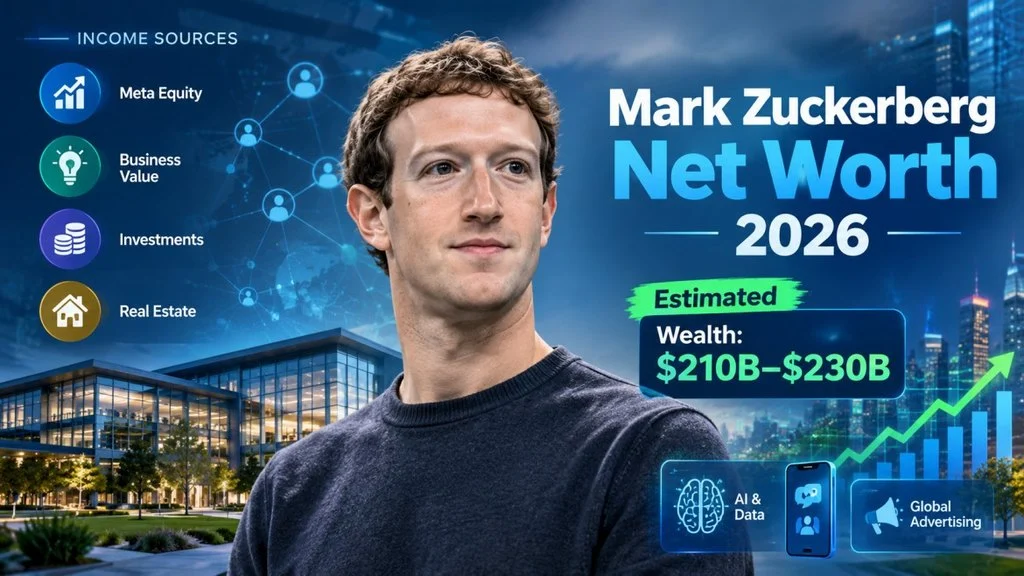
Mark Zuckerberg’s estimated net worth in 2026 is approximately $210 billion–$230 billion, with the range primarily reflecting the value of his Meta Platforms ownership and day-to-day stock-market movements. Forbes reported a real-time figure of about $230.1 billion on September 16, 2026, while its 2026 Forbes 400 snapshot valued him at $212 billion using an earlier valuation date.
Mark Zuckerberg’s financial story is unusual even by billionaire standards. He did not build his fortune primarily through a conventional executive salary. Instead, his wealth has largely followed the value of the company he cofounded as a teenager: Facebook, now part of Meta Platforms.
As of September 2026, public billionaire estimates place Mark Zuckerberg net worth in the neighborhood of $210 billion to $230 billion. Forbes listed his real-time net worth at approximately $230.1 billion on September 16, 2026, while the 2026 Forbes 400 used a September 4 stock-price snapshot and estimated his fortune at $212 billion. Those differences demonstrate why a billionaire’s net worth should be treated as a moving estimate rather than a permanent number.
The important point is that Zuckerberg’s fortune is closely tied to equity ownership. Meta generated approximately $200.97 billion in revenue in 2025, including $196.18 billion from advertising, while Zuckerberg continued to hold a large Meta position and substantial voting power.
Bio Data Table
| Detail | Information |
|---|---|
| Full Name | Mark Elliot Zuckerberg |
| Date of Birth | May 14, 1984 |
| Age as of 2026 | 42 |
| Place of Birth | White Plains, New York, United States |
| Nationality | American |
| Height | Not publicly verified to a sufficiently reliable standard |
| Weight | Not publicly verified |
| Health Conditions | Not publicly verified |
| Religion | Not publicly verified |
| Education | Harvard University; left before completing his degree |
| Profession / Industry | Technology entrepreneur, software developer, business executive |
| Zodiac Sign | Taurus |
| Marriage / Relationship Status | Married to Priscilla Chan |
| Children | 3 |
| Estimated Net Worth | Approximately $210 billion–$230 billion in 2026 |
| Social Media Accounts | Publicly active on Facebook and Instagram; exact account details should be verified before publication |
| Still Alive | Yes |
| Famous For | Cofounding Facebook and leading Meta Platforms |
Forbes’ current profile lists Zuckerberg as 42, married, the father of three children, a Harvard dropout and a U.S. citizen. It also identifies Facebook as his primary source of wealth and says he owns about 13% of Meta’s stock.
Who Is Mark Zuckerberg? Background & Early Life
Mark Zuckerberg was born in 1984 in White Plains, New York. His interest in computers emerged early, and programming became an important part of his education and personal projects.
He attended Harvard University, where he studied computer science and developed the project that would eventually become Facebook. Harvard’s own account of his early career notes that Zuckerberg launched Facebook in 2004 and later moved to Palo Alto, California, with his colleagues after the company’s rapid growth made it difficult to continue along the traditional university path.
The early Facebook business was initially focused on college communities. Its expansion beyond universities transformed it into a mass-market social network. Meta’s own historical material describes Zuckerberg as Facebook’s founder and highlights his responsibility for the company’s overall direction and product strategy.
Facebook’s early commercial development also attracted outside capital. In 2006, the company announced a $25 million financing round led by Greylock Partners, with participation from Meritech Capital and existing investors. At the time, Facebook said its site had more than seven million users.
That early combination of software development, network effects and ownership became the foundation of Zuckerberg’s wealth.
Mark Zuckerberg Net Worth Overview 2026 Estimate
A reasonable 2026 estimate for Mark Zuckerberg net worth is approximately $210 billion to $230 billion.
The range is intentionally broad enough to account for changes in Meta’s stock price, differences in valuation dates and changes in Zuckerberg’s reported holdings.
Forbes reported approximately $230.1 billion in real-time net worth on September 16, 2026. Its 2026 Forbes 400 calculation, based on share prices from September 4, placed his fortune at $212 billion.
That difference is not necessarily an error. Public billionaire wealth estimates are often calculated by taking known or estimated ownership stakes and multiplying them by current or reference-date market values, while also accounting for other assets and liabilities where information is available.
Why Meta Ownership Matters So Much
Zuckerberg’s fortune is primarily an ownership story rather than a salary story.
Meta’s 2026 proxy statement reported that Zuckerberg beneficially owned approximately 341.8 million Class B shares, plus additional Class A shares, and held approximately 60.8% of Meta’s total voting power based on the disclosure methodology used in the filing.
This structure helps explain why Zuckerberg can have enormous influence over Meta without receiving a conventional billionaire-level executive salary.
Career Earnings vs. Net Worth
These figures should not be confused:
- Salary: The amount paid to an executive for employment.
- Career earnings: Cumulative income received over a career.
- Business revenue: Money generated by a company before expenses.
- Ownership income: Economic benefit associated with owning shares or business interests.
- Net worth: Assets minus liabilities.
- Market value of shares: The value of stock at a particular market price.
Zuckerberg’s $1 annual salary at Meta illustrates the distinction. Meta’s 2026 proxy says that during 2025 he requested and received only $1 in salary, with no bonus or equity award. His reported compensation instead largely reflected security-related costs and other company-paid items.
Therefore, his billions of dollars in wealth should not be interpreted as salary accumulated from Meta.
Net Worth Growth Timeline
Before Fame
Before Facebook became a global company, Zuckerberg’s economic position was fundamentally different from the billionaire profile associated with him today.
His early financial opportunity came from programming ability and entrepreneurship rather than celebrity endorsements or a traditional corporate career. The critical asset was not a large salary; it was ownership in a rapidly growing technology company.
Breakthrough Phase
The creation and expansion of Facebook represented the major turning point.
After Facebook launched in 2004, its user base expanded rapidly. Zuckerberg and his team relocated the operation to Palo Alto, while the company attracted investors and began building the infrastructure required for a global technology platform. Harvard describes the rapid growth of Facebook as the reason Zuckerberg ultimately devoted his full attention to the business.
The company later went public in 2012. Forbes notes that Zuckerberg still owns approximately 13% of Meta’s stock, making the company’s market value a central component of his personal fortune.
Peak / Recent Years
The modern phase of Zuckerberg’s wealth has been shaped by Meta’s enormous advertising business and the market’s changing valuation of large technology companies.
Meta reported $200.97 billion in total revenue for 2025, up 22% from 2024. Advertising generated approximately $196.18 billion, while Reality Labs generated approximately $2.21 billion.
Meta also reported $83.28 billion in operating income for 2025, showing the scale of the underlying business connected to Zuckerberg’s equity position.
His wealth therefore moves with several variables, particularly Meta’s stock valuation, his ownership percentage, broader technology-market sentiment and the company’s financial performance.
Main Sources of Income
Core Profession Income
Zuckerberg’s core professional role is leading Meta Platforms as its founder, chairman and CEO.
Meta operates several major consumer platforms, including Facebook, Instagram, Messenger and WhatsApp, while Reality Labs focuses on virtual and augmented reality-related hardware, software and content.
His economic exposure to this ecosystem comes primarily through ownership rather than conventional employment income.
Salary and Executive Compensation
Zuckerberg’s base salary is exceptionally small compared with his estimated wealth.
Meta’s 2026 proxy states that Zuckerberg received $1 in salary during 2025 and did not participate in the company’s bonus plan or receive equity awards during that year.
However, Meta also reported substantial security-related compensation and expenses associated with his role. The company’s proxy says that approximately $8.5 million in 2025 related to personal security at his residences and during personal travel, alongside a $14 million annual pre-tax security allowance.
This compensation should not be interpreted as the source of his billionaire wealth.
Meta Ownership
Meta equity is the central wealth engine behind Zuckerberg’s fortune.
Because he holds a substantial ownership position, changes in Meta’s market capitalization can cause his estimated net worth to rise or fall by billions of dollars without him receiving billions of dollars in cash.
This is a critical concept for understanding billionaire wealth.
Business Revenue
Meta itself generates enormous revenue, but Meta’s revenue is not Zuckerberg’s personal income.
In 2025, Meta reported approximately $200.97 billion in revenue, of which $196.18 billion came from advertising. The company generates advertising revenue through Facebook, Instagram, Messenger and related platforms.
Zuckerberg benefits economically because he owns shares in the company, not because Meta’s entire revenue is transferred to him.
Investments and Ownership Stakes
Zuckerberg’s public wealth profile also includes other assets and investment exposure, although the exact value and structure of many private holdings are not publicly transparent.
The clearest publicly documented financial exposure remains his Meta ownership.
Business Strategy Behind the Wealth
Zuckerberg’s wealth is closely connected to a business strategy built around ownership, scale and network effects.
Reputation and Founder Positioning
Zuckerberg has remained closely identified with Meta since Facebook’s founding. This gives him unusual founder visibility and influence within the company.
Ownership
The biggest financial distinction between Zuckerberg and a conventional technology executive is ownership.
An employee may receive a salary and stock compensation. A founder with a major equity position can see personal wealth compound as the company’s market value grows.
Career Positioning
Facebook began as a social networking service but expanded into a broad family of digital platforms. Meta’s current business includes Facebook, Instagram, Messenger and WhatsApp, while Reality Labs represents a separate technology investment focused on immersive computing.
Brand Leverage
Zuckerberg’s public profile gives him a degree of founder visibility that can support long-term business influence, although personal fame itself is not a direct substitute for company value.
Long-Term Wealth Strategy
A major element of Zuckerberg and Priscilla Chan’s long-term strategy is philanthropy. In 2015, they announced plans to give 99% of their Meta shares over their lifetimes through the Chan Zuckerberg Initiative.
That pledge is relevant when discussing long-term wealth because it indicates that gross equity ownership and eventual personal wealth are not necessarily the same thing.
Awards & Achievements and Financial Impact
Zuckerberg’s achievements have influenced his public profile and business credibility, although awards themselves are not the primary source of his fortune.
Facebook Founder
The most important achievement is the creation of Facebook in 2004. The company eventually became one of the world’s largest social-media businesses.
Financially, this achievement is significant because Zuckerberg retained substantial ownership as Facebook grew.
Time Person of the Year
Time named Zuckerberg Person of the Year in 2010, a major recognition of Facebook’s influence and his role in the company’s development. Harvard also records this recognition in its profile of Zuckerberg.
The award did not directly create his fortune, but it reflected Facebook’s rapidly increasing cultural and commercial influence.
Harvard Honorary Degree
Harvard awarded Zuckerberg an honorary Doctor of Laws degree in 2017, when he returned to deliver the university’s commencement address.
Breakthrough Prize
Zuckerberg has also been involved in the Breakthrough Prize, which recognizes major scientific achievements. Harvard reported that the prize was founded by Zuckerberg and Yuri Milner.
These achievements contribute to his public reputation, but Meta equity remains much more important to his personal financial position.
Assets & Lifestyle
Real Estate
Zuckerberg has accumulated significant real-estate holdings over the years.
Forbes reports that he purchased approximately $59 million worth of waterfront property on Lake Tahoe in 2019.
Real estate can form an important part of a billionaire’s asset base, but property values do not necessarily equal liquid wealth. Real estate also involves taxes, maintenance, security, financing and transaction costs.
Cars & Luxury
Zuckerberg’s public image has historically been less centered on luxury vehicles and fashion than that of many entertainment celebrities.
Specific current vehicle collections should not be presented as fact unless supported by reliable documentation.
Private Aircraft and Security
Meta’s filings provide unusually detailed evidence about Zuckerberg’s security arrangements.
The company says Zuckerberg uses private aircraft for certain personal travel in connection with his overall security program, including aircraft indirectly and wholly owned by him and operated by an independent charter company. Meta also reports security and travel-related expenses as compensation under applicable disclosure rules.
These expenses are important financial context, but they are not evidence that Zuckerberg receives a traditional executive compensation package comparable to his estimated wealth.
Business Assets
The most economically significant asset associated with Zuckerberg remains his equity position in Meta.
That ownership is much more important to his estimated net worth than individual luxury purchases.
Net Worth Comparison with Peers / Industry
Zuckerberg’s estimated wealth sits within the highest tier of technology-founder fortunes, but peer estimates vary considerably depending on company valuations and the date used.
For example, Forbes’ real-time billionaire data in September 2026 placed Jeff Bezos at roughly $367 billion, while Larry Ellison’s real-time estimate was around $184.5 billion on September 16.
Forbes’ annual 2026 snapshot valued Zuckerberg at $212 billion using September 4 prices, while its real-time profile later showed approximately $230.1 billion.
These figures demonstrate why peer comparisons should be viewed as snapshots rather than fixed rankings.
The underlying business models are also different:
- Zuckerberg’s wealth is heavily connected to Meta.
- Bezos’ wealth is linked primarily to Amazon and other holdings.
- Ellison’s fortune is strongly associated with Oracle and additional investments.
- Other technology founders may have concentrated wealth in private companies, public shares or venture investments.
Because these assets are valued differently, comparing billionaire net worth requires attention to ownership structure, liquidity and valuation dates.
Controversies, Challenges & Financial Risks
Zuckerberg’s financial position carries risks typical of a founder whose wealth is heavily concentrated in one public technology company.
Stock-Market Volatility
The largest risk is market volatility.
If Meta’s share price falls, Zuckerberg’s paper wealth can decline by billions of dollars without him selling a single share.
Conversely, rising shares can increase his estimated net worth rapidly.
Regulatory Pressure
Meta operates globally and faces continuing regulatory, privacy, competition and technology-policy scrutiny.
Regulatory changes can affect operating costs, advertising practices, product development and investor expectations.
Concentration Risk
A large portion of Zuckerberg’s estimated wealth is associated with Meta equity.
Concentrated ownership can create enormous upside, but it also means a substantial portion of net worth is exposed to the performance of one company.
Operating Costs
Meta’s own 2025 results show the scale of the business’s cost structure. Total costs and expenses were approximately $117.69 billion in 2025, while Reality Labs continued to generate significant operating losses.
Security Expenses
Zuckerberg’s position also carries unusually high security-related costs. Meta disclosed a $14 million annual pre-tax security allowance and additional security expenses connected with residences and travel.
Philanthropic Commitments
The planned transfer or charitable use of much of the couple’s Meta holdings is another reason personal wealth should not simply be treated as permanently available spending money. The couple announced their intention to give 99% of their Meta shares over their lifetimes through CZI.
Philanthropy & Social Impact
Mark Zuckerberg and Priscilla Chan founded the Chan Zuckerberg Initiative in 2015.
CZI focuses on areas including science, education and community support. Its current work emphasizes areas such as AI-powered biology, scientific research, education technology and local communities.
The scale of CZI’s activities is substantial. The organization says it has committed more than $7.22 billion in grants since its launch and has invested nearly $300 million through its venture activities.
CZI’s venture program also invests in companies developing scalable solutions aligned with its mission.
The couple’s 2015 announcement that they planned to give 99% of their Meta shares over their lifetimes is particularly important when analyzing Zuckerberg’s wealth. It means his financial story is not solely about accumulation; it also involves a long-term plan to redirect a substantial portion of his equity toward philanthropic objectives.
How Mark Zuckerberg Makes Money Outside Core Profession
Zuckerberg’s wealth outside his direct executive salary is primarily connected to ownership and investment rather than celebrity-style income.
Equity Ownership
His Meta shares represent the central source of his estimated net worth.
Private Investments
CZI operates a venture investment program that invests in companies aligned with its mission. However, CZI’s investments should not automatically be treated as Zuckerberg’s personal investment portfolio. CZI is a separate organization from Meta, and its assets should not be casually added to Zuckerberg’s personal net worth.
Real Estate
His documented real-estate holdings, including Lake Tahoe property, represent another component of his broader asset base.
Other Assets
Private investments, cash, property and other assets may contribute to his overall net worth, but many details are not publicly disclosed in enough detail to calculate them independently.
Future Net Worth Projection
Any projection beyond the current 2026 estimate should be treated as a scenario rather than a prediction.
Zuckerberg’s future wealth will likely remain closely connected to several measurable factors:
- Meta’s share price
- Meta’s advertising revenue
- Growth of Instagram, Facebook, WhatsApp and Messenger
- Artificial-intelligence investment and monetization
- Reality Labs performance
- Changes in Zuckerberg’s ownership
- Taxes and charitable transfers
- Regulatory developments
- Broader technology-market valuations
Meta’s 2025 financial results provide a strong indication of the scale underlying Zuckerberg’s equity position. The company generated nearly $201 billion in annual revenue, with advertising accounting for the overwhelming majority.
If Meta’s valuation continues to grow and Zuckerberg retains a substantial ownership stake, his estimated wealth could increase significantly. If the stock declines or his ownership changes substantially, the opposite could happen.
Because those variables cannot be known with certainty, a specific future net-worth figure would be speculative.
Frequently Asked Questions
What is Mark Zuckerberg’s net worth in 2026?
Mark Zuckerberg’s 2026 net worth is estimated at approximately $210 billion to $230 billion. Forbes reported a real-time estimate of about $230.1 billion on September 16, 2026, while its 2026 Forbes 400 snapshot placed him at $212 billion based on an earlier valuation date.
What is Mark Zuckerberg’s main source of wealth?
His main source of wealth is his ownership stake in Meta Platforms, the parent company of Facebook, Instagram, Messenger and WhatsApp. Forbes identifies Facebook/Meta as his primary source of wealth.
Does Mark Zuckerberg make billions in salary?
No. Meta’s 2026 proxy states that Zuckerberg received $1 in salary during 2025, with no bonus or equity award that year. His billionaire-level wealth primarily comes from ownership of Meta shares rather than salary.
How much of Meta does Mark Zuckerberg own?
Forbes says Zuckerberg owns approximately 13% of Meta’s stock. Meta’s 2026 proxy also shows that his Class B holdings give him approximately 60.8% of the company’s total voting power under the filing’s calculation.
Is Mark Zuckerberg’s net worth officially confirmed?
No single official document confirms a permanent net-worth figure. Billionaire estimates such as those published by Forbes are calculations based on market prices, ownership information and other available data. Because Meta’s stock price changes continuously, estimated wealth can change from one day to the next.
Is Mark Zuckerberg’s wealth mostly cash?
Not publicly verified. His wealth is substantially connected to Meta equity, so it should not be interpreted as an equivalent amount of cash sitting in bank accounts.
Conclusion
Mark Zuckerberg net worth in 2026 is reasonably estimated at approximately $210 billion–$230 billion, based primarily on the value of his substantial Meta Platforms ownership and current public billionaire estimates. Forbes’ September 2026 figures illustrate how quickly the number can change: its annual Forbes 400 snapshot put Zuckerberg at $212 billion, while its real-time profile later showed about $230.1 billion.
The central lesson behind Zuckerberg’s wealth is ownership. His $1 annual salary at Meta is tiny compared with his estimated fortune, because the majority of his financial exposure comes from equity rather than traditional employment income.
Meta’s business scale also helps explain the valuation. In 2025, the company generated approximately $200.97 billion in revenue, with about $196.18 billion coming from advertising.
His financial story also includes significant philanthropy through the Chan Zuckerberg Initiative, where he and Priscilla Chan have committed substantial resources toward science, education and community initiatives.
Ultimately, Zuckerberg’s net worth should be understood as a market-sensitive estimate of assets and ownership, not as salary earned or cash income received. Net worth figures are estimates based on publicly available data and may vary.
Read More Related Articles:
- Drake Net Worth, Career Earnings & Wealth Journey | From Rap …
- Chauncey Billups Net Worth 2026 | Career Earnings & Wealth
- Zac Efron Net Worth, Salary & Assets | The Hollywood Journey …






2 thoughts on “Mark Zuckerberg Net Worth, Salary & Wealth Journey | The Fortune Behind Meta in 2026”