

Quick Answer:
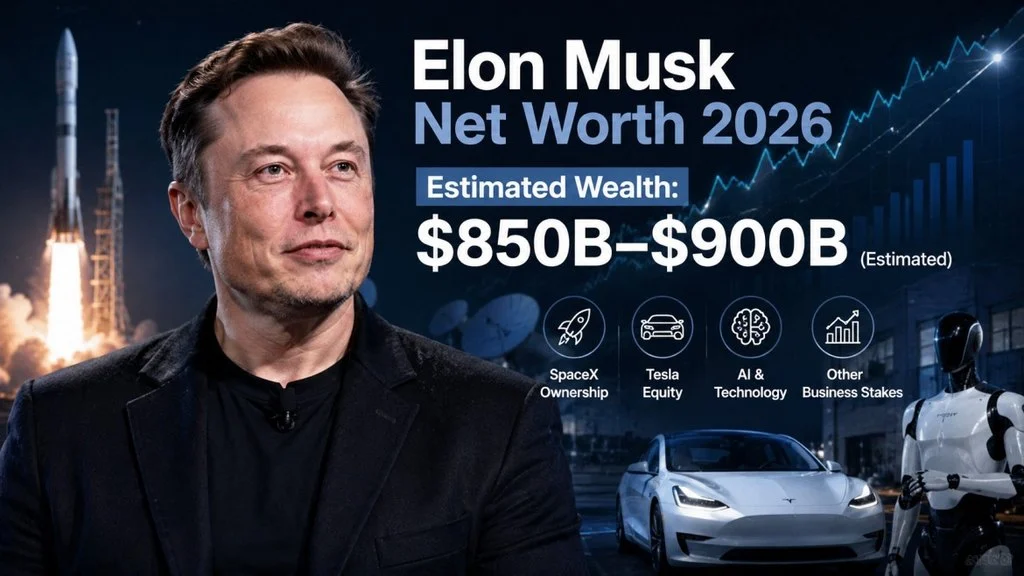
As of September 2026, Elon Musk’s estimated net worth is roughly $850 billion to $900 billion, with Forbes recently placing it around $872.3 billion; the estimate is driven primarily by his equity in SpaceX and Tesla, along with stakes in other ventures, and should not be treated as a fixed or confirmed cash fortune.
Few modern entrepreneurs have built a fortune as closely tied to technological ambition as Elon Musk. From online payments and electric vehicles to reusable rockets and artificial intelligence, Musk has repeatedly placed his personal wealth behind companies attempting to reshape major industries. That makes elon musk net worth one of the most searched billionaire-wealth topics for readers interested in technology, investing, entrepreneurship, and business strategy.
In 2026, the question became even more complicated because Musk’s wealth experienced extraordinary swings alongside the value of his major companies. Forbes reported that his fortune briefly crossed the trillion-dollar threshold following the SpaceX public-market debut, before falling substantially and then recovering. As of September 2, 2026, Forbes’ real-time estimate placed his fortune at approximately $872.3 billion.
That volatility is important. Musk does not hold his fortune primarily as cash in a bank account. Much of his wealth comes from ownership stakes in businesses, particularly SpaceX and Tesla. When the value of those companies changes, his estimated personal fortune can move by tens or even hundreds of billions of dollars without Musk receiving an equivalent amount of cash.
The following analysis therefore separates confirmed business and ownership information from estimated personal wealth.
Bio Data Table
| Field | Details |
|---|---|
| Full Name | Elon Reeve Musk |
| Date of Birth | June 28, 1971 |
| Age as of 2026 | 55 |
| Place of Birth | Pretoria, South Africa |
| Nationality | U.S. citizen; South African-born |
| Height | Not publicly verified for this analysis |
| Weight | Not publicly verified |
| Health Conditions | Not publicly verified |
| Religion | Not publicly verified |
| Education | University of Pennsylvania — physics and business/economics degrees |
| Profession / Industry | Entrepreneur, technology executive, investor; technology, aerospace, automotive, AI |
| Zodiac Sign | Cancer |
| Marriage / Relationship Status | Divorced, according to Forbes |
| Children | Forbes currently reports 14 |
| Estimated Net Worth | Approximately $850 billion–$900 billion in September 2026 |
| Social Media Accounts | X account publicly associated with Elon Musk; other personal-account details should be independently verified before publication |
| Still Alive | Yes |
| Famous For | Tesla, SpaceX, electric vehicles, reusable rockets, AI ventures, and other technology businesses |
Tesla’s investor-relations biography confirms that Musk has served as Tesla’s CEO since October 2008 and has also held senior leadership roles at SpaceX. It also records his earlier involvement with Zip2 and PayPal and his degrees from the University of Pennsylvania and Wharton.
For personal details such as height, weight, religion, and health conditions, reliable public verification is either inconsistent or unnecessary to understanding his finances, so those fields should not be filled with speculation.
Who Is Elon Musk? Background & Early Life
Elon Reeve Musk was born on June 28, 1971, in Pretoria, South Africa. He developed an interest in computers and entrepreneurship at an early age and eventually moved through South Africa, Canada, and the United States before establishing himself in the technology industry.
His education became an important part of his professional foundation. Tesla’s official investor-relations biography states that Musk earned a bachelor’s degree in physics from the University of Pennsylvania and a business degree from the Wharton School.
Musk’s first major entrepreneurial chapter began with Zip2, an internet software company he co-founded with his brother Kimbal Musk. Zip2 was acquired by Compaq in 1999. He subsequently became involved with X.com, an online financial-services company that eventually became part of the business that developed into PayPal.
PayPal’s sale to eBay in 2002 gave Musk capital that he could redirect toward substantially more ambitious projects. Tesla’s own historical material notes that the PayPal transaction provided Musk with money to pursue electric vehicles and space technology.
That decision ultimately shaped the financial story behind his fortune.
Rather than simply becoming a highly paid executive, Musk repeatedly maintained substantial ownership positions in the companies he helped build. That distinction is central to understanding why his wealth became so much larger than conventional executive compensation.
elon musk net worth Overview 2026 Estimate
The most reasonable current range for elon musk net worth in 2026 is approximately $850 billion to $900 billion, based on major wealth-tracking estimates available in early September 2026.
Forbes’ real-time billionaire tracker placed Musk at approximately $872.3 billion on September 2, 2026, ranking him first globally.
Forbes’ September 1 ranking had estimated his fortune at approximately $892 billion. The difference illustrates an important point: Musk’s net worth can change substantially from one trading session to another.
Why Is the Estimate So High?
The answer is ownership.
Forbes reported in 2026 that Musk owns approximately 38% of SpaceX, including relevant options, and nearly 11% of Tesla, excluding certain unvested restricted stock from its calculation. Forbes also identifies smaller stakes in businesses including Neuralink and The Boring Company.
SpaceX became particularly important to Musk’s wealth calculation after its 2026 public-market debut. Forbes reported that SpaceX reached a valuation approaching $2 trillion during its initial public trading period, making Musk’s ownership position enormously valuable on paper.
However, estimated net worth is not the same thing as liquid cash.
A useful distinction is:
- Gross earnings: Money generated before taxes and expenses.
- Career earnings: Total compensation and income accumulated over a career.
- Salary: Direct employment compensation.
- Business revenue: Money generated by a company, not the owner’s personal income.
- Ownership value: The estimated market value of shares or business interests owned by an individual.
- Personal net worth: Assets and ownership interests minus relevant liabilities and obligations.
- Liquid wealth: Money or assets that can realistically be accessed as cash without materially affecting ownership or value.
Musk’s fortune is dominated by the ownership-value category.
Net Worth Growth Timeline
Before Fame
Musk’s early wealth came from technology entrepreneurship rather than a conventional executive salary.
Zip2 represented his first major business success. After its acquisition by Compaq, Musk moved into online financial services through X.com and the PayPal business that followed.
Tesla’s historical account says PayPal was sold to eBay in 2002 for approximately $1.5 billion, with Musk holding a significant stake.
This period established the capital base that allowed Musk to finance later ventures.
Breakthrough Phase
The next phase involved simultaneously pursuing electric vehicles and space exploration.
Musk joined Tesla in its early development and became its CEO in 2008. Tesla subsequently grew from a relatively small electric-vehicle company into a major global automotive and energy business.
At the same time, Musk founded SpaceX in 2002 and continued investing heavily in rocket development. Tesla’s biography notes SpaceX’s development of the Falcon 1, Falcon 9, Dragon spacecraft, Falcon Heavy, Starship, and Starlink.
The financial significance was enormous because Musk retained substantial ownership while the underlying businesses increased in value.
Peak / Recent Years
The largest acceleration in Musk’s wealth occurred as Tesla’s market capitalization expanded and SpaceX became one of the world’s most valuable private technology companies.
Forbes says Musk first became the world’s wealthiest person in January 2021 as Tesla shares surged.
The 2026 SpaceX public listing created another dramatic inflection point. Forbes reported that Musk briefly became the world’s first trillionaire following the SpaceX IPO, although his fortune subsequently declined as market prices moved.
This illustrates the difference between peak estimated wealth and average annual income. Musk’s fortune can rise or fall by hundreds of billions of dollars primarily because of changes in the valuation of businesses he owns.
Main Sources of Income
Core Profession Income
Musk’s financial model is fundamentally different from that of an actor, athlete, or conventional corporate executive.
His major wealth engine is equity ownership.
His role at Tesla provides executive compensation, but the enormous value associated with Tesla comes primarily from the shares and equity-linked awards connected to his ownership position.
Tesla’s 2018 compensation structure was designed around performance rather than a traditional guaranteed salary. Tesla said Musk’s compensation under that arrangement contained no guaranteed salary or cash bonus and was tied to market-capitalization and operational milestones.
Tesla Ownership and Compensation
Tesla remains one of Musk’s largest financial assets.
A June 2026 SEC filing showed Musk beneficially owning hundreds of millions of Tesla shares, including shares held through his revocable trust and restricted shares subject to service conditions.
Tesla’s later compensation disclosures also show how unusual Musk’s compensation structure is. The company’s 2025 CEO performance award involved approximately 423.7 million shares of performance-based restricted stock, with its preliminary aggregate fair value estimated at $87.75 billion for accounting purposes.
That accounting value should not automatically be interpreted as cash compensation received by Musk.
Tesla’s 2025 annual report explains that the awards contain market, service, and performance conditions and that significant assumptions are required for accounting valuation.
SpaceX Ownership
SpaceX is arguably the most important driver of Musk’s 2026 fortune.
Forbes reported that Musk owns approximately 38% of SpaceX, including options. After SpaceX became publicly traded, its valuation reached extraordinary levels, dramatically increasing the estimated value of Musk’s stake.
This is a textbook example of why billionaire net worth is primarily a valuation calculation.
If SpaceX’s market capitalization rises by $100 billion, Musk’s estimated ownership value can increase by tens of billions of dollars even if he does not sell a single share.
Other Business Ownership
Musk’s financial interests extend beyond Tesla and SpaceX.
Tesla identifies him as a founder of The Boring Company and Neuralink, while Forbes also identifies stakes in these ventures.
His technology portfolio has therefore developed across several industries:
- Electric vehicles and energy
- Aerospace and launch services
- Artificial intelligence
- Social media
- Brain-computer interfaces
- Infrastructure and tunneling
The exact current market value of some private-company interests is not publicly transparent, so those portions of the fortune carry greater uncertainty than publicly traded Tesla shares.
Business Strategy Behind the Wealth
Musk’s wealth strategy has several defining characteristics.
Ownership Over Salary
The most important is ownership.
Rather than relying primarily on a large annual cash salary, Musk has historically emphasized equity and performance-based compensation. That means his financial outcome is strongly linked to the long-term value of the companies he leads.
Concentrated Bets
Musk has also built a highly concentrated portfolio.
Instead of spreading his wealth evenly across dozens of conventional investments, a large portion has historically been connected to businesses in which he has operational influence.
That concentration creates both enormous upside and substantial risk.
Brand Leverage
Musk himself has become a major technology brand.
His personal reputation can generate attention for companies, products, launches, and technological initiatives without relying exclusively on traditional advertising.
The advantage is obvious: attention can reduce customer-acquisition and publicity barriers.
The disadvantage is equally important: controversies involving Musk can create reputational risk for companies associated with him.
Long-Term Technology Positioning
The companies associated with Musk operate in sectors where investors frequently assign high valuations to future growth.
Electric vehicles, energy storage, reusable rockets, satellite communications, AI, robotics, and brain-computer interfaces all involve large potential markets.
That gives Musk’s ownership stakes exposure to multiple long-term technology themes.
Awards & Achievements and Financial Impact
Musk’s most financially significant achievements are business milestones rather than conventional entertainment awards.
Building Tesla Into a Global EV Company
Tesla expanded from an early-stage electric-vehicle manufacturer into a large-scale automotive and energy company. Tesla’s own materials describe its development of electric vehicles, energy storage, solar products, and large manufacturing operations.
That business expansion was financially significant because Tesla’s increasing market value increased the value of Musk’s equity.
SpaceX and Reusable Rockets
SpaceX’s development of reusable launch technology transformed its competitive position in commercial spaceflight.
Tesla’s official biography highlights the Falcon 1 reaching orbit and later milestones involving Falcon 9, Dragon, Falcon Heavy, and other systems.
These achievements helped turn SpaceX into a highly valuable aerospace company and consequently increased the value of Musk’s ownership.
Becoming the World’s Wealthiest Person
Musk’s appearance at the top of global billionaire rankings is itself a consequence rather than an independent source of wealth.
Forbes says he first reached the No. 1 position in January 2021 and remained the world’s richest person again in 2026.
Assets & Lifestyle
Real Estate
Musk has owned or lived in several high-value properties over the years, but his real-estate holdings are not the primary explanation for his current fortune.
Compared with his company equity, residential real estate represents a much smaller component of the estimated wealth calculation.
Because property ownership can change and valuations differ, individual homes should only be included in a published article when supported by current property records or reputable reporting.
Cars & Luxury
Musk’s public image has often been associated with Tesla vehicles and advanced technology rather than traditional displays of luxury.
Specific claims about his current private-car collection, luxury purchases, or personal spending should not be treated as established facts unless independently verified.
Business Assets and Equity
The most important “asset” category is not a mansion or vehicle.
It is ownership in companies.
Tesla and SpaceX account for the overwhelming majority of Musk’s estimated fortune according to Forbes.
That makes his wealth unusually sensitive to stock-market movements and private/public-company valuations.
Net Worth Comparison with Peers / Industry
Musk’s closest financial comparisons are other technology founders and major shareholders rather than entertainers or athletes.
As of September 1, 2026, Forbes listed Musk at approximately $892 billion, compared with Larry Page at roughly $277 billion.
Forbes’ September 2 real-time tracker placed Musk around $872.3 billion, while Larry Page was around $275.7 billion, Jeff Bezos around $263.4 billion, and Sergey Brin around $254.4 billion.
These comparisons demonstrate how unusual Musk’s wealth has become.
However, peer figures are also estimates. Their fortunes can change with public stock prices, private-company valuations, exchange rates, transactions, taxes, and changes in ownership.
It is therefore more accurate to describe Musk as far ahead of other technology billionaires on current wealth estimates rather than claiming that any exact ranking is permanent.
Controversies, Challenges & Financial Risks
Musk’s fortune is exposed to several major risks.
Market Volatility
Because a large portion of his wealth is connected to equity values, market declines can reduce his estimated fortune rapidly.
The 2026 experience demonstrates this clearly: Forbes reported that his fortune dropped below $700 billion in July before rebounding toward $900 billion in August.
Tesla Compensation and Legal Disputes
Musk’s compensation packages have also faced legal scrutiny.
Tesla’s 2025 annual filing states that a Delaware Supreme Court decision in December 2025 reversed an earlier rescission of his 2018 compensation package, reinstating it while awarding nominal damages.
The dispute illustrates why large equity awards can involve complicated legal, governance, tax, and shareholder considerations.
Concentration Risk
Musk’s wealth is heavily concentrated in a relatively small number of businesses.
That can create enormous wealth when those businesses perform well, but it also means that operational setbacks, changing valuations, regulatory developments, competition, technological failures, or broader market declines could materially affect his fortune.
Private-Company Valuation Risk
Some Musk-associated companies are harder to value than publicly traded corporations.
Private-market valuations can change dramatically when new financing rounds, transactions, or public listings establish new reference prices.
Therefore, estimated values for private stakes should generally be treated as less certain than exchange-traded holdings.
Reputation and Governance Risk
Musk’s public profile is closely connected to his companies.
That creates brand leverage but also reputational exposure. Public controversies, regulatory disagreements, leadership disputes, or changes in consumer sentiment can potentially affect company performance and valuation.
Philanthropy & Social Impact
Musk has established the Musk Foundation, which supports causes including science and engineering education, pediatric research, renewable energy research, human-spaceflight research, and work related to artificial intelligence.
His charitable giving has included substantial transfers of Tesla shares.
Reuters reported that Musk donated approximately 268,000 Tesla shares worth about $108.2 million to unnamed charities in late 2024, based on a regulatory filing. Reuters also reported previous multibillion-dollar Tesla-share donations to the Musk Foundation.
The foundation’s 2024 tax data reported by ProPublica showed approximately $474.4 million in charitable-purpose expenses and approximately $463 million in year-end net assets.
These figures should not be interpreted as equivalent to Musk’s personal annual charitable spending. Foundation assets, grants, stock transfers, and distributions are separate financial categories.
How Elon Musk Makes Money Outside Core Profession
Musk’s additional wealth sources are largely connected to business ownership, rather than conventional side hustles.
Technology Company Stakes
His interests in Neuralink and The Boring Company provide exposure to additional technology sectors.
Artificial Intelligence
AI has become an increasingly important part of Musk’s business portfolio through xAI. Forbes reported that SpaceX acquired xAI in 2026 following the earlier combination of xAI and X.
Social Media
Musk’s acquisition of Twitter, subsequently known as X, added another major technology and media business to his portfolio. Tesla’s historical filing confirms that Musk became Twitter’s CEO in 2022.
The financial impact of this business should be treated separately from Tesla and SpaceX because private-company valuation and ownership structures can be difficult to assess.
Future Net Worth Projection
Predicting Musk’s future net worth requires more caution than predicting the wealth of someone whose assets are mostly cash or diversified public investments.
If Tesla continues to grow, SpaceX maintains a high valuation, and Musk’s AI and other technology ventures succeed, his estimated fortune could remain above the $1 trillion threshold or potentially rise significantly beyond it.
However, that outcome is not guaranteed.
The most important factors include:
- Tesla’s market capitalization
- SpaceX’s valuation and operating performance
- The value of AI-related businesses
- Musk’s future equity compensation
- Potential dilution
- Taxes and share sales
- Regulatory developments
- Technology and execution risks
- Public-market volatility
- The performance of Musk’s private-company holdings
The 2026 experience is a useful warning against assuming that a trillion-dollar peak represents permanent wealth. Forbes documented Musk moving from a record estimated fortune of roughly $1.2 trillion during SpaceX’s early public trading period to substantially lower levels afterward.
A reasonable long-term view is therefore that Musk’s wealth could remain extraordinarily high while still fluctuating by hundreds of billions of dollars.
Frequently Asked Questions
What is Elon Musk’s net worth in 2026?
Elon Musk’s estimated net worth is approximately $850 billion to $900 billion as of September 2026. Forbes’ September 2 real-time estimate was about $872.3 billion.
What is Elon Musk’s main source of wealth?
The largest sources are his ownership interests in SpaceX and Tesla. Forbes identifies those two companies as the primary sources of his fortune.
Is Elon Musk’s net worth $1 trillion?
Musk briefly became the world’s first trillionaire in 2026 based on Forbes’ valuation following SpaceX’s public-market debut. However, his estimated fortune subsequently moved below $1 trillion, demonstrating how quickly billionaire wealth can change.
Does Elon Musk receive a normal salary from Tesla?
Musk’s Tesla compensation has historically relied heavily on performance-based equity rather than a conventional guaranteed salary. Tesla stated that his 2018 performance award contained no guaranteed salary or cash bonus.
How much of SpaceX does Elon Musk own?
Forbes reported in 2026 that Musk owns approximately 38% of SpaceX, including options.
Is Elon Musk’s net worth confirmed?
No. Net worth is an estimate of the value of assets and ownership interests minus relevant liabilities and is not a single publicly reported personal bank balance. Different wealth trackers can produce different figures depending on market prices, private-company valuations, ownership assumptions, and treatment of equity awards.
Conclusion
The current elon musk net worth estimate for September 2026 sits roughly between $850 billion and $900 billion, with Forbes recently estimating approximately $872.3 billion.
The extraordinary scale of Musk’s fortune comes primarily from ownership rather than traditional salary income. Tesla and especially SpaceX account for the largest portions of his estimated wealth, while additional technology interests provide exposure to AI, brain-computer interfaces, infrastructure, and social media.
His financial story is also a reminder that billionaire net worth is not equivalent to cash. Musk’s fortune can rise or fall dramatically as Tesla and SpaceX valuations change. His compensation arrangements, private-company stakes, taxes, legal obligations, potential dilution, and future share transactions can further affect the calculation.
For readers interested in entrepreneurship, Musk’s most important financial lesson may be the role of ownership. His fortune was not created simply through a large executive paycheck. It grew alongside the companies he founded, financed, led, and retained equity in.
Net worth figures are estimates based on publicly available data and may vary.
Editorial Note on Net Worth Estimates
Net worth estimates should always be treated as moving financial snapshots rather than confirmed personal bank balances.
For Elon Musk, this distinction is particularly important because much of his fortune comes from equity in major businesses. Publicly traded Tesla shares can be valued using current market prices, but private-company interests and certain restricted or performance-based awards require additional assumptions.
Public earnings are also not the same as personal wealth. Company revenue belongs to the company, while executive compensation is only one component of an individual’s financial position. Taxes, liabilities, investment costs, share dilution, charitable transfers, asset sales, and reinvestment can all affect the final calculation.
For this article, publicly reported wealth estimates from Forbes were used as the principal current benchmark, while Tesla and SEC materials were used to establish company roles, ownership, compensation, and corporate facts.
Read More Related Articles:
- Zac Efron Net Worth, Salary & Assets | The Hollywood Journey …
- Tracy Morgan Net Worth | Career Earnings, Comedy Empire …
- Chauncey Billups Net Worth 2026 | Career Earnings & Wealth







One thought on “Elon Musk Net Worth, Career & Wealth | Inside the Fortune Built on Innovation 2026”