
Quick answer:
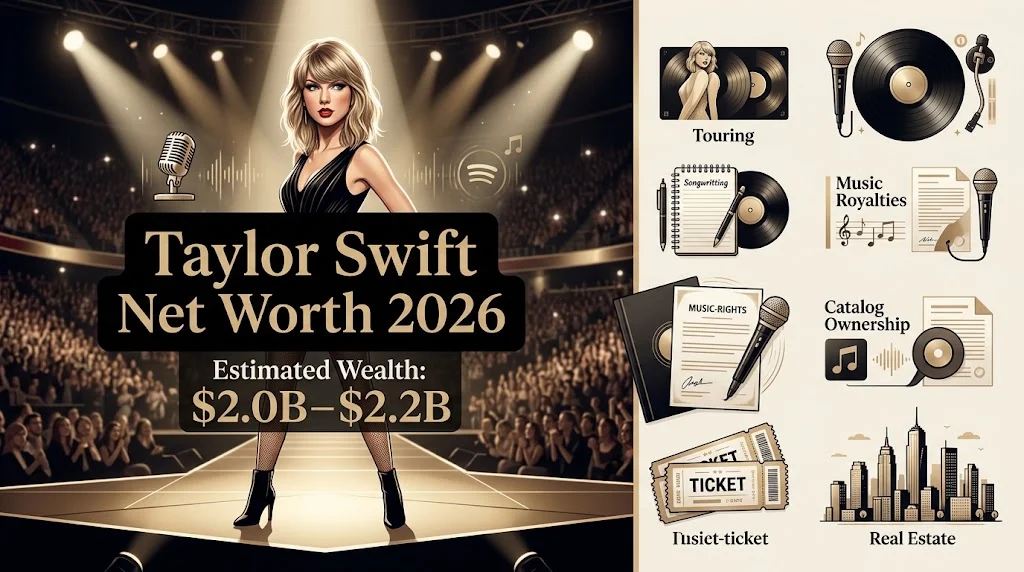
Taylor Swift’s net worth in 2026 is reasonably estimated at about $2.0 billion to $2.2 billion, based primarily on Forbes’ current billionaire estimates, her music catalog and ownership rights, touring and royalty income, real estate and other publicly documented assets; the exact figure is not publicly verified and can change with asset valuations and income.
Taylor Swift has reached a financial level that is unusual even among the world’s most successful musicians. Her fortune was not built around a single corporate empire or a traditional billionaire business exit. Instead, it developed from songwriting, recorded music, touring, intellectual-property ownership, merchandise and carefully managed control over her creative work.
Forbes’ September 2026 profile lists Swift at approximately $2 billion, while a July 2026 Forbes analysis estimated her wealth at more than $2.1 billion. Those figures are close enough to support a practical 2026 estimate of roughly $2.0 billion–$2.2 billion, rather than pretending that one exact number can be independently verified. Forbes says her fortune includes hundreds of millions from touring and royalties, a highly valuable music catalog and a substantial real-estate portfolio.
The more interesting question, however, is not simply how much Taylor Swift is worth. It is how a musician turned ownership of songs, recordings and live performances into a multibillion-dollar personal fortune.
Bio Data Table
| Category | Details |
|---|---|
| Full Name | Taylor Alison Swift |
| Date of Birth | December 13, 1989 |
| Age as of 2026 | 36 |
| Place of Birth | Reading, Pennsylvania, United States |
| Nationality | American |
| Height | Not publicly verified |
| Weight | Not publicly verified |
| Health Conditions | Not publicly verified |
| Religion | Not publicly verified |
| Education | Hendersonville High School; later completed education through homeschooling after her music career accelerated |
| Profession / Industry | Singer-songwriter, musician, producer, filmmaker / Music & entertainment |
| Zodiac Sign | Sagittarius |
| Marriage / Relationship Status | Married to Travis Kelce in 2026, according to current public reporting |
| Children | Not publicly verified |
| Estimated Net Worth | Approximately $2.0B–$2.2B in 2026 |
| Social Media Accounts | Official social links are available through Taylor Swift’s official website |
| Still Alive | Yes |
| Famous For | Songwriting, albums, record-breaking tours, music ownership and global pop-cultural influence |
The Recording Academy identifies Swift as Taylor Alison Swift, born December 13, 1989, in Reading, Pennsylvania. It also records 14 Grammy wins from 58 nominations and notes that she is the first and only artist to win Album of the Year four times.
Taylor Swift’s official website provides links to her social platforms, including Instagram, TikTok, YouTube, Facebook, Tumblr and other channels.
Who Is Taylor Swift? Background & Early Life
Taylor Swift began building her career unusually young. Born in Pennsylvania, she spent part of her childhood on her family’s Christmas tree farm near Wyomissing before her family moved to Tennessee to support her ambitions in country music. Biography.com reports that Swift began performing locally as a child, learned guitar and started writing songs at a young age. Her family’s move toward the Nashville area gave her closer access to the center of the American country-music industry.
At 16, Swift released her self-titled debut album through Big Machine Records in 2006. The record introduced her as a teenage country singer-songwriter, but her songwriting quickly became the foundation of a much broader pop career.
Her breakthrough accelerated with Fearless in 2008. Songs such as “Love Story” helped Swift move beyond country radio and into mainstream pop culture. The Recording Academy notes that Fearless became her first No. 1 album and that Swift won four Grammys at the 2010 ceremony, including Album of the Year.
From there, Swift developed a career defined by reinvention. Speak Now, Red, 1989, Reputation, Lover, Folklore, Evermore, Midnights and The Tortured Poets Department expanded both her audience and her commercial footprint. Her 2025 album The Life of a Showgirl continued that momentum, while her subsequent 2026 releases kept her catalog commercially active.
That career evolution matters financially because Swift did not remain dependent on one revenue model. She moved from relatively conventional recording income into a much more valuable combination of live entertainment, intellectual property, ownership and direct fan commerce.
Taylor Swift Net Worth 2026 Estimate
The most credible current benchmark is Forbes.
Forbes’ real-time profile showed Taylor Swift at approximately $2 billion as of September 2, 2026, while its July 2026 analysis placed her fortune at more than $2.1 billion. Forbes also estimated a roughly $125 million real-estate portfolio and emphasized the value of her music ownership.
For this article, therefore, a reasonable working range is:
Estimated Taylor Swift Net Worth in 2026: $2.0 billion–$2.2 billion
That range is not an audited personal balance sheet. It is an analytical estimate based on reputable published wealth estimates and publicly documented assets and income sources.
Forbes’ 2026 billionaire profile says Swift’s fortune includes nearly $800 million accumulated from royalties and touring, an estimated $600 million music catalog, and roughly $110 million in real estate in its profile methodology. A later July Forbes analysis valued her real estate at approximately $125 million and described her catalog as substantially more valuable now that she controls her recordings and publishing rights.
These differences demonstrate why net worth should be presented as a range.
A person’s gross earnings are not the same as personal wealth. Concert ticket sales, album revenue and merchandise sales are generated before expenses. Touring requires enormous spending on production, venues, personnel, transportation, insurance and other operating costs. Music income can also involve distributors, collaborators, publishers, taxes and professional fees.
Personal net worth is instead the approximate value of what an individual owns minus liabilities, with private assets and intellectual property requiring valuation assumptions.
That distinction is particularly important in Swift’s case because her fortune is heavily connected to assets whose market value is difficult to establish precisely.
Net Worth Growth Timeline
Before Fame
Before Swift became a global star, her earning power was comparatively modest. Her financial foundation during this period was her developing songwriting ability rather than significant personal wealth.
The key asset being built was not simply income—it was intellectual property.
Writing songs and establishing a recognizable artistic identity gave Swift something that could continue generating economic value through recordings, publishing, performances, licensing and future use.
Breakthrough Phase
The release of Taylor Swift in 2006 and Fearless in 2008 transformed her commercial position.
Swift’s early albums established several important wealth drivers:
- Recorded music sales
- Songwriting and publishing income
- Concert revenue
- Merchandise
- Licensing opportunities
- Growing endorsement potential
Her songwriting became especially important. Forbes noted in its earlier analysis that Swift wrote nearly all of her top 50 Billboard-charting hits and was the sole writer on more than one-quarter of them, increasing the portion of publishing income attributable to her own songwriting.
Peak / Recent Years
The biggest acceleration in Swift’s fortune came during the 2020s.
The Eras Tour became a major financial and cultural event. Pollstar reported that the tour concluded after 149 performances across 51 cities and 19 countries, with an estimated $2.2 billion gross and more than 10 million tickets sold.
Importantly, that $2.2 billion figure represents tour gross, not Taylor Swift’s personal profit.
Still, the scale of the tour dramatically increased her earning power and reinforced the value of her brand, catalog and fan ecosystem.
Forbes says Swift’s fortune more than doubled from the point at which she first entered the billionaire ranks in 2023, with the growth largely attributed to recording and performance income during the following years.
Main Sources of Income
Music Royalties and Songwriting
Songwriting is one of the most important foundations of Taylor Swift’s wealth.
A recording artist can earn money from multiple layers of music rights, including composition and recording rights. Swift’s position is unusually powerful because she is both a performer and prolific songwriter.
Her catalog can generate income through:
- Streaming
- Digital sales
- Physical album sales
- Publishing
- Performance royalties
- Licensing
- Synchronization
- Re-recorded albums
- Catalog exploitation
This is one reason Swift’s fortune cannot be understood simply by looking at concert income.
The underlying songs can continue generating economic value even when she is not touring.
Music Catalog Ownership
Ownership has become arguably the most strategically important component of Swift’s financial model.
In May 2025, Swift announced that she had reacquired the rights to the master recordings of her first six albums. Forbes reported that she now owns her entire catalog, including the masters of Taylor Swift, Fearless, Speak Now, Red, 1989 and Reputation.
The ownership dispute had begun years earlier after the sale of Big Machine and its catalog.
Swift responded by re-recording albums as “Taylor’s Version,” allowing her to create new master recordings while strengthening her control over her artistic legacy.
That strategy changed the economics of her catalog.
Forbes estimated the original six-album masters had previously changed hands for hundreds of millions of dollars, and its 2026 reporting indicated Swift’s acquisition was negotiated at a price close to the approximately $360 million that had been paid in an earlier transaction.
The broader lesson is significant: ownership can be more valuable than simply earning fees for using someone else’s asset.
Touring
Touring became one of Swift’s most powerful income engines.
The Eras Tour generated an estimated $2.2 billion in gross ticket sales, according to Pollstar. It ran for nearly 21 months and became the highest-grossing concert tour on record at the time of its completion.
Swift also benefited from the commercial ecosystem surrounding the tour, including merchandise and the concert film.
Forbes reported that the Eras Tour concert film earned approximately $260 million worldwide and that Swift subsequently secured an estimated $75 million Disney+ streaming deal, followed by additional estimated revenue connected with later concert and behind-the-scenes projects.
Again, these figures should not be treated as dollar-for-dollar additions to her net worth. Production, distribution, taxes and other costs reduce gross revenue.
Album Sales and Streaming
Swift’s recorded music remains a major wealth source.
Her ability to release new music while simultaneously revitalizing earlier albums through the “Taylor’s Version” project gives her multiple ways to monetize the same creative history.
In 2025, Luminate data cited by Forbes estimated Swift’s catalog generated 14.7 million album-equivalent unit sales, more than twice that of any other artist. Forbes also estimated that she earned approximately $202 million before taxes and fees in 2025, despite having no tour dates that year.
That is an important illustration of the difference between touring wealth and catalog wealth.
Even without a stadium tour, Swift’s music can generate substantial income.
Merchandise and Direct Fan Commerce
Merchandise is another important component of the Swift business model.
Her official website maintains a direct-to-consumer store featuring physical albums, vinyl, CDs, cassettes and collectible editions.
Direct merchandise sales can be financially attractive because they connect the artist with consumers without relying entirely on traditional retail channels.
Limited editions, alternate covers and collectible formats also encourage highly engaged fans to purchase multiple versions of the same project.
Film and Media Projects
Swift has increasingly expanded beyond conventional recorded music.
The Eras Tour concert film demonstrated that her audience could translate from stadiums into cinemas and streaming platforms.
Forbes reported that the self-funded concert film grossed roughly $260 million worldwide, followed by an estimated $75 million Disney+ deal.
This creates another valuable income category: monetizing the existing audience through different forms of media without abandoning the core music business.
Business Strategy Behind the Wealth
Taylor Swift’s financial strategy is less about launching dozens of unrelated companies and more about increasing her control over the economic value of her existing creative assets.
Ownership
The strongest example is her music catalog.
Rather than accepting permanent dependence on third-party ownership of important recordings, Swift pursued re-recording and eventually reacquired her original masters.
Brand Leverage
Swift’s name has become an unusually powerful commercial asset.
A new album can drive streaming. Streaming can revive older albums. Older albums can stimulate merchandise. Merchandise strengthens fan engagement. A major tour then brings the catalog into a live environment.
That creates a connected commercial ecosystem.
Audience Loyalty
Swift’s business model is also supported by a highly engaged global fan base.
The scale of the Eras Tour demonstrates that her audience is willing to spend across several categories: concert tickets, merchandise, physical music, streaming and entertainment experiences.
Direct Control
Forbes reported that Swift has her own in-house management, touring and production companies.
Greater operational control can allow a superstar to capture more economic value, although it also means taking on more responsibility and costs.
Long-Term Intellectual Property Strategy
Perhaps the most important strategy is treating songs as long-term assets rather than disposable entertainment products.
Swift’s career demonstrates how songwriting can function like a portfolio of intellectual property.
Awards & Achievements and Financial Impact
Swift’s awards are not direct deposits into her bank account, but they can strengthen the commercial value of her career.
The Recording Academy lists 14 Grammy Awards from 58 nominations and identifies Swift as the only artist to have won Album of the Year four times. Her wins came for Fearless, 1989, Folklore and Midnights.
Other major achievements include:
- Multiple No. 1 albums
- One of the largest global music audiences
- The record-setting Eras Tour
- Four Album of the Year Grammy wins
- Successful re-recorded “Taylor’s Version” releases
- Ownership of her complete music catalog
- Major film and streaming projects
These achievements can have indirect financial consequences.
Awards increase prestige. Prestige can strengthen negotiating leverage. Successful releases increase catalog consumption. Strong demand can support ticket prices and merchandise sales. A larger audience can make future entertainment projects more commercially attractive.
In other words, the financial impact of an award is often indirect rather than a simple prize check.
Assets & Lifestyle
Real Estate
Real estate represents a significant portion of Swift’s publicly estimated assets.
Forbes’ July 2026 analysis valued her real-estate portfolio at approximately $125 million. The properties identified by Forbes included:
- Beverly Hills mansion approximately $37.4 million
- Rhode Island estate approximately $33.9 million
- New York City penthouse approximately $17.6 million
- New York City townhouse approximately $16.8 million
- New York City loft approximately $9.5 million
- Nashville house approximately $6.7 million
- Nashville Music Row apartment approximately $3.6 million
These are estimated property values rather than cash holdings, and real estate valuations can move over time.
Cars and Luxury
Swift’s lifestyle includes luxury travel, high-value properties and expensive personal assets, but individual valuations of private possessions are difficult to verify.
For that reason, this article does not assign unsupported dollar values to her personal wardrobe, vehicles, jewelry or other luxury possessions.
The larger financial point is that her wealth is not dependent on luxury consumption. Her most important assets are music rights, cash-generating intellectual property, real estate and the earning power of her brand.
Business Assets
Swift’s music ownership and production infrastructure should also be viewed as business assets.
Her control over recordings, songwriting rights and entertainment projects gives her an economic interest in intellectual property that can continue producing revenue beyond individual performances.
Net Worth Comparison with Peers / Industry
Taylor Swift’s estimated $2.0 billion–$2.2 billion fortune places her among the most financially successful musicians ever measured.
Forbes’ 2026 celebrity-billionaire ranking placed Swift at approximately $2 billion, alongside other major entertainment fortunes. The same Forbes analysis said her wealth was built primarily through touring, royalties, her music catalog and real estate rather than a large beauty or consumer-goods company.
That distinction is important when comparing her with musicians such as Beyoncé, Jay-Z or Rihanna.
Different artists reach billionaire-level wealth through different combinations of:
- Music
- Touring
- Catalog ownership
- Publishing
- Consumer brands
- Equity stakes
- Investments
- Fashion
- Alcohol or beauty businesses
Swift’s case is particularly notable because the overwhelming economic engine remains closely connected to music and entertainment itself.
Peer net-worth figures should also be treated as estimates. Private investments, taxes, liabilities and ownership percentages are not fully disclosed for most celebrities.
Controversies, Challenges & Financial Risks
Swift’s wealth does not eliminate financial risk.
Catalog Ownership Costs
Buying valuable intellectual property requires significant capital.
Although acquiring the first six masters strengthened Swift’s long-term ownership position, the transaction also required substantial financial resources. Forbes estimated the acquisition at a figure close to $360 million based on the previous transaction history.
Touring Expenses
A $2.2 billion tour gross is not $2.2 billion of personal income.
Stadium production, stage construction, dancers, musicians, crew, transportation, security, venues, insurance, taxes and management expenses can consume substantial amounts.
Taxes and Professional Fees
High-income entertainers face significant tax obligations and generally work with teams of agents, managers, lawyers, accountants and other professionals.
Therefore, reported gross earnings can significantly overstate the amount ultimately retained as personal wealth.
Intellectual-Property Risk
Music ownership also involves legal and commercial complexity.
Copyright rules, licensing agreements, streaming economics and the long-term popularity of songs can influence catalog value.
Reputation Risk
For an artist whose business depends heavily on audience loyalty, reputation remains economically important.
Negative public sentiment, disputes, canceled performances or changes in consumer behavior can affect demand.
Nevertheless, Swift’s diversification across recordings, touring, merchandise, film and intellectual property provides some protection against dependence on any single income source.
Philanthropy & Social Impact
Taylor Swift has also made publicly documented charitable contributions.
The Associated Press reported that Swift donated the equivalent of hundreds of thousands of meals to food banks during the Eras Tour, with donations taking place in multiple tour cities.
In October 2024, Feeding America announced that Swift donated $5 million toward hunger-relief efforts following Hurricanes Helene and Milton. Reuters independently reported the donation.
These contributions demonstrate that her financial impact extends beyond entertainment.
However, philanthropy should not be treated as an income stream or as evidence that every reported charitable claim about a celebrity is accurate. Only publicly documented contributions should be included in financial analysis.
How Taylor Swift Makes Money Outside Her Core Profession
Swift’s largest wealth sources remain connected to music, but several adjacent businesses extend the value of her core career.
Concert Films
The Eras Tour film transformed a concert experience into a theatrical product and then into a streaming asset.
Merchandise
Swift’s official store sells physical music and collectible products, allowing her to monetize fan demand directly.
Licensing and Media
Her music can create additional economic value through film, television and other licensed uses.
Production
Swift’s involvement in directing and entertainment production creates opportunities beyond simply performing songs.
Intellectual-Property Ownership
This is perhaps the most important “outside the stage” wealth mechanism. Owning the rights to music means she can potentially benefit from its economic activity across multiple channels.
The key distinction is that these aren’t completely separate businesses in the way a celebrity-owned cosmetics company might be. They are largely extensions of the same intellectual-property ecosystem.
Future Net Worth Projection
Because 2026 is the current target year, a future projection should be treated as a scenario rather than a prediction.
If Swift maintains strong music consumption, releases additional recordings, continues monetizing her catalog and selectively returns to touring, her wealth could continue growing.
The most important potential drivers include:
- Catalog appreciation Her complete ownership of her music could become increasingly valuable as her body of work grows.
- New music Successful albums and singles can generate substantial recording, publishing and streaming income.
- Touring Another stadium-scale tour could produce another major increase in gross revenue, although expenses would remain significant.
- Media projects Concert films, documentaries and other productions can diversify entertainment income.
- Merchandise Direct-to-consumer commerce can continue monetizing an unusually loyal global audience.
- Real estate Property appreciation could increase the asset value of her portfolio.
- Brand strength Swift’s global cultural relevance can support commercial opportunities even between album cycles.
The opposite scenario is also possible. Reduced touring activity, lower music consumption, major expenses, taxes, litigation or declining valuations could slow wealth growth.
Therefore, a responsible long-term estimate should focus on range and probability, not a guaranteed future billionaire figure.
Frequently Asked Questions
What is Taylor Swift’s net worth in 2026?
Taylor Swift’s 2026 net worth is estimated at approximately $2.0 billion to $2.2 billion. Forbes’ current profile lists her around $2 billion, while its July 2026 analysis estimated her wealth at more than $2.1 billion.
How did Taylor Swift become a billionaire?
Swift became a billionaire primarily through her music career, including touring, royalties, recorded music and the rising value of her music catalog. Forbes added her to its billionaire ranking in 2023.
What is Taylor Swift’s biggest source of income?
There is no single publicly verified annual income source that can be identified as permanently the largest. Touring, royalties, recorded music and music-rights ownership are among the most important components of her wealth. Her Eras Tour was especially significant, with Pollstar estimating more than $2 billion in gross ticket sales.
Does Taylor Swift own her music?
Yes, Swift announced in 2025 that she had acquired the master rights to her first six albums. Forbes subsequently reported that she owns her entire catalog, including those original masters and her later recordings under her Universal/Republic arrangement.
How much did Taylor Swift’s Eras Tour make?
Pollstar estimated that the Eras Tour generated approximately $2.2 billion in ticket-sales gross across 149 shows. Gross tour revenue is not the same as Swift’s personal profit because touring involves substantial operating expenses, taxes and professional costs.
Is Taylor Swift’s net worth officially confirmed?
No. Celebrity net worth figures are estimates. Forbes provides one of the strongest publicly available benchmarks, but Taylor Swift does not publish a personal audited net-worth statement. Different estimates can therefore vary according to assumptions about catalog values, property prices, taxes, expenses and other assets.
Conclusion
Taylor Swift’s estimated net worth in 2026 is approximately $2.0 billion–$2.2 billion, making her one of the most financially successful musicians in modern history.
What makes Swift’s fortune particularly interesting is how closely it is tied to the economics of music itself. Her wealth has been built through songwriting, recordings, royalties, touring, merchandise, entertainment projects, real estate and perhaps most importantly ownership of her intellectual property.
The Eras Tour demonstrated the extraordinary financial power of her live audience, generating an estimated $2.2 billion in gross ticket sales. Meanwhile, her decision to regain control of her early masters transformed a difficult dispute over music ownership into a long-term business strategy. Forbes’ 2026 analysis now places substantial value on her complete catalog ownership.
Her financial story also illustrates an important principle: career earnings are not the same as net worth. Gross concert sales, album revenue and streaming income must be adjusted for expenses, taxes, fees, collaborators, business operations and asset purchases before they become personal wealth.
Swift’s greatest financial advantage may ultimately be the durability of her intellectual property. Songs can be streamed, licensed, performed, purchased and rediscovered for decades. As long as her catalog continues to generate demand, the underlying assets can remain economically productive.
Read More Related Articles:
- Zac Efron Net Worth, Salary & Assets | The Hollywood Journey …
- Tracy Morgan Net Worth | Career Earnings, Comedy Empire …
- Chauncey Billups Net Worth 2026 | Career Earnings & Wealth