

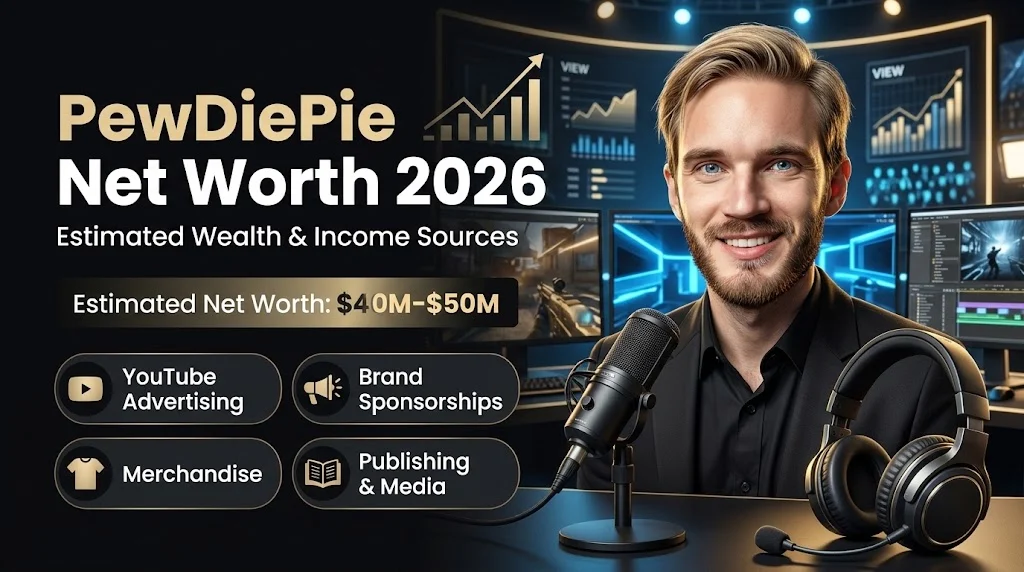
Quick Answer:
PewDiePie’s net worth in 2026 is estimated at approximately $40 million to $50 million, based on his long-running YouTube career, advertising revenue, sponsorships, merchandise, and business ventures, although his exact personal wealth has not been publicly verified.
PewDiePie, whose real name is Felix Kjellberg, became one of the most recognizable creators in YouTube history. His gaming videos, comedy commentary, reaction content, and distinctive online personality helped him build a global audience and turn internet entertainment into a major business.
Interest in PewDiePie net worth remains strong in 2026 because his career illustrates how a digital creator can build long-term wealth through content, audience loyalty, brand partnerships, and products beyond the platform itself. However, subscriber counts and video views do not reveal how much money a creator actually keeps. Advertising shares, production expenses, taxes, management costs, business arrangements, and investments all influence personal wealth. His net worth is therefore an estimate, not a confirmed financial figure.
Bio Data Table
| Field | Details |
|---|---|
| Full Name | Felix Arvid Ulf Kjellberg |
| Date of Birth | October 24, 1989 |
| Age as of 2026 | 37 years old |
| Place of Birth | Gothenburg, Sweden |
| Nationality | Swedish |
| Height | Approximately 5 feet 11 inches; commonly reported |
| Weight | Not publicly verified |
| Health Conditions | Not publicly verified as a complete medical profile |
| Religion | Not publicly verified |
| Education | Attended Chalmers University of Technology but left before completing his studies |
| Profession / Industry | YouTuber, video creator, and digital entertainer |
| Zodiac Sign | Scorpio |
| Marriage / Relationship Status | Married to Marzia Kjellberg |
| Children | One son |
| Net Worth | Estimated at $40 million to $50 million in 2026; not officially confirmed |
| Social Media Accounts | YouTube, Instagram, and other public social media platforms |
| Still Alive | Yes |
| Famous For | Gaming videos, comedy commentary, reaction content, and becoming one of YouTube’s most subscribed individual creators |
Who Is PewDiePie? Background & Early Life
Felix Arvid Ulf Kjellberg was born on October 24, 1989, in Gothenburg, Sweden. He grew up in a family that supported his interests in technology, gaming, and creative activities. His early interest in video games later became the foundation of a career that would make him one of the most recognizable personalities on YouTube.
Kjellberg attended Chalmers University of Technology in Gothenburg, where he studied industrial economics and technology management. However, he eventually left university to pursue his growing interest in online video creation. This decision was significant because YouTube was still developing as a major entertainment platform, and few creators could predict how large the digital creator economy would become.
He launched his YouTube channel, PewDiePie, in 2010. His early videos focused largely on gaming, especially horror games and titles that allowed him to react directly to unusual or frightening moments. Energetic commentary, humor, and recognizable reactions helped distinguish his videos from conventional gameplay uploads.
His online success also brought opportunities outside ordinary video uploads. Advertising revenue, brand partnerships, merchandise, publishing, and other commercial activities gave him ways to generate income from his audience. His career became an example of how a creator could develop a recognizable personal brand and turn an online following into a broader business.
PewDiePie’s personal life also became part of his public story. He married Italian social media personality Marzia Kjellberg in 2019. The couple later welcomed their first child. In more recent years, he has shared aspects of family life and living abroad through selected online content, while maintaining a different publishing pace from the period when he uploaded videos more frequently.
PewDiePie Net Worth 2026 Estimate
PewDiePie’s net worth in 2026 is estimated at $40 million to $50 million. This range is an analytical estimate based on his long-term online career, historical audience reach, advertising opportunities, sponsorship activity, merchandise, and other reported business interests. He has not publicly confirmed an exact personal net worth.
His financial success is closely linked to the scale and longevity of his YouTube channel. Over many years, his videos attracted enormous audiences, creating opportunities to earn through advertising. YouTube’s Partner Program allows eligible creators to receive a share of advertising revenue generated by their content, subject to platform rules and the type of monetization involved.
However, total video views cannot be converted directly into personal wealth. Advertising rates vary by audience location, content category, advertiser demand, video length, season, and viewer behavior. Revenue can also be affected by demonetization, copyright claims, platform policies, and the share retained by the platform.
Sponsorships and merchandise provide additional financial possibilities. Creators with large audiences may negotiate paid promotional campaigns, product partnerships, or commercial arrangements. Merchandise can also generate income, although manufacturing, shipping, marketing, inventory, and retailer costs affect the profit retained.
PewDiePie’s long career may have allowed him to build savings and investments beyond his direct creator income. Nevertheless, the complete details of his private financial portfolio, property holdings, business interests, and liabilities are not publicly verified.
How the Estimate Is Assessed
The estimated range considers several factors:
- His long period as a major YouTube creator.
- The large audience and viewership accumulated by his channel.
- Historical opportunities for advertising revenue.
- Brand partnerships and sponsored content.
- Merchandise and other creator-related commercial activity.
- Potential savings and investments accumulated over time.
These factors support the view that PewDiePie has built substantial wealth. They do not establish a precise figure because the public cannot see his complete balance sheet or the terms of every business agreement.
Career Earnings Are Not Personal Net Worth
It is important to distinguish between the money generated by a creator’s career and the wealth the creator owns.
Gross earnings refer to revenue before expenses and deductions. Career earnings describe income generated over the course of a professional life, while business revenue refers to money received by a business before its operating costs. Personal net worth, by contrast, represents the estimated value of assets minus liabilities.
For a YouTube creator, expenses may include editors, production equipment, software, staff, travel, legal and accounting services, management fees, and taxes. Merchandise operations can involve manufacturing, inventory, delivery, customer service, and marketing costs.
A creator may generate substantial revenue without retaining the same amount as personal wealth. The estimated $40 million to $50 million range should therefore be viewed as an approximation of accumulated wealth, not a calculation of all the money his channel has generated.
Net Worth Growth Timeline
Before Fame
Before becoming a major online personality, Kjellberg was a student in Sweden with an interest in gaming and digital creativity. His early YouTube activity was not initially a large commercial operation.
During this stage, his income from online videos was likely limited or inconsistent. A new creator generally needs time to build an audience, meet monetization requirements, and establish a reliable publishing routine. There is no publicly verified record of PewDiePie’s personal wealth before his channel became popular.
His decision to leave university and focus on content creation represented a career risk. At the time, YouTube offered opportunities, but the long-term earning potential of an individual gaming channel was still uncertain.
Breakthrough Phase
PewDiePie’s breakthrough came as his gaming videos began attracting a rapidly growing audience. His commentary style helped viewers feel connected to the person behind the gameplay, creating a community that returned for new uploads.
As his subscriber count and viewership increased, advertising became a more important potential income source. A larger audience also made the channel more attractive to advertisers and sponsors seeking access to gaming and internet-entertainment viewers.
His rise during the early 2010s coincided with the expansion of YouTube as a mainstream entertainment platform. This timing helped him benefit from growing advertiser interest in online video. His income likely shifted from small or inconsistent creator earnings toward a more substantial business built around regular content and audience attention.
Peak and Recent Years
PewDiePie’s channel reached a major milestone when it became the most-subscribed individual channel on YouTube for a period. His rivalry with T-Series in 2018 and 2019 attracted widespread attention and brought his channel into mainstream news coverage.
This period increased his public visibility and strengthened his position as a leading online creator. The larger audience also created opportunities for sponsorships, merchandise, and other commercial activities. However, the exact amount of income generated by this attention is not publicly verified.
Over time, PewDiePie changed his publishing habits and content direction. He no longer follows the same high-frequency upload pattern associated with his earlier career. His established channel and long-standing audience may continue to provide commercial value, although income from advertising depends on current views and monetization conditions rather than subscriber totals alone.
His financial growth is therefore best understood as a progression from an independent gaming creator to a global digital personality with multiple potential income streams and a long-established online brand.
Main Sources of Income
1. YouTube Advertising Revenue
YouTube advertising has been one of the most important income categories associated with PewDiePie’s career. Eligible creators can earn a share of advertising revenue from videos that meet the platform’s monetization requirements.
The amount a creator receives depends on factors such as views, audience geography, advertiser demand, video subject, ad placement, and monetization eligibility. Two videos with similar view counts can generate very different revenue.
PewDiePie’s channel has accumulated a large archive of videos and a substantial audience over many years. Older content may continue attracting views, although its current earnings depend on actual viewing activity and whether the videos remain eligible for monetization.
It would be inaccurate to multiply lifetime views by a single assumed advertising rate and present the result as his personal income. Such a calculation would overlook platform revenue shares, changing advertising rates, demonetized content, and operating expenses.
2. Sponsored Videos and Brand Partnerships
Brand partnerships have been another potential source of income for PewDiePie. Companies often work with established creators to introduce products or services to audiences that follow their content.
A creator’s sponsorship value can depend on average views, audience demographics, engagement, brand suitability, and the type of campaign. A large subscriber count may attract attention, but advertisers generally care about the actual audience reached and the campaign’s performance.
PewDiePie’s influence in gaming and online entertainment made him commercially relevant to brands seeking digital exposure. However, sponsorship agreements are often private. The complete value and frequency of his individual deals are not publicly verified.
3. Merchandise and Product Sales
Merchandise can help creators earn money beyond advertising. Products may include clothing, accessories, and other items connected to a creator’s identity or community.
PewDiePie has been associated with creator merchandise and products aimed at his audience. A recognizable online personality can use an established fan community to support product launches, but gross sales should not be confused with profit.
Merchandise businesses have operating costs. These may include product design, manufacturing, inventory, fulfillment, shipping, payment processing, returns, customer support, and promotional activity. The creator’s share also depends on ownership and commercial agreements.
The exact amount PewDiePie has personally earned from merchandise is not publicly verified. Nevertheless, merchandise represents a relevant extension of his digital brand.
4. Publishing and Other Media Projects
PewDiePie expanded his creator identity through projects beyond ordinary YouTube uploads. His book This Book Loves You, published in 2015, is one example of his move into publishing.
Books can generate income through advances, sales, and contractual royalties, depending on the publishing agreement. However, the financial terms of his book deal and the total personal income it generated are not publicly verified.
Other media projects can also increase brand visibility and provide opportunities for additional commercial work. Their financial importance depends on audience demand, distribution arrangements, and the terms of each project.
5. Digital Brand and Audience Value
A creator’s personal brand can have commercial value even when it is not recorded as a separate asset on a public balance sheet. A recognizable name, loyal audience, and established online identity can help attract partnerships, merchandise buyers, and viewers.
PewDiePie’s long-standing connection with YouTube audiences is an important part of his business position. His brand is built around his personality and content history, rather than a single product or entertainment format.
However, brand value should not be treated as a specific financial asset unless a reliable valuation is available. There is no publicly verified independent valuation of PewDiePie’s personal brand.
6. Investments and Ownership Interests
PewDiePie may hold savings, investments, or private ownership interests accumulated during his career. These could influence his overall wealth, but the complete details are not publicly verified.
A responsible net worth estimate should not invent company stakes, investment returns, or private business values. His known creator-related income opportunities provide a stronger basis for analysis than speculation about undisclosed holdings.
Business Strategy Behind the Wealth
PewDiePie’s financial success is closely connected to his ability to build a recognizable online identity and maintain a direct relationship with viewers. His career shows how a creator can turn audience attention into a business without relying exclusively on traditional entertainment companies.
Building a Distinctive Personal Brand
One of PewDiePie’s most important advantages has been his recognizable personality. His humor, reactions, commentary, and informal presentation helped viewers identify his content quickly. Instead of positioning himself only as a gaming channel, he developed a personal brand that could extend into different types of online entertainment.
This flexibility helped him move between gaming, commentary, reaction videos, internet culture, and personal content. As audience interests changed, his channel could evolve without completely abandoning its established identity.
Developing a Loyal Audience
A large subscriber count is valuable, but an engaged audience can be even more important for a creator’s business. Viewers who regularly return to a channel can support advertising activity, share content, purchase merchandise, and increase the appeal of sponsorship opportunities.
PewDiePie built a community that followed his career over many years. This relationship helped him remain relevant through changes in gaming trends, YouTube culture, and the wider creator economy.
Diversifying Beyond Advertising
Depending only on advertising can make a creator vulnerable to changes in platform policies and advertiser demand. Sponsorships, merchandise, publishing, and other media projects offer additional ways to generate revenue.
PewDiePie’s career demonstrates the value of developing income opportunities around an established audience. These activities may not all produce the same level of revenue, but they can reduce dependence on one monetization method.
Adapting to Platform Changes
YouTube’s rules, recommendation systems, advertising market, and audience habits have changed significantly since PewDiePie began uploading videos. Creators who depend on one platform must adapt to these changes to protect their long-term business position.
PewDiePie’s shift in content style and publishing frequency reflects a career that has changed with time. His existing channel and recognizable name may continue to provide value even when his upload schedule differs from the period of his greatest activity.
Long-Term Wealth Management
Building wealth from online content requires more than earning money from videos. Creators must manage taxes, professional expenses, investments, business costs, and financial planning. A successful creator may also need legal and accounting support to manage contracts and commercial arrangements.
PewDiePie’s private financial strategy is not fully public. It is therefore not possible to identify his exact investment approach or calculate the contribution of individual assets to his net worth.
Awards & Achievements and Financial Impact
PewDiePie’s career includes several widely recognized digital milestones. His influence is particularly significant because he became one of the most prominent individual creators during YouTube’s growth into a major entertainment platform.
Reaching the Top of YouTube
PewDiePie became YouTube’s most-subscribed individual creator for a period. This milestone helped establish his name beyond the gaming community and made him a recognizable figure in discussions about online entertainment.
The achievement increased his visibility and may have strengthened his commercial appeal to advertisers and potential partners. However, subscriber numbers do not directly determine income. Advertising revenue is influenced by actual views, audience location, advertiser demand, and monetization eligibility.
The PewDiePie and T-Series Competition
The competition between PewDiePie and Indian music and film company T-Series became one of YouTube’s most widely discussed subscriber milestones. The public campaign attracted significant attention from viewers and media outlets.
The event demonstrated the scale of PewDiePie’s online influence and helped reinforce his position in internet culture. Its financial effect cannot be calculated from subscriber growth alone, and no verified figure establishes how much additional income it generated.
Creator Culture and Gaming Entertainment
PewDiePie helped popularize personality-driven gaming videos at a time when online gameplay commentary was becoming a major entertainment format. His style influenced the wider culture of YouTube gaming and reaction content.
This long-term recognition can contribute to brand value by keeping an established creator relevant to audiences and media coverage. However, cultural influence is not the same as a measurable financial asset.
Publishing and Media Recognition
His book This Book Loves You expanded his work beyond video content and demonstrated that his audience could engage with projects in other formats. Publishing can create additional revenue, although sales, advances, and royalty details are not publicly verified.
Overall, PewDiePie’s achievements helped create opportunities across advertising, partnerships, products, and media projects. Their financial impact is best understood as indirect support for his business rather than a guaranteed monetary reward.
Assets & Lifestyle
PewDiePie’s estimated wealth may include property, savings, investments, and other personal assets. However, public information does not provide a complete inventory or an independently verified valuation of everything he owns.
Real Estate
PewDiePie has shared aspects of his home and personal surroundings through online content over the years. Public reporting has also discussed his life in different countries, including Japan. However, a creator’s location or appearance in a home video does not establish property ownership.
The current ownership status, market value, financing arrangements, and complete details of his real estate holdings are not publicly verified. Any property estimate should distinguish between a confirmed purchase, a reported residence, and a home that may be rented or otherwise occupied.
Real estate can contribute to net worth when an individual owns property, but the property’s value must be considered alongside mortgages, taxes, maintenance costs, and other liabilities.
Cars and Luxury Purchases
PewDiePie’s public image has generally been associated with internet entertainment rather than a heavily promoted luxury lifestyle. He has shared selected personal purchases and experiences online, but these do not establish the value of a complete car collection or luxury asset portfolio.
Specific claims about the current value of his vehicles, watches, or other expensive possessions should not be treated as confirmed unless supported by reliable information. His full collection of personal assets is not publicly verified.
Fashion, Investments, and Business Assets
Clothing, technology, cameras, computers, and other equipment can be part of a creator’s professional environment. Some equipment may be used for content production, while other items are personal purchases.
PewDiePie’s financial assets may also include savings and investments, but their types and values are not publicly disclosed in a complete form. There is no reliable public basis for assigning exact values to an investment portfolio or private business interests.
His YouTube channel and established personal brand are central to his commercial identity, but they should not automatically be assigned a separate market value without an independent valuation.
Net Worth Comparison with Peers and the Creator Economy
PewDiePie’s estimated wealth can be considered alongside other prominent online creators. The comparison is useful because digital personalities can build wealth through different combinations of advertising, sponsorships, merchandise, entertainment projects, and business ownership.
| Creator | Main Industry | Financial Context |
|---|---|---|
| PewDiePie | Gaming and digital entertainment | Long-running YouTube presence, advertising, sponsorships, merchandise, and media projects |
| MrBeast | YouTube entertainment and entrepreneurship | Large-scale video production, sponsorships, advertising, and business ventures |
| Markiplier | Gaming and digital entertainment | YouTube content, entertainment projects, merchandise, and other media activities |
| Jacksepticeye | Gaming and online entertainment | Video advertising, sponsorships, merchandise, and creator-related projects |
| KSI | Online entertainment, music, and business | Digital content, music, partnerships, and business ventures |
These creators have different business models. Some invest heavily in large-scale video production, while others focus on gaming communities, merchandise, or businesses outside their channels.
PewDiePie’s career is notable for its longevity. He built a major audience during an earlier stage of YouTube’s development and maintained recognition as the platform’s content formats evolved. His income profile may differ from creators who operate larger production companies or have extensive product businesses.
All public net worth comparisons should be treated as estimates. Private investments, ownership arrangements, expenses, taxes, and liabilities are rarely available in enough detail to establish a precise ranking.
Controversies, Challenges & Financial Risks
PewDiePie’s career has included public controversies that attracted criticism and raised questions about the responsibilities of influential online creators. These events are relevant to understanding the risks associated with building a business around a personal brand.
Content Controversies and Reputation
Some of PewDiePie’s past videos and public statements generated criticism because of offensive or controversial material. In 2017, a report about content on his channel led to a public dispute and the cancellation of a planned project with Disney-owned Maker Studios.
The incident demonstrated how a creator’s content can affect relationships with commercial partners. Brands often consider reputation and audience suitability before entering sponsorship agreements, so controversy can create financial risks even when a creator maintains a large following.
It would be inaccurate to claim that every commercial opportunity was affected or to assign a specific financial loss without verified figures. The broader lesson is that online creators can face consequences when content conflicts with the expectations of advertisers and business partners.
Dependence on YouTube
PewDiePie’s career has been strongly connected to YouTube. This creates exposure to changes in the platform’s monetization rules, recommendation systems, advertising policies, and content standards.
A creator may experience lower revenue if videos receive fewer views, become ineligible for advertising, or attract reduced advertiser demand. Platform dependence is therefore an important risk for anyone whose business relies heavily on one digital service.
Changes in Audience Habits
Internet audiences move between creators, platforms, and content formats. A channel that was extremely popular during one period may experience changes in viewership as new personalities and entertainment trends emerge.
PewDiePie’s established name and long history may help protect his relevance, but no creator is guaranteed the same level of audience attention indefinitely.
Business and Operating Costs
Creators who operate merchandise businesses or produce complex content may face costs related to staff, equipment, software, shipping, legal advice, and customer support. These expenses can affect profit even when sales or advertising revenue appear strong.
Taxes and financial obligations also reduce the amount of gross income that becomes personal wealth. The exact effect of these costs on PewDiePie’s finances is not publicly verified.
His financial position should therefore be evaluated through a combination of career longevity, income opportunities, and the risks that come with a platform-based business.
Philanthropy & Social Impact
PewDiePie’s public influence has extended beyond gaming and entertainment. His large audience has given him the ability to draw attention to charitable causes and encourage viewers to participate in fundraising efforts.
One widely reported example was his support for a fundraising campaign connected to the Save the Children charity. The campaign received public attention because of his large online following and demonstrated how creators can use their platforms to direct viewers toward charitable activity.
PewDiePie has also been associated with charitable fundraising efforts during different periods of his career. However, the exact value of all his donations and the full extent of his private charitable contributions are not publicly verified.
His wider cultural impact comes from helping establish gaming commentary and personality-led video content as major forms of online entertainment. He also demonstrated how an individual creator could build a global audience without following the traditional route through television or film.
That influence is significant in the development of the creator economy, although cultural reach should not be confused with a direct financial asset.
How PewDiePie Makes Money Outside His Core Profession
PewDiePie’s main profession is digital content creation, but his commercial activity has included projects beyond regular YouTube uploads.
Merchandise and Consumer Products
Merchandise gives creators a way to sell products directly to their audience. Clothing and accessories connected to an online personality can generate revenue when viewers want to support or identify with that creator.
PewDiePie’s merchandise-related activity is an extension of his personal brand. However, the financial results depend on product demand, production costs, sales arrangements, and ownership terms. His complete merchandise profit is not publicly verified.
Publishing
His book This Book Loves You represents a move into publishing. Books can provide an additional revenue stream through advances and royalties, depending on the agreement between the creator and publisher.
Publishing also gives an online personality an opportunity to reach people who may not regularly watch videos. The precise financial return from PewDiePie’s book is not publicly verified.
Brand Partnerships and Appearances
A creator with a large audience may receive opportunities to work with brands, participate in campaigns, or appear in media projects. These activities can generate income outside ordinary video advertising.
PewDiePie’s international recognition makes these opportunities relevant to his business profile. However, individual contracts and fees are generally private, and specific earnings should not be assumed without reliable reporting.
Investments and Other Financial Assets
PewDiePie may hold financial investments or other assets accumulated through his career. Such holdings could contribute to personal wealth independently of current content income.
The types, values, and returns of any private investments are not publicly verified. A responsible assessment should acknowledge the possibility of additional assets without inventing specific companies, ownership stakes, or investment profits.
Future Net Worth Projection
PewDiePie’s financial outlook beyond 2026 will depend on his content activity, audience engagement, commercial partnerships, investments, and decisions about his online career. His established brand gives him advantages that newer creators may not have, but future earnings are not guaranteed.
Continued Value of His YouTube Channel
PewDiePie’s channel has a long history and a substantial library of videos. Older uploads may continue attracting views, creating opportunities for advertising revenue when they remain eligible for monetization.
However, a large archive does not guarantee consistent income. Video performance can change over time, and advertising rates depend on audience behavior, platform policies, and advertiser demand.
Sponsorship and Brand Opportunities
His established reputation may continue to create opportunities for selective commercial partnerships. Brands often value creators who have a recognizable identity and an audience that trusts their content.
The number and value of future partnerships will depend on his public activity, audience engagement, brand suitability, and the wider advertising market.
Merchandise and Other Projects
Merchandise, publishing, and other creator-related projects could contribute to future income. These opportunities depend on demand and the ability to manage operating costs effectively.
Expanding into new projects may create additional revenue, but it can also require investment, staff, marketing, and operational resources. The profitability of any future venture cannot be predicted without information about its structure and performance.
Investments and Personal Assets
Private investments and property may influence PewDiePie’s future net worth independently of his current YouTube activity. Their performance will depend on market conditions, asset management, taxes, and personal financial decisions.
Because his complete investment portfolio and liabilities are not publicly verified, assigning a specific future value would be speculative.
Overall Financial Outlook
PewDiePie’s long career, established online identity, and multiple creator-related income opportunities provide a foundation for continued financial stability. His net worth could increase if his investments perform well and his commercial activities remain successful. It could also change because of reduced platform revenue, spending, taxes, or broader market conditions.
The estimated $40 million to $50 million range for 2026 should be understood as an approximation, not a guaranteed baseline for future growth.
Frequently Asked Questions
1. What is PewDiePie’s net worth in 2026?
PewDiePie’s net worth is estimated at approximately $40 million to $50 million in 2026. This estimate reflects his long YouTube career, advertising revenue opportunities, sponsorships, merchandise, and other creator-related projects. His exact personal wealth has not been publicly confirmed.
2. How does PewDiePie make most of his money?
PewDiePie has primarily earned money through YouTube content creation. Advertising revenue, sponsored content, merchandise, and publishing projects have also contributed to his wider commercial profile. The exact income from each source is not publicly verified.
3. How much does PewDiePie earn from YouTube?
His current annual YouTube income is not publicly verified. Earnings depend on video views, advertising rates, audience location, monetization eligibility, and platform revenue sharing. Subscriber numbers alone cannot establish his annual income.
4. Is PewDiePie richer than other YouTubers?
PewDiePie is among the most financially successful creators associated with YouTube’s early growth. However, comparisons with creators such as MrBeast, Markiplier, and KSI depend on estimates that may use different methods. Their private assets and liabilities are not fully available for comparison.
5. Is PewDiePie married and does he have children?
Yes. PewDiePie married Marzia Kjellberg in 2019. The couple have one son. They have shared selected aspects of their family life publicly, while keeping other personal details private.
6. Is PewDiePie’s net worth officially confirmed?
No. PewDiePie has not publicly confirmed an exact personal net worth. Figures published online are estimates based on available information about his career, business activity, and potential assets. They should not be treated as audited financial statements.
Conclusion
PewDiePie net worth in 2026 is estimated at $40 million to $50 million, reflecting his long-running success as a YouTube creator and digital entertainer. His financial journey began with gaming videos and grew into a broader online business supported by advertising opportunities, sponsorships, merchandise, publishing, and a recognizable personal brand.
His career is financially significant because it demonstrates how an individual creator can build substantial commercial value through audience loyalty and years of consistent online influence. Achievements also highlight the opportunities available in the creator economy beyond traditional entertainment industries.
However, total video views, subscriber counts, and reported business revenue do not reveal personal wealth. Taxes, production costs, management fees, investments, liabilities, and private ownership arrangements all affect the final calculation.
Discover More Post:
- Henry Winkler Net Worth 2026 | Career Earnings, Iconic Roles …
- Cassidy Hutchinson Net Worth, Career & Financial Journey
- Rob Reiner Net Worth | Career, Fortune and the Legacy Behind His …