

Quick Answer:
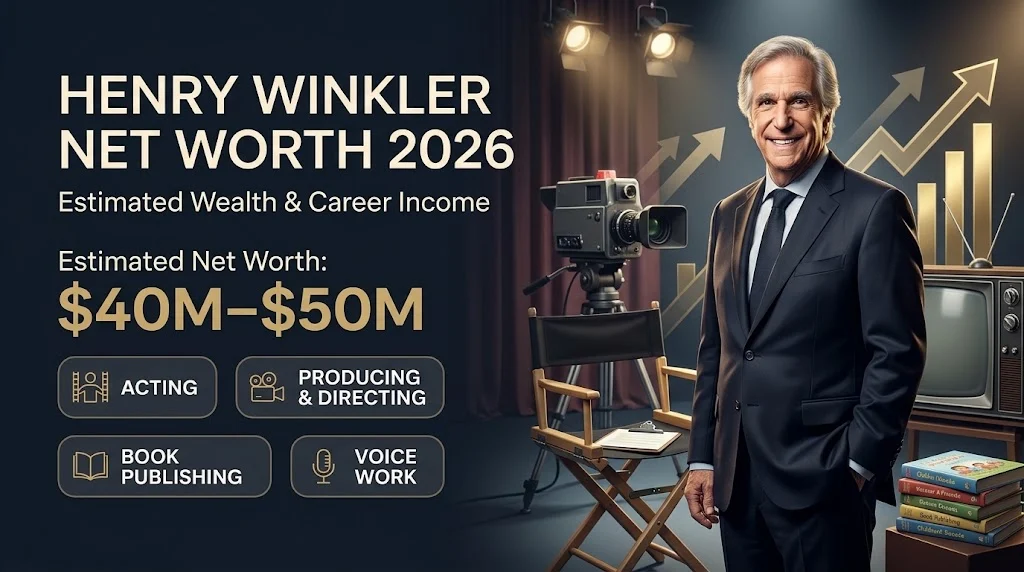
Henry Winkler’s net worth in 2026 is estimated at approximately $40 million to $50 million, based on his decades of acting, television and film work, producing projects, directing, and children’s book publishing, although his exact personal wealth has not been publicly verified.
Henry Winkler has built a long-lasting career in entertainment by moving beyond a single famous role. Best known as Arthur “Fonzie” Fonzarelli on Happy Days, he became a recognizable television star before expanding into film, directing, producing, and writing. His continued work across different formats helps explain why interest in Henry Winkler net worth remains strong in 2026.
Unlike entertainers whose income depends mainly on a short period of popularity, Winkler has worked across several generations of television and film audiences. His career includes acting roles, behind-the-camera projects, and a successful series of children’s books co-written with Lin Oliver. However, public career credits do not reveal his complete financial position. Taxes, agent and manager fees, production costs, investments, property expenses, and private financial obligations can all affect personal wealth. His net worth should therefore be understood as an estimate, not a confirmed financial statement.
Bio Data Table
| Field | Details |
|---|---|
| Full Name | Henry Franklin Winkler |
| Date of Birth | October 30, 1945 |
| Age as of 2026 | 80 years old until October 30, 2026; turns 81 on that date |
| Place of Birth | Manhattan, New York City, New York, United States |
| Nationality | American |
| Height | Commonly reported at approximately 5 feet 6 inches; not independently verified here |
| Weight | Not publicly verified |
| Health Conditions | Has publicly discussed dyslexia and learning difficulties |
| Religion | Jewish; Winkler has discussed his Jewish background |
| Education | Emerson College; Yale School of Drama |
| Profession / Industry | Actor, producer, director, and author |
| Zodiac Sign | Scorpio |
| Marriage / Relationship Status | Married to Stacey Weitzman |
| Children | Three children, including a stepson |
| Net Worth | Estimated at $40 million to $50 million in 2026; not officially confirmed |
| Social Media Accounts | Public social media presence includes Instagram; account details should be checked through verified profiles |
| Still Alive | Yes |
| Famous For | Playing Arthur “Fonzie” Fonzarelli in Happy Days and Gene Cousineau in Barry |
Who Is Henry Winkler? Background & Early Life
Henry Winkler was born on October 30, 1945, in Manhattan, New York City. His parents, Harry and Ilse Winkler, were German Jewish immigrants who came to the United States before World War II. His upbringing placed considerable emphasis on education, but he struggled with learning difficulties that were not properly understood during his childhood.
Winkler later learned that he had dyslexia, a learning difference that affected his reading and writing. He has spoken publicly about the frustration he experienced in school and how those challenges influenced his confidence. His personal experiences eventually became a source of inspiration for his work as a children’s author.
Despite these difficulties, Winkler pursued acting. He attended Emerson College in Boston, where he earned a degree, and continued his training at the Yale School of Drama. His formal education gave him a foundation in performance and helped prepare him for professional opportunities in theatre, television, and film.
After moving to Los Angeles, Winkler began building his career through auditions and television appearances. His breakthrough came in 1974, when he began playing Arthur “Fonzie” Fonzarelli in the sitcom Happy Days. The character’s confidence, leather jacket, and memorable mannerisms made Fonzie one of American television’s best-known figures.
Winkler also established himself as a children’s book author. Working with co-author Lin Oliver, he helped create the Hank Zipzer series, inspired in part by his own experiences with dyslexia. His publishing career expanded his work beyond the screen and created another professional avenue alongside acting and producing.
This combination of television fame, ongoing screen work, production experience, and publishing helps explain the longevity of Winkler’s career. His wealth is not tied to one sitcom alone; it reflects decades of activity across several areas of entertainment.
Henry Winkler Net Worth 2026 Estimate
Henry Winkler’s net worth in 2026 is estimated at $40 million to $50 million. This is a broad estimate based on publicly reported wealth figures and his long career in acting, producing, directing, and publishing. The precise value of his assets and liabilities is not publicly verified.
Some celebrity wealth estimates place Winkler’s net worth at around $40 million. A wider range is useful because public estimates rarely disclose a complete calculation. They may differ in how they value property, account for taxes, estimate investment assets, or treat income from past projects.
Winkler has worked in television and film for more than five decades. His career includes a major sitcom role, recurring and guest appearances in other productions, voice acting, producing credits, directing projects, and children’s books. Each type of work can be compensated differently, and the timing of payments may vary.
Publishing is another part of his career. Winkler’s children’s books, including the Hank Zipzer series, have reached readers through traditional publishing. Book income may involve advances, royalties, and other contractual payments, depending on the agreement. His books have been commercially successful, but his precise lifetime publishing income is not publicly verified.
How the Estimate Is Assessed
A reasonable estimate considers several factors:
- Career longevity: Winkler has worked in the entertainment industry for more than 50 years.
- Television and film roles: His credits span major sitcom work, films, guest appearances, and later television projects.
- Producing and directing: His behind-the-camera work expanded his professional opportunities.
- Publishing: His children’s books and memoir provide another potential income stream.
- Assets and expenses: Property, investments, taxes, management fees, and personal costs may affect the amount of wealth he retains, but the full details are private.
These factors support the view that Winkler has accumulated substantial wealth, but they cannot establish a precise balance sheet. The $40 million to $50 million range should therefore be treated as an estimate rather than a verified statement of his current financial position.
Career Earnings Are Not the Same as Net Worth
Understanding Winkler’s wealth requires separating several financial concepts.
Gross earnings refer to money generated before expenses and deductions. Career earnings describe income received over the course of a professional life, while salary or acting fees refer to compensation for particular roles or projects. Production revenue is the money generated by a show or film, not necessarily the amount paid to an individual performer.
Personal net worth is different. It represents the estimated value of assets minus liabilities. Even an actor who has earned substantial amounts over many years may retain considerably less after taxes, agents’ and managers’ fees, legal expenses, living costs, investment losses, and other financial obligations.
For Winkler, public career achievements are well documented, but his complete income history, asset portfolio, debts, and private investments are not. A cautious estimate is therefore more responsible than a precise figure presented as fact.
Net Worth Growth Timeline
Before Fame
Before becoming a household name, Winkler was focused on education and professional acting training. His studies at Emerson College and the Yale School of Drama helped him prepare for a career in performance, but his early financial position is not publicly verified.
Like many aspiring actors, he initially had to compete for roles and build experience. Early acting work can be irregular, with earnings varying according to the size and length of each engagement. It would be misleading to assign a specific net worth to this stage without reliable financial records.
The important development during this period was professional preparation. Training, auditions, and early television work created the foundation for the opportunity that would change his career.
Breakthrough Phase
Winkler’s casting as Fonzie in Happy Days marked the turning point. The series became a major television success, and his character developed into one of its central attractions.
A prominent recurring television role can offer more consistent employment than occasional guest appearances. As a series becomes successful, an actor may also gain negotiating leverage for future contracts. The exact terms of Winkler’s Happy Days salary and any related financial arrangements are not publicly verified here, so the series’ popularity should not be converted into an invented earnings total.
His fame also created opportunities beyond the sitcom. He appeared in films and pursued additional entertainment projects, helping him build a career that extended beyond one character. His awards recognition and status as a recognizable television personality strengthened his professional profile.
Peak and Recent Years
Following Happy Days, Winkler continued to work in television and film while developing producing and directing credits. These activities helped diversify his professional experience and reduced his dependence on the original sitcom role.
His appearance in Barry marked another important stage. Playing acting teacher Gene Cousineau brought him critical acclaim and a Primetime Emmy win in 2018. The role showed that he could remain professionally relevant decades after his first major success.
Winkler’s publishing work also became an important part of his later career. His books with Lin Oliver connected his own learning experiences with stories aimed at children. The success of the Hank Zipzer series and other books expanded his reach beyond screen audiences.
By 2026, Winkler’s financial position is best understood as the cumulative result of long-term employment across acting, producing, directing, and writing. Some earnings would have been tied to specific projects, while others may have continued through book sales or contractual arrangements. The exact mix and value of these sources remain private.
Main Sources of Income
1. Acting in Television and Film
Acting is the clearest foundation of Winkler’s wealth. His work on Happy Days established his public profile, while later roles in television and film helped sustain his career over several decades.
Actors may be paid per episode, per film, by project, or through other negotiated arrangements. Their compensation can depend on the size of the role, production budget, experience, bargaining position, and contract terms. A regular television role may offer more predictable income during production, while film appearances and guest roles can be shorter and more project-based.
Winkler’s career includes comedy, drama, family entertainment, and voice performances. This range allowed him to work with different production teams and reach audiences with varied interests. Nevertheless, his exact total acting income is not publicly verified, and reported career earnings should not be treated as his current wealth.
2. Producing and Executive Producing
Winkler has also worked as a producer and executive producer on television projects. Producing involves responsibilities that differ from acting, including helping develop projects, coordinating production, and working with creative or business teams.
Compensation for producers varies. Some receive a negotiated fee, while certain agreements may include additional payments depending on the project’s performance and contractual terms. Not every producer owns the underlying production or receives a share of its long-term revenue.
Winkler’s producing credits, including work associated with television series such as MacGyver, demonstrate that his career extended beyond performing. These roles may have contributed to his financial stability, but the amounts he earned and any ownership interests are not publicly verified.
3. Directing
Directing has provided another professional avenue. Winkler directed films including Memories of Me and Cop and a Half, along with television projects.
Directors are generally compensated according to their agreements with a production. Their fees may vary with the project’s budget, schedule, responsibilities, and bargaining arrangements. A director’s credit does not automatically mean the director owns the film or receives ongoing revenue from it.
For Winkler, directing broadened his experience and gave him another way to participate in the entertainment industry. Its exact contribution to his net worth cannot be calculated from public credits alone.
4. Children’s Books and Publishing
Winkler’s publishing career is a meaningful part of his professional story. He co-wrote the Hank Zipzer books with Lin Oliver, drawing inspiration from his own experiences with dyslexia. The series became popular with young readers and expanded into multiple books.
He has also worked on other children’s titles and published his memoir, Being Henry: The Fonz…and Beyond. Book income may include advances, royalties, and other payments under publishing agreements. Royalties generally depend on sales, contractual rates, formats, and rights arrangements.
The publishing industry has its own costs and divisions of revenue. Publishers handle production, distribution, marketing, and other activities, while authors receive compensation according to their contracts. Where a book has a co-author, the financial arrangement may also involve sharing payments. Winkler’s exact publishing income is not publicly verified.
5. Voice Acting and Guest Appearances
Winkler has provided voice work for animated programmes and appeared in a wide range of television productions. Voice acting can create opportunities without requiring the same on-camera schedule as a live-action role, although fees and working conditions depend on the production and contract.
Guest appearances can also help an established actor maintain professional visibility. Some are paid engagements, while others may be tied to promotional or broader project arrangements. It would be speculative to assign a fixed annual income to Winkler’s voice work or guest appearances without reliable contract information.
6. Residuals and Other Contractual Payments
Depending on the applicable contracts and industry rules, actors may receive residual payments when eligible productions are reused or distributed through qualifying channels. These payments are distinct from an original acting fee.
The amount and duration of residual income depend on the production, the actor’s agreement, distribution arrangements, and the relevant rules. Although Winkler has appeared in numerous television and film projects, the value of any residual payments he receives is not publicly verified.
Business Strategy Behind the Wealth
Winkler’s career illustrates how an entertainer can maintain professional relevance by developing more than one skill and adapting to different opportunities.
Building a Recognizable Reputation
The character of Fonzie gave Winkler a highly recognizable place in television history. A successful signature role can open doors to future projects, but it can also create the risk of being associated too closely with one character.
Winkler’s later career shows a broad range of work beyond Happy Days. He took roles in films, comedy series, dramas, and family entertainment, allowing audiences to see him in different contexts. His later performance in Barry further demonstrated his range and brought renewed critical attention.
Expanding Beyond Acting
By producing and directing, Winkler developed professional experience behind the camera. These roles can create additional work opportunities and allow an experienced performer to contribute to projects in different ways.
However, producing and directing are not automatically more profitable than acting. Their financial value depends on the agreement, the project’s performance, and whether the individual has any ownership stake. Winkler’s specific contractual arrangements are not publicly verified.
Developing a Publishing Career
The Hank Zipzer books connected Winkler’s personal experience with an audience of children and families. The series addressed learning differences through an accessible fictional character, giving the books both entertainment value and a relatable educational theme.
A successful book series can create repeat opportunities through additional titles and continued sales. Yet publishing income depends on sales, advances, royalties, co-author arrangements, and publisher agreements. The exact financial contribution of the series to Winkler’s wealth remains unknown.
Maintaining Long-Term Career Value
A long career can be financially valuable because it creates opportunities across different market cycles. An actor who continues to work may benefit from new roles, returning audiences, and a professional reputation built over time.
Winkler’s approach has combined recognizable legacy work with newer projects. His ability to continue acting and writing after his original television breakthrough is an important part of his professional longevity. Still, the value of this strategy cannot be measured precisely without access to private financial records.
Awards & Achievements and Financial Impact
Winkler’s awards and career achievements demonstrate his standing in television and entertainment. Recognition can improve professional visibility and create opportunities, although it does not guarantee a specific salary or net worth.
Golden Globe Awards
Winkler won two Golden Globe Awards for his performance in Happy Days. The awards recognized his work during the period when Fonzie became a major television character.
Such recognition can strengthen an actor’s reputation and support future opportunities. In Winkler’s case, his success on the show helped establish a professional identity that continued to be relevant long after the series ended.
Primetime Emmy Award
In 2018, Winkler won the Primetime Emmy Award for Outstanding Supporting Actor in a Comedy Series for playing Gene Cousineau in Barry. He had received Emmy nominations earlier in his career, including for his work on Happy Days.
The win was significant because it recognized a later-career performance rather than only his iconic earlier role. Awards can help renew public attention, increase industry credibility, and strengthen an actor’s position when considering future projects. They do not, however, establish how much an actor was paid.
Television Critics Choice Awards
Winkler has also won Critics Choice recognition for his supporting role in Barry. This achievement added to the critical response to his performance and reinforced his standing among television performers.
Awards may contribute indirectly to professional value by increasing visibility and strengthening an actor’s reputation. The direct financial impact depends on the projects and agreements that follow.
Hollywood Walk of Fame and Television Legacy
Winkler received a star on the Hollywood Walk of Fame for his contributions to entertainment. His portrayal of Fonzie also became a defining part of American television history.
Legacy and recognition can keep an actor’s work visible to new audiences through reruns, streaming, retrospectives, and cultural references. However, the financial effect of that continued visibility depends on the rights and contracts associated with each production. A famous role is evidence of cultural impact, not proof of a particular residual income.
Children’s Books and Advocacy
Winkler’s success as a children’s author has added another dimension to his public career. His books about Hank Zipzer draw on his experiences with dyslexia and have helped introduce learning differences to young readers.
This work has expanded his reputation beyond acting and connected him with families, educators, and children. The books’ commercial success is relevant to his career, although the amount of money he personally earned from publishing is not publicly verified.
Assets & Lifestyle
Winkler’s long career has led to public interest in his home, possessions, and lifestyle. Yet a responsible net worth assessment must avoid assigning exact values to assets that have not been reliably documented.
Real Estate
Public reporting has associated Winkler with a home in Los Angeles, where he and his family have lived. However, the current market value of his property holdings, any outstanding mortgage balances, and the complete structure of ownership are not publicly verified here.
Property can be an important part of a celebrity’s net worth, but its contribution depends on more than the estimated selling price. Maintenance costs, taxes, renovations, financing, and market conditions all affect the amount of equity an owner may hold.
Without reliable details about all of these factors, it would be inappropriate to assign a precise real estate value to Winkler’s financial portfolio.
Cars and Luxury
Winkler’s public image is closely associated with Fonzie, whose leather jacket became an iconic television costume. The character’s image should not be confused with Winkler’s private lifestyle or personal possessions.
Specific details about Winkler’s current car collection, luxury purchases, and the total value of his personal belongings are not publicly verified. A role in a famous television series does not establish that an actor owns the props or items associated with that character.
Fashion, Investments, and Business Assets
As an established entertainer, Winkler may have savings, investments, retirement assets, or other financial holdings. The details and values of any such portfolio are not publicly verified.
His best-documented professional assets are the skills, reputation, and body of work he developed across acting, directing, producing, and writing. These can create future opportunities, but they are not the same as liquid financial assets and should not be assigned an unsupported dollar value.
Net Worth Comparison with Peers and the Entertainment Industry
Henry Winkler’s estimated wealth can be understood more clearly by considering the careers of other actors who built long-term success in television and film. The comparisons below focus on career structure rather than claiming precise financial rankings, because publicly reported celebrity net worth figures are not audited and may use different methods.
| Actor | Known For | Career and Income Context |
|---|---|---|
| Henry Winkler | Happy Days, Barry | Acting, producing, directing, voice work, and children’s books |
| Ron Howard | Happy Days, directing and producing | Acting, directing, producing, and work through production ventures |
| Tom Hanks | Film and television roles | Acting, producing, and long-term film projects |
| William Shatner | Star Trek and other screen roles | Acting, public appearances, writing, and other entertainment projects |
| Bryan Cranston | Breaking Bad and other roles | Television, film, stage work, and producing |
Each performer has a different career history and financial structure. Some have focused heavily on acting, while others have expanded into directing, production, writing, or business ventures. Their private contracts, ownership interests, assets, and liabilities also differ.
Winkler’s estimated wealth reflects his long career and work across several entertainment categories. Unlike an actor whose income comes almost entirely from films, his professional history includes television, producing, directing, voice work, and publishing. That diversity may have helped him sustain work across different periods of the entertainment industry.
Nevertheless, peer comparisons cannot confirm an exact net worth. The figures often circulated online are estimates, and differences in calculation methods can produce misleading rankings. The most reliable conclusion is that Winkler has enjoyed a long and commercially successful entertainment career, while his exact personal wealth remains private.
Controversies, Challenges & Financial Risks
Winkler’s career has lasted for decades, but longevity in entertainment does not eliminate financial uncertainty. His professional path also illustrates challenges that actors can face when moving between major roles and different types of work.
Typecasting and Career Changes
After the success of Happy Days, Winkler was strongly associated with Fonzie. Being closely identified with a popular character can create opportunities, but it can also make it harder for an actor to be seen in different roles.
Winkler continued working in film and television and later earned recognition for Barry. His career demonstrates how varied roles can help an actor remain relevant. However, the financial outcome of career changes depends on available projects, audience response, and contract terms.
Inconsistent Project Income
Acting income is not always steady. Television seasons, films, guest roles, and voice work follow different schedules, and an actor may experience periods with fewer projects. Even established performers can face gaps between contracts.
Winkler’s long list of credits suggests sustained participation in the industry, but the amount he earned in any specific year is not publicly verified. His career should not be interpreted as proof of a fixed annual income.
Production and Contractual Risks
Producing and directing involve financial and operational responsibilities that differ from acting. Project schedules can change, productions may exceed budgets, and contractual payments can depend on specific conditions.
There is no basis here to claim that Winkler experienced a particular financial loss or dispute. These are general risks associated with entertainment work, not allegations about his private finances.
Taxes, Fees, and Asset Costs
Actors may pay agents, managers, accountants, attorneys, publicists, and other professionals. Taxes and the costs of maintaining homes or other assets can also affect the amount of wealth retained over time.
Without access to Winkler’s financial statements, it is impossible to calculate these expenses accurately. They are relevant because gross career earnings do not equal personal net worth.
Changing Media Distribution
The entertainment industry has shifted from traditional broadcast television toward streaming and other distribution models. These changes affect how programmes reach audiences and how contractual compensation may be structured.
Older shows can remain culturally relevant, but the financial impact of reruns, streaming distribution, and residual payments depends on the relevant rights and agreements. Winkler’s exact income from any such arrangements is not publicly verified.
Philanthropy & Social Impact
Henry Winkler has publicly supported causes involving children, education, and people with disabilities. His advocacy is particularly connected to his own experiences with dyslexia, which he has discussed openly in interviews and in his writing.
His Hank Zipzer books draw on the challenges he experienced as a student. The stories portray a child with learning differences in a way that can help young readers understand that academic struggles do not define a person’s abilities or potential.
Winkler has also been associated with charitable and educational initiatives, including work connected with children and disability awareness. His public service has included participation in organizations and programmes focused on helping young people and supporting people with disabilities.
These activities contribute to his public impact, although the total value of his personal charitable donations is not publicly verified. It would be inappropriate to assign a monetary figure to his philanthropy without reliable evidence.
His advocacy also illustrates how a public figure can use personal experience to support a wider conversation. Winkler’s career as an author has allowed him to reach readers who may never have encountered his television work, expanding the educational and cultural influence of his public profile.
How Henry Winkler Makes Money Outside His Core Profession
Acting remains the most recognizable part of Winkler’s career, but he has also developed income opportunities through writing, producing, directing, and related entertainment work.
Book Publishing
Winkler’s children’s books and memoir represent a distinct professional activity outside acting. Publishing can generate income through advances, royalties, and sales across different formats, depending on the contract.
His books have reached a broad audience, and the Hank Zipzer series has been especially notable. However, book sales do not equal the author’s personal earnings because publishers, distributors, co-authors, and other parties may share in the financial arrangement.
Producing and Directing
Producing and directing have allowed Winkler to work on projects beyond his own performances. These roles may provide negotiated fees and, in some cases, additional compensation under specific agreements.
His production and directing credits establish that he has worked in these areas, but they do not confirm ownership of every project or ongoing participation in its revenue. The exact financial returns from his behind-the-camera work are not publicly verified.
Public Appearances and Speaking
Established entertainers may be invited to participate in interviews, industry events, conventions, or speaking engagements. These opportunities can sometimes involve compensation, but the terms vary and are not always public.
Winkler has spoken about his career and experiences with dyslexia, making his perspective relevant to audiences interested in entertainment, education, and personal development. However, the amount he earns from public appearances or speaking engagements is not publicly verified.
Investments and Property
Real estate and investments can contribute to an individual’s overall wealth outside their primary profession. However, there is insufficient verified information to quantify Winkler’s complete investment portfolio or establish specific investment returns.
These categories should be treated as possible parts of his broader financial picture, not as confirmed income streams with known values. His best-documented sources of professional income remain acting, producing, directing, and writing.
Future Net Worth Projection
Henry Winkler’s financial position beyond 2026 will depend on his future work, the continued commercial value of his existing projects, publishing activity, and personal financial decisions. His long experience and established reputation may continue to create professional opportunities, but any forecast should remain cautious.
Continued Acting Opportunities
Winkler has remained active across several generations of television and film. If he continues accepting suitable roles, acting fees may remain a source of income. The volume and value of future projects cannot be predicted with certainty, particularly because schedules and production decisions change.
Publishing and Writing
His established work as a children’s author and memoirist may continue to generate sales. The long-term value of a book catalogue depends on readership, distribution, new editions, licensing arrangements, and contractual terms. Exact future publishing income is not publicly verified.
Continued Value of Past Work
Older television and film projects can remain visible through reruns, streaming services, and other forms of distribution. Depending on contractual arrangements, this may lead to residual payments or other income. The value of any payments to Winkler is not publicly verified, and continued availability does not guarantee a particular amount.
Financial Risks and Uncertainty
Taxes, living costs, investment performance, property expenses, and other personal financial decisions may affect his net worth. Changes in entertainment demand could also influence future income.
A cautious outlook is that Winkler’s decades of work across acting, production, directing, and publishing provide a substantial professional foundation. His estimated wealth may remain stable or change depending on future income and expenses, but there is not enough verified information to calculate a precise future value.
Frequently Asked Questions
1. What is Henry Winkler’s net worth in 2026?
Henry Winkler’s net worth is estimated at approximately $40 million to $50 million in 2026. Some published estimates place him near $40 million, but his exact assets and liabilities have not been publicly verified.
2. How did Henry Winkler make his money?
Winkler built his wealth primarily through acting in television and films. Producing, directing, voice work, and children’s book publishing have also contributed to his long career.
3. How much did Henry Winkler earn from Happy Days?
The exact amount Winkler earned from Happy Days is not publicly verified here. His role as Fonzie was a major career breakthrough, but the show’s popularity alone does not establish his salary or total earnings.
4. Does Henry Winkler earn money from his books?
Winkler co-wrote children’s books, including the Hank Zipzer series, and published his memoir. These works may generate income through advances, royalties, and sales, but his precise publishing earnings are not publicly verified.
5. Is Henry Winkler still alive in 2026?
Yes. Henry Winkler is alive in 2026 and has continued to be recognized for his work as an actor, producer, director, and author.
6. Is Henry Winkler’s net worth officially confirmed?
No. The commonly reported figures are third-party estimates rather than an official financial disclosure. Different estimates may use different assumptions about income, property, investments, taxes, and expenses.
Conclusion
Henry Winkler net worth in 2026 is estimated at $40 million to $50 million, reflecting a career that spans television, film, producing, directing, voice acting, and children’s book publishing. His iconic portrayal of Fonzie in Happy Days established his place in television history, while later work, including his award-winning performance in Barry, helped maintain his professional relevance.
Winkler’s financial story is notable because he developed opportunities beyond his best-known role. His work behind the camera and his publishing success expanded his career into different areas of entertainment. These activities may have contributed to long-term financial stability, although the exact amounts he earned from individual projects are not publicly verified.
His reported wealth should not be treated as a confirmed balance sheet. Career earnings differ from personal net worth because taxes, professional fees, living expenses, investments, and liabilities affect the final amount. The $40 million to $50 million range is therefore an estimate based on available information, not a guaranteed or officially confirmed figure.
Discover More Post:
- Trump Net Worth | How Donald Trump Built His Fortune and …
- Beyoncé Net Worth | The Billion-Dollar Journey Behind Her …
- Rihanna Net Worth, Career Milestones & Wealth | From Music Star …







5 thoughts on “Henry Winkler Net Worth 2026 | Career Earnings, Iconic Roles, and the Surprising Story Behind His Lasting Hollywood Success”