
Quick answer:
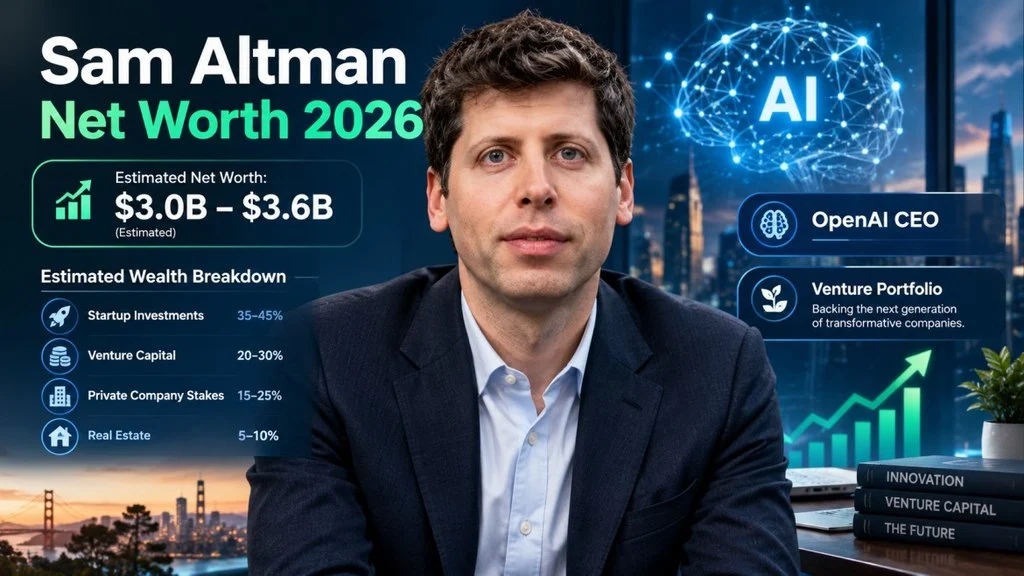
Sam Altman’s estimated 2026 net worth is approximately $3.0 billion to $3.6 billion, with the strongest recent estimates clustering around $3.3 billion, largely because of his extensive venture investments rather than an OpenAI ownership stake or a large CEO salary.
Sam Altman has become one of the most recognizable names in the technology industry, but the story behind his fortune is more unusual than the typical billionaire founder narrative. As the CEO of OpenAI, the company behind ChatGPT, Altman sits at the center of the artificial intelligence boom. Yet his personal wealth is not primarily tied to ownership of OpenAI. Instead, his fortune has been built through years of startup investing, venture activity, entrepreneurial exits, and stakes in companies across technology, energy, biotechnology, and other emerging industries.
That distinction is what makes Sam Altman net worth one of the most searched financial questions surrounding the AI industry in 2026. A headline valuation for OpenAI does not automatically translate into personal wealth for Altman. Public reporting has consistently indicated that he does not hold direct equity in OpenAI, meaning his financial position is fundamentally different from that of founders whose fortunes rise and fall directly with their company’s valuation.
Recent 2026 estimates place Altman’s wealth in the low-to-mid $3 billion range. Forbes has reported a real-time estimate around $3.3 billion, while other Forbes reporting earlier in 2026 placed his fortune around $3.5 billion. Because much of his wealth is connected to private-company investments whose values can change between funding rounds, a reasonable range is more useful than an exact figure.
Bio Data Table
| Category | Details |
|---|---|
| Full Name | Samuel Harris Altman |
| Date of Birth | April 22, 1985 |
| Age as of 2026 | 41 |
| Place of Birth | Chicago, Illinois, United States |
| Nationality | American |
| Height | Not publicly verified |
| Weight | Not publicly verified |
| Health Conditions | Not publicly verified |
| Religion | Not publicly verified |
| Education | Stanford University, computer science; did not complete degree |
| Sports / Profession / Industry | Technology entrepreneur, investor, AI executive |
| Zodiac Sign | Taurus |
| Marriage / Relationship Status | Married to Oliver Mulherin |
| Children | One son |
| Net Worth | Estimated $3.0 billion to $3.6 billion in 2026 |
| Social Media Accounts | X: @sama; other personal accounts not publicly verified |
| Still Alive | Yes |
| Famous For | CEO of OpenAI, former Y Combinator president, startup investor |
Who Is Sam Altman? Background & Early Life
Sam Altman was born in Chicago in 1985 and later grew up in St. Louis, Missouri. His interest in computers developed early, and technology eventually became the foundation of his career.
Altman attended Stanford University to study computer science but left before completing his degree. Rather than following a conventional academic path, he focused on entrepreneurship. That decision became an important turning point in his financial story because his early startup experience introduced him to Silicon Valley’s founder and investment ecosystem.
In 2005, Altman co-founded Loopt, a location-based social networking company. The startup was accepted into Y Combinator’s first batch, giving Altman an early connection to one of Silicon Valley’s most influential startup accelerators.
Loopt eventually became a significant liquidity event for Altman. Green Dot acquired the company in 2012 for approximately $43 million. The sale provided capital that Altman could subsequently deploy into other technology companies and investment opportunities.
His relationship with Y Combinator also became central to his career. Altman became a partner and later served as president from 2014 through 2019. During this period, he gained exposure to hundreds of founders and emerging startups, strengthening his ability to identify businesses with significant growth potential.
In 2015, Altman became one of the co-founders of OpenAI. He eventually became CEO in 2019 after leaving his leadership role at Y Combinator.
OpenAI later became one of the most influential AI organizations in the world, particularly following the launch of ChatGPT in November 2022. The success of ChatGPT transformed Altman from a prominent Silicon Valley investor into a globally recognized technology executive.
Sam Altman Net Worth Overview 2026 Estimate
The most reasonable 2026 estimate for Sam Altman’s net worth is approximately $3.0 billion to $3.6 billion, with approximately $3.3 billion serving as a useful midpoint.
The important point is that this figure should not be confused with OpenAI’s corporate valuation.
OpenAI is a separate business entity from Altman’s personal finances. Altman has repeatedly indicated that he does not own direct equity in OpenAI. This means that even enormous increases in OpenAI’s valuation do not automatically add the same percentage increase to his personal wealth.
Instead, Altman’s financial position is largely connected to investments outside OpenAI.
Recent court documents disclosed during litigation involving OpenAI revealed more than $2 billion in stakes across companies that have conducted business with OpenAI. The disclosed investments included major positions associated with companies such as Helion Energy, Stripe, and Retro Biosciences. These figures help explain why Altman can have billionaire-level wealth despite receiving a relatively modest salary from OpenAI.
His reported 2023 compensation from OpenAI was $76,001. That amount is tiny compared with his estimated net worth.
This illustrates the difference between salary and wealth.
A salary is annual employment income. Net worth is the estimated value of everything a person owns after accounting for liabilities and other financial factors. For a technology investor, the largest part of wealth may exist in private-company shares that generate no regular paycheck.
Altman’s estimated wealth therefore depends heavily on the value of his investment portfolio, the value of privately held companies, real estate, taxes, liquidity, debt, and the ownership percentages attached to his various investments.
Net Worth Growth Timeline
Before Fame
Altman’s earliest wealth-building phase began with entrepreneurship rather than a high-paying corporate career.
After leaving Stanford, he focused on Loopt. The company raised venture capital and ultimately sold to Green Dot for approximately $43.4 million in 2012.
The acquisition was important not simply because of the sale price but because it gave Altman capital and experience that could be redirected into the startup ecosystem.
During this period, his wealth was primarily entrepreneurial and event-based. It depended on the value of his ownership interest and the eventual acquisition of the company rather than a traditional salary.
Breakthrough Phase
The next major stage came through Y Combinator and venture investing.
As president of Y Combinator from 2014 to 2019, Altman became deeply involved in startup selection, fundraising, company building, and technology strategy.
His investment activity expanded significantly. Over time, he invested in numerous startups, including companies that later became major names in technology.
This strategy created a very different wealth profile from that of a traditional executive. Instead of relying on one company, Altman spread his financial exposure across multiple emerging businesses.
Peak / Recent Years
The biggest visibility boost came after ChatGPT transformed OpenAI into a global technology leader.
However, the increase in Altman’s personal net worth did not simply come from owning OpenAI.
His investment portfolio became increasingly valuable as companies in which he held stakes grew. His investments span AI, software, biotechnology, energy, transportation, financial technology, and other areas.
By 2026, Forbes estimated his net worth at approximately $3.3 billion, while other Forbes reporting during the year placed the estimate closer to $3.5 billion.
The variation reflects the difficulty of valuing private investments.
Main Sources of Income
Core Profession Income
Altman’s core professional role is leading OpenAI.
As CEO, he is responsible for strategic direction, partnerships, fundraising, product development, public policy, organizational leadership, and the company’s broader position in the AI market.
However, his CEO compensation is not the primary reason for his billionaire status.
His reported OpenAI compensation has historically been around the tens of thousands of dollars annually rather than the multimillion-dollar packages common among public-company CEOs.
Startup Exits and Career Earnings
The sale of Loopt was an early source of capital.
The approximately $43 million acquisition created liquidity that could be reinvested into other businesses and opportunities.
Career earnings therefore played an important role in establishing Altman’s investment base, but they should not be treated as equivalent to his current net worth.
The acquisition price of a company is not the same as the founder’s personal proceeds. Founders can have co-founders, investors, employees with equity, taxes, transaction expenses, and other financial obligations.
Venture Capital and Startup Investments
Venture investing is arguably the most important component of Altman’s wealth.
His investment activity has included companies such as Stripe, Reddit, Airbnb, Instacart, Uber, Asana, Helion Energy, and other technology and emerging-industry companies.
The scale of his investment network is significant. Industry research has identified more than 100 investments associated with Altman since 2010.
This strategy creates both substantial upside and considerable valuation uncertainty.
A private startup may be valued at billions of dollars during a funding round, but that does not mean the investor can immediately sell the shares for that valuation.
Investments or Ownership Stakes
Altman’s publicly reported investment holdings span several industries.
Helion Energy is particularly notable because Altman invested heavily in the nuclear fusion company. His exposure to Helion became a subject of public scrutiny because the company has also had a commercial relationship with OpenAI.
Other disclosed holdings include Stripe, Reddit, and Retro Biosciences.
These investments demonstrate why Altman’s wealth is better understood as a portfolio story than an OpenAI salary story.
Real Estate
Real estate represents another meaningful component of Altman’s assets.
Public property reporting has linked him to high-value properties in San Francisco, Hawaii, and Napa.
However, property value should not automatically be added dollar-for-dollar to net worth because purchase prices, current market values, mortgages, taxes, renovation costs, and ownership structures can all affect the true financial value.
Business Strategy Behind the Wealth
Sam Altman’s wealth-building strategy is closely connected to his understanding of technology markets.
The first component is early positioning.
Altman has repeatedly invested in companies before they became widely recognized. Early-stage investing can generate enormous returns when a startup grows into a major technology company.
The second component is portfolio diversification.
Rather than placing all of his financial exposure into a single company, Altman has invested across software, financial technology, AI, biotechnology, energy, transportation, and other sectors.
The third component is network leverage.
His years at Y Combinator gave him access to founders, venture capitalists, engineers, and technology companies. That network can create opportunities that are difficult for ordinary investors to access.
The fourth component is long-term ownership.
Startup investing frequently requires patience. Private companies may take years to reach liquidity events, and successful investors can benefit from multiple financing rounds and long-term company growth.
Finally, Altman’s career positioning has increased his ability to influence the technology conversation. His role at OpenAI gives him a level of visibility that reinforces his position within the global technology ecosystem.
Awards & Achievements and Financial Impact
Altman’s most important achievements are connected to entrepreneurship, technology leadership, and influence rather than conventional entertainment or sports awards.
One major milestone was co-founding OpenAI in 2015. The organization’s development of ChatGPT helped bring generative AI into mainstream public consciousness.
Altman was also recognized by TIME as its 2023 CEO of the Year.
He has appeared on TIME’s influential AI lists multiple times, including TIME100 AI in 2023, 2024, and 2025.
These recognitions do not directly create a specific dollar amount of income. Their financial importance is indirect.
High-profile recognition can strengthen executive credibility, attract business partnerships, increase access to influential networks, and reinforce a person’s ability to participate in major technology deals.
His tenure at Y Combinator is another significant career achievement. The accelerator became one of the most important startup ecosystems in Silicon Valley, giving Altman experience that later became valuable in building OpenAI and managing relationships with investors and technology companies.
Assets & Lifestyle
Real Estate
Altman’s real estate holdings have received substantial media attention.
Property reporting has connected him to a high-value Russian Hill property in San Francisco, several adjacent San Francisco homes, a Napa ranch, and a large Hawaii estate.
His Hawaii property was publicly listed for approximately $49 million in 2025. The property had previously been purchased by Altman and was also associated with his 2024 wedding to Oliver Mulherin.
In San Francisco, reports have indicated that Altman purchased three neighboring homes for approximately $12.8 million each in 2025. A nearby Russian Hill mansion had previously been purchased for around $27 million.
These figures illustrate the scale of his property holdings, but they should not be interpreted as a confirmed total real estate net worth.
Cars & Luxury
Publicly verified information about Altman’s personal car collection is limited.
Unlike some technology billionaires who regularly publicize exotic automobiles, Altman’s public financial profile is much more strongly associated with technology investments, real estate, and venture capital.
Specific luxury-car valuations are therefore not included here because they are not sufficiently verified.
Fashion, Investments & Business Assets
Altman’s most significant non-real-estate assets appear to be his private-company investments.
Unlike a celebrity whose wealth may be tied to jewelry, fashion collections, or entertainment catalogs, Altman’s financial profile is dominated by equity interests and investment assets.
This makes his net worth more difficult to calculate because many holdings are private and do not trade on public stock exchanges every day.
Net Worth Comparison with Peers / Industry
Sam Altman’s wealth is unusual when compared with other major technology executives.
For example, NVIDIA CEO Jensen Huang has accumulated a fortune measured in the hundreds of billions because he owns a significant stake in NVIDIA.
Similarly, Elon Musk’s wealth is overwhelmingly connected to ownership stakes in companies such as Tesla and SpaceX.
Altman is different.
He leads one of the world’s most valuable AI companies but does not have the direct ownership position that would normally make a founder-CEO’s wealth move in lockstep with corporate valuation.
Another useful comparison is OpenAI president Greg Brockman. By 2026, Brockman’s wealth had been reported at vastly higher levels because his fortune is directly connected to his OpenAI equity stake.
Altman’s estimated $3.0 billion to $3.6 billion fortune therefore places him among the wealthy technology elite but far below the largest founder-billionaires whose fortunes are dominated by publicly traded or highly valuable private-company equity.
Peer net worth figures are also estimates and can change rapidly.
Controversies, Challenges & Financial Risks
Altman’s financial position comes with several risks.
One of the most significant is private-company valuation risk.
A private startup’s valuation is usually based on funding transactions and investor expectations rather than daily public-market pricing. If market conditions change, those valuations can decline.
Another risk is concentration in high-growth technology.
Although Altman has diversified across industries, a substantial portion of his investment identity is connected to technology and emerging businesses. Startup investments can fail completely, even when other investments succeed.
There have also been public questions surrounding potential conflicts of interest because some companies in Altman’s personal investment portfolio have done business with OpenAI.
In 2026, court documents disclosed more than $2 billion in stakes across companies that have conducted business with OpenAI. Altman has said that he recused himself from relevant decisions.
These issues do not establish wrongdoing by themselves, but they demonstrate why governance and disclosure can become important financial and reputational considerations for executives with extensive personal investment portfolios.
OpenAI itself also faces regulatory, legal, competitive, and technological risks. Changes in AI regulation, lawsuits, competition, safety concerns, infrastructure costs, and market conditions could indirectly affect Altman’s reputation and the value of companies in his portfolio.
Philanthropy & Social Impact
Altman and his husband, Oliver Mulherin, signed the Giving Pledge in 2024.
Their pledge states that they intend to give the majority of their wealth toward charitable causes during their lifetimes or through their estate planning.
They specifically described an interest in supporting technology that can create greater abundance and opportunities for people.
Altman has also been associated with initiatives involving universal basic income and technology-driven social change.
The Giving Pledge is particularly relevant to discussions of long-term net worth because a commitment to donate a substantial portion of wealth can eventually affect the amount of wealth retained personally.
However, a philanthropic pledge should not be treated as an immediate deduction from his current estimated net worth.
How Sam Altman Makes Money Outside Core Profession
Altman’s wealth outside his CEO role is primarily connected to investment ownership.
Startup Investments
He has invested in a large number of startups, including major technology companies and emerging businesses.
Venture Capital
Altman’s investment activity has included venture funds and investment structures connected to the startup ecosystem.
Private Equity Stakes
His portfolio includes ownership interests in private companies whose valuations can rise substantially when they raise new funding or experience business growth.
Real Estate
High-value property holdings provide another form of asset exposure.
Business Ownership
Altman’s earlier entrepreneurial experience, including Loopt, provided the capital foundation for later investing.
Unlike influencers or entertainers, Altman does not appear to depend heavily on sponsorships, merchandise, appearances, or royalties. His financial model is primarily based on equity ownership and capital appreciation.
Future Net Worth Projection
Sam Altman’s future wealth will likely depend less on his OpenAI salary and more on the performance of his investment portfolio.
If companies such as Stripe, Reddit, Helion Energy, biotechnology ventures, AI businesses, and other private holdings continue to increase in value, his net worth could rise substantially.
The potential upside is significant because successful venture investments can appreciate many times over their original purchase prices.
However, projecting an exact future fortune would be speculative.
The biggest variables include private-company valuations, public-market conditions, liquidity events, taxes, investment exits, new investments, philanthropic giving, and the performance of the technology sector.
A reasonable scenario is that Altman’s net worth could remain in the multi-billion-dollar range or move meaningfully higher if several major investments experience successful exits.
An eventual IPO or major liquidity event involving one or more portfolio companies could make his wealth easier to measure.
On the other hand, a technology-market correction or decline in private startup valuations could temporarily reduce his estimated fortune.
The most important factor is that Altman’s wealth is diversified across ownership interests rather than dependent on a conventional executive salary.
Frequently Asked Questions
What is Sam Altman’s net worth in 2026?
Sam Altman’s estimated 2026 net worth is approximately $3.0 billion to $3.6 billion, with Forbes placing his real-time estimate around $3.3 billion. The figure is an estimate rather than a confirmed personal financial statement.
How does Sam Altman make most of his money?
Most of Altman’s wealth is associated with investments and ownership stakes in private and public companies. His OpenAI salary is comparatively small and is not the primary source of his billionaire fortune.
Does Sam Altman own OpenAI?
Public reporting indicates that Sam Altman does not own direct equity in OpenAI. His wealth instead comes primarily from investments in other companies.
What was Sam Altman’s OpenAI salary?
A publicly reported OpenAI tax filing showed $76,001 in compensation for 2023. Altman has historically described his compensation as being around the minimum necessary for health insurance rather than a conventional executive salary.
Is Sam Altman’s net worth confirmed?
No. Net worth estimates are not the same as audited personal financial statements. Because Altman owns stakes in private companies, the value of those holdings can be difficult to determine precisely.
What are Sam Altman’s biggest investments?
Public reporting has identified investments in companies including Helion Energy, Stripe, Reddit, Retro Biosciences, and other technology and emerging-industry businesses. The exact current value of every holding is not publicly verified.
Conclusion
Sam Altman’s estimated 2026 net worth of approximately $3.0 billion to $3.6 billion reflects a financial strategy that is very different from the conventional billionaire-founder model.
Although he leads OpenAI, his fortune is not primarily based on direct ownership of the company or an enormous CEO paycheck. Instead, his wealth has been built through entrepreneurship, early startup investments, venture activity, private-company ownership, and valuable assets accumulated over many years.
The sale of Loopt provided an early source of capital. His years at Y Combinator expanded his startup network and investment knowledge. Later investments in companies across AI, financial technology, biotechnology, energy, and other emerging sectors helped transform that early capital into a multibillion-dollar portfolio.
His financial position also demonstrates why career earnings are not the same as net worth. Salary represents income received from employment. Business revenue belongs to companies rather than individuals. Investment wealth depends on ownership percentages and changing asset values. Personal net worth must ultimately account for assets, taxes, liabilities, expenses, and other financial considerations.
For 2026, the most defensible conclusion is that Sam Altman is a multibillionaire whose wealth is primarily investment-driven. The exact number remains uncertain because many of his assets are private and difficult to value in real time.
Read More Related Articles:
- Rihanna Net Worth, Career Milestones & Wealth | From Music Star …
- Tyrese Gibson Net Worth | Salary, Acting Career, Music …