
Quick Answer:
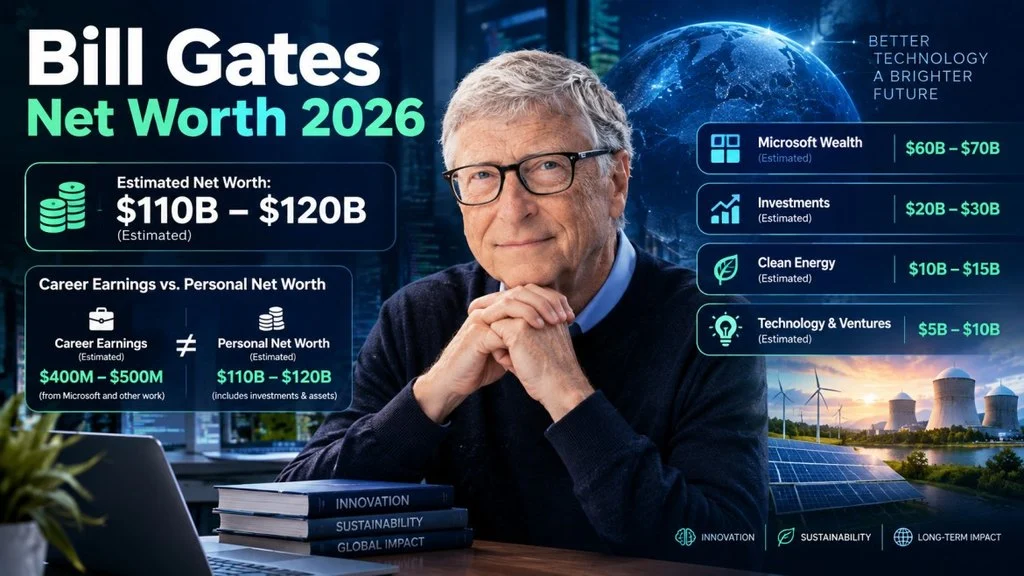
Bill Gates’ estimated net worth in 2026 is approximately $110 billion to $120 billion, with Forbes reporting a real-time figure around $115 billion in September 2026; the estimate is primarily supported by his diversified investments, remaining Microsoft exposure, private business interests, and long-term asset ownership, although his extensive philanthropy makes his personal wealth difficult to calculate precisely.
Bill Gates is one of the most recognizable technology entrepreneurs in modern history, but the story behind his wealth is much more complicated than simply multiplying the value of his original Microsoft stake. As of 2026, bill gates net worth remains a major search topic because Gates continues to rank among the world’s wealthiest people while simultaneously committing enormous resources to philanthropy, climate technology, healthcare, and scientific innovation.
Forbes placed Gates’ real-time fortune at approximately $114.8 billion in September 2026, while another Forbes snapshot showed approximately $115.7 billion later in the same period. Those figures illustrate an important point: billionaire wealth can change daily because public-market investments fluctuate.
Gates originally built his fortune through Microsoft, the software company he co-founded with Paul Allen in 1975. Over the decades, however, his financial structure evolved from concentrated Microsoft ownership into a much broader portfolio of investments, private ventures, real estate, and philanthropic assets. Forbes estimates that Gates’ Microsoft ownership is now below 1%, following years of share donations and diversification.
That is why a credible net worth estimate should not treat Gates’ historical Microsoft earnings as his current personal wealth. Career earnings, business revenue, investment assets, charitable transfers, taxes, and ownership percentages all produce different financial measurements.
Subject Identification
| Category | Details |
|---|---|
| Person Name | Bill Gates |
| Profession | Technology entrepreneur, investor, philanthropist, author |
| Country | United States |
| Industry / Niche | Technology, software, investment, philanthropy, climate and energy innovation |
| Relevance | Co-founder of Microsoft and one of the world’s best-known technology billionaires |
| Living Status | Alive |
| Search Intent | Informational + curiosity-driven |
| Ideal Reader | Technology readers, business and entrepreneurship audiences, investors, wealth-curious readers, philanthropy followers, and people researching billionaire finances |
Bio Data Table
| Bio Detail | Information |
|---|---|
| Full Name | William Henry Gates III |
| Date of Birth | October 28, 1955 |
| Age as of 2026 | 70 |
| Place of Birth | Seattle, Washington, United States |
| Nationality | American |
| Height | Not publicly verified |
| Weight | Not publicly verified |
| Health Conditions | Not publicly verified |
| Religion | Not publicly verified |
| Education | Lakeside School; attended Harvard College but left before completing his degree |
| Sports / Profession / Industry | Technology entrepreneur, investor and philanthropist |
| Zodiac Sign | Scorpio |
| Marriage / Relationship Status | Divorced |
| Children | 3 |
| Net Worth | Estimated $110 billion to $120 billion in 2026 |
| Social Media Accounts | X: @BillGates |
| Still Alive | Yes |
| Famous For | Co-founding Microsoft, philanthropy, technology investment and global health initiatives |
The Gates Foundation identifies Gates as chair and board member and confirms that he co-founded Microsoft with Paul Allen in 1975. It also states that Gates grew up in Seattle and has three children. His current public profile is also listed by Forbes as age 70, divorced, with three children and a primary source of wealth in Microsoft.
His X account is publicly listed as @BillGates.
Personal details such as his exact height, weight and religion are not included here because reliable current public verification is limited.
Who Is Bill Gates? Background & Early Life
Bill Gates was born William Henry Gates III in Seattle, Washington, in 1955. He grew up in a family with strong professional and civic connections. His father, William H. Gates Sr., was an attorney and civic leader, while his mother, Mary Gates, was a teacher, University of Washington regent and civic leader. The Gates Foundation notes that Bill grew up with two sisters.
His interest in computing developed early. Gates attended Lakeside School, where he gained access to computer equipment and developed programming skills. His interest eventually connected him with Paul Allen, who became his closest business collaborator.
In 1975, Gates and Allen created Microsoft after recognizing the potential of the emerging personal-computer industry. Microsoft initially focused on software for early microcomputers, including the Altair 8800. Microsoft’s own historical records identify 1975 as the year Gates and Allen started the company after being inspired by the Altair.
Gates later left Harvard College to concentrate on Microsoft. The decision became one of the most consequential choices in technology-business history.
Microsoft’s growth accelerated as personal computers became mainstream. MS-DOS became closely associated with IBM’s personal computers, while Windows eventually became Microsoft’s defining consumer software platform. Microsoft also developed Office into a major productivity-software business.
Gates’ wealth therefore did not emerge from a single salary. It was largely created through ownership in a rapidly growing technology company.
Bill Gates Net Worth Overview 2026 Estimate
The most defensible 2026 estimate places Bill Gates’ personal net worth in the $110 billion to $120 billion range.
Forbes reported approximately $114.8 billion in September 2026 and another Forbes snapshot placed him around $115.7 billion.
This range is preferable to presenting one fixed number because billionaire wealth changes with stock prices, private-company valuations, investment performance, charitable transfers and other financial movements.
Gates’ current wealth also looks very different from his wealth structure during Microsoft’s fastest-growth period. Forbes estimates that his Microsoft stake is now below 1%, following substantial donations of Microsoft shares to the trust associated with the Gates Foundation.
His wealth is therefore better understood as a diversified financial ecosystem rather than a giant pile of Microsoft shares.
Important components include:
- Remaining public-market holdings
- Investment assets managed through his broader investment structure
- Private-company and venture investments
- Climate and energy ventures
- Technology and healthcare investments
- Real estate and other assets
- Business interests connected to Gates’ private office and investment activities
It is also essential to distinguish net worth from career earnings.
Career earnings represent money earned over time. Business revenue represents the income generated by a company. Salary represents compensation for work. Ownership income can include dividends or realized investment gains. Net worth, by contrast, is the approximate value of assets minus liabilities at a particular point in time.
Gates’ enormous historical wealth creation also has to be viewed alongside his philanthropic giving. Forbes says Gates has donated more than $59 billion to the Gates Foundation.
The Gates Foundation says Bill Gates has pledged to give virtually all of his remaining wealth through the foundation over the next two decades, with the organization scheduled to close at the end of 2045.
This means his current net worth should not automatically be interpreted as wealth he intends to preserve indefinitely.
Net Worth Growth Timeline
Before Fame
Before Microsoft became a global technology company, Gates’ personal financial position was relatively modest compared with what followed.
His early economic opportunity came from software rather than traditional corporate employment. The Microsoft story began with the recognition that personal computers would need useful software.
Microsoft’s first documented 1975 year-end sales totaled $16,005, according to Microsoft’s historical material.
At this stage, income was business-based and entrepreneurial rather than investment-driven.
Breakthrough Phase
The company’s breakthrough came as personal computers became increasingly important to consumers and businesses.
MS-DOS became a major part of the IBM PC ecosystem, while Windows and Microsoft Office later strengthened Microsoft’s position in personal and business computing.
As Microsoft grew, Gates’ ownership stake became significantly more valuable. This is the critical financial distinction: his fortune grew primarily because he owned part of an enormously successful company.
His wealth therefore appreciated through equity ownership, not simply through salary.
Peak / Recent Years
Gates became one of the world’s wealthiest individuals during Microsoft’s extraordinary expansion. Forbes has documented that he reached several historic wealth milestones during the late 1990s, including briefly crossing the $100 billion threshold before the technology bubble collapsed.
In more recent years, his wealth strategy shifted toward diversification and philanthropy.
Forbes estimates his Microsoft ownership at below 1%, while his broader financial interests include investments and private ventures.
The result is a modern fortune that is less directly tied to Microsoft’s stock than it was decades ago.
Main Sources of Income
Technology Ownership and Microsoft Wealth
Microsoft remains the foundation of Gates’ financial legacy.
He co-founded the company in 1975 with Paul Allen, and Microsoft’s growth transformed Gates from a young software entrepreneur into one of the world’s richest individuals.
However, it would be inaccurate to say that Gates currently earns most of his wealth from a Microsoft salary. He left his full-time Microsoft leadership role years ago and has significantly reduced his direct ownership.
The company’s historical equity value is the primary engine behind the fortune he accumulated.
Investment Portfolio
Investment diversification is now a major part of Gates’ wealth strategy.
Cascade Investment is a private investment entity associated with Gates and his assets. SEC filings show Cascade as a private investment entity seeking appreciation of assets for the benefit of its sole member.
Because many private investments do not have daily public-market prices, determining their exact value can be more complicated than valuing a publicly traded stock.
This is one reason billionaire net worth estimates differ between financial publications.
Climate and Clean Energy Ventures
Gates has increasingly connected his wealth and business interests with climate technology.
He founded Breakthrough Energy, an organization focused on accelerating technologies designed to address climate change. Its portfolio and strategy include areas such as electricity, manufacturing, agriculture, transportation and buildings.
Gates also founded TerraPower, an advanced nuclear-energy company. TerraPower identifies Gates as its founder and chairman and says the company is developing advanced nuclear technologies intended to provide abundant carbon-free energy.
In 2025, TerraPower announced a $650 million fundraising round involving new and existing investors, including Gates.
These investments may create substantial long-term value, but private-company ownership should not be treated as guaranteed income.
Gates Ventures and Strategic Investments
The Gates Foundation identifies Gates Ventures as his private office, through which he pursues interests in climate change, clean energy innovation, Alzheimer’s research, healthcare, education and technology.
This gives Gates exposure to multiple sectors beyond traditional software.
Business Strategy Behind the Wealth
The financial strategy behind Gates’ fortune can be understood through several principles.
Ownership Over Salary
Gates’ greatest wealth-building advantage was ownership.
Instead of simply being compensated as an employee, he held a major stake in a rapidly expanding technology company. When Microsoft’s market value grew, the value of his ownership increased.
This is a classic example of how equity can create substantially more wealth than a conventional executive salary.
Diversification
Gates did not keep his wealth concentrated indefinitely in Microsoft.
Over time, his financial interests expanded into investments, real estate, climate technology, healthcare, energy and other areas. This diversification reduced dependence on one company.
Long-Term Positioning
Another defining characteristic is long-term thinking.
Microsoft addressed personal computing. Later, Gates focused on global health. More recently, his private investment interests have included clean energy, nuclear technology, healthcare and scientific innovation.
This creates a portfolio based on sectors where Gates believes technological innovation can have large-scale impact.
Brand Leverage
Gates’ reputation also has economic value.
His decades of experience in technology provide credibility when he participates in scientific, energy and investment projects. That reputation can make it easier to attract partners, investors, researchers and entrepreneurs.
However, brand value is not itself a cash balance and should not be added directly to net worth.
Awards & Achievements and Financial Impact
Bill Gates’ most important achievement is arguably the creation and expansion of Microsoft.
Microsoft’s development of software for personal computers helped shape the modern technology industry. Its historical records identify Gates and Allen as the company’s founders in 1975.
His business success produced enormous equity value and established him as a globally recognized technology leader.
Another major achievement is the creation and development of the Gates Foundation.
The foundation says its work has focused on reducing poverty and disease, improving global health, and creating greater economic opportunity. In 2025 alone, it reported more than $8.4 billion in charitable support.
Gates also helped create the Giving Pledge with Warren Buffett and Melinda French Gates in 2010. The initiative encourages wealthy individuals and families to commit the majority of their wealth to philanthropy.
These achievements do not directly translate into salary, but they contribute substantially to Gates’ global influence and business leverage.
Assets & Lifestyle
Real Estate
Gates has long been associated with substantial real estate holdings, and Forbes lists Medina, Washington, as his residence.
However, the precise current market value and ownership structure of every property should not be treated as publicly verified.
For that reason, this article does not assign a specific total real estate value to his fortune.
Cars & Luxury
Gates’ exact current vehicle collection is not sufficiently documented through authoritative public records to provide a reliable valuation.
Rather than repeating celebrity-lifestyle claims, it is more accurate to state that specific luxury-car holdings and their current values are not publicly verified.
Investments and Business Assets
Investments are arguably more important to understanding Gates’ modern wealth than luxury possessions.
His interests include public investments, private investments, climate technology, advanced nuclear energy and healthcare-related initiatives. TerraPower and Breakthrough Energy are particularly relevant to his current business and innovation strategy.
Net Worth Comparison with Peers / Industry
Bill Gates remains one of the world’s richest technology entrepreneurs, although his fortune is no longer at the very top of the billionaire rankings.
Forbes’ real-time billionaire data in 2026 placed technology figures such as Michael Dell, Mark Zuckerberg, Larry Ellison and others above Gates, while Gates remained around the top 20 globally.
This comparison is important because Gates’ financial strategy differs from that of several younger technology billionaires.
Some technology founders continue to hold large stakes in the companies they founded. Gates, by contrast, has progressively reduced his Microsoft ownership and committed enormous resources to philanthropy.
For example, Forbes estimates that Gates’ Microsoft stake is now below 1%.
Consequently, his current net worth reflects diversification and investment management rather than concentrated ownership of Microsoft alone.
Peer net worth figures should also be treated as estimates because public-company stock prices can change dramatically from day to day.
Controversies, Challenges & Financial Risks
Gates’ financial story has not been free of challenges.
One of the biggest long-term risks is investment-market volatility. A large investment portfolio can rise or fall substantially depending on stock prices, interest rates, economic conditions, private-company valuations and sector performance.
Private investments create another challenge because their values are not always observable in real time.
His climate and nuclear investments also involve technological and regulatory risks. TerraPower, for example, is developing advanced nuclear technology that requires major engineering, regulatory and construction milestones before large-scale commercial deployment. TerraPower has stated that its first Natrium project is progressing toward commercial operation.
Philanthropy creates a different type of financial consideration.
Gates has committed to giving virtually all of his remaining wealth through the Gates Foundation over the next two decades. The foundation plans to close at the end of 2045.
Therefore, his future personal net worth may decline substantially even if his investments continue to perform well.
The 2021 end of Gates’ marriage to Melinda French Gates also represented an important personal and financial transition. The Gates Foundation publicly confirmed the change in its governance context at the time.
Philanthropy & Social Impact
Philanthropy is central to understanding Bill Gates’ wealth.
The Gates Foundation was established in 2000 by Bill and Melinda Gates and has grown into one of the world’s most significant philanthropic organizations. The foundation says its mission is to help create a world in which everyone has the opportunity to live a healthy and productive life.
The foundation reports that it provided more than $8.4 billion in charitable support during 2025.
Its work includes global health, infectious diseases, maternal and child health, poverty reduction, education and economic mobility.
The scale of Gates’ giving is directly relevant to his net worth because money donated to charitable organizations is no longer part of his personal balance sheet.
In 2025, Gates announced an even more aggressive philanthropic timeline. He said he intended to give virtually all of his remaining wealth through the Gates Foundation over the following two decades, with the foundation scheduled to close in 2045.
The foundation says that during its first 25 years it distributed more than $100 billion and expects to distribute roughly twice that amount during the following 20 years.
How Bill Gates Makes Money Outside Core Profession
Bill Gates no longer fits neatly into the traditional category of a software executive.
His current financial interests extend beyond Microsoft’s original business model.
Private Investments
Investment management is a major part of Gates’ financial structure. Cascade Investment is associated with Gates and is used to manage a broad collection of investments. SEC records provide evidence of Cascade’s ownership interests in publicly traded companies.
Climate Technology
Through Breakthrough Energy, Gates supports companies and technologies designed to reduce emissions and expand clean-energy innovation.
Nuclear Energy
TerraPower provides another long-term investment area. Gates founded the company and serves as chairman, with the company working on advanced nuclear reactor technology.
Healthcare and Scientific Innovation
Through Gates Ventures and his broader philanthropic and investment activities, Gates supports work involving healthcare, Alzheimer’s research, climate science, education and technology.
The financial value of these activities should not be confused with direct annual income. Some are philanthropic, while others are long-term investments whose eventual returns remain uncertain.
Future Net Worth Projection
Predicting Bill Gates’ future net worth is unusually difficult because his financial strategy is strongly connected to philanthropy.
In a conventional billionaire projection, continued investment growth could potentially push a fortune higher over time. Gates’ situation is different because he has publicly committed to giving virtually all of his remaining wealth to the Gates Foundation over the next two decades.
That means investment performance alone will not determine his future wealth.
A reasonable short-term scenario is that his net worth could continue fluctuating around the broad $100 billion-plus range, depending on markets and private investment valuations. However, large philanthropic transfers could gradually reduce the personal fortune even if investment returns remain positive.
Beyond 2030, the direction becomes even less predictable.
If Gates follows through on his stated philanthropic timeline, his personal net worth should eventually fall considerably as assets are transferred for charitable purposes.
Therefore, a future projection should not assume perpetual billionaire wealth accumulation.
The most realistic outlook is:
- Near term: substantial fluctuations driven by investments and markets.
- Medium term: potential decline as philanthropic transfers accelerate.
- Long term: significantly lower personal net worth if the 2045 giving commitment proceeds as announced.
- Business impact: private investments in energy, technology and healthcare may continue creating value, but their financial outcomes are uncertain.
Frequently Asked Questions
What is Bill Gates’ net worth in 2026?
Bill Gates’ estimated 2026 net worth is approximately $110 billion to $120 billion. Forbes reported figures around $115 billion during September 2026, although the exact number changes with market movements and valuation updates.
How did Bill Gates become so wealthy?
Gates built most of his original fortune through Microsoft, which he co-founded with Paul Allen in 1975. His ownership in the rapidly expanding software company created substantial equity wealth.
Does Bill Gates still own Microsoft?
Yes, but Forbes estimates that Gates’ Microsoft stake is now below 1%. He has donated substantial Microsoft shares and diversified his wealth over the years.
Does Bill Gates receive a salary from the Gates Foundation?
No. The Gates Foundation states that Gates does not receive a salary or personally profit from the foundation’s charitable activities.
Will Bill Gates remain a billionaire?
His future status cannot be confirmed. Gates has announced that he intends to give virtually all of his remaining wealth through the Gates Foundation over the next two decades, meaning his personal fortune is expected to change significantly over time.
Is Bill Gates’ net worth officially confirmed?
No single official source confirms a definitive personal net worth figure. Financial publications such as Forbes produce estimates using publicly available market information, ownership data and other financial analysis. The figures can vary between sources and from day to day.
Conclusion
Bill Gates’ estimated 2026 net worth of approximately $110 billion to $120 billion reflects one of the most remarkable wealth-building stories in modern technology. His fortune began with Microsoft, where ownership rather than salary was the key driver of wealth creation.
Today, his financial position is considerably more diversified. Investments, private ventures, climate technology, nuclear energy and healthcare-related interests all form part of the broader picture. Forbes estimates that his Microsoft ownership is now below 1%, demonstrating how dramatically his portfolio has changed over time.
At the same time, Gates’ fortune cannot be separated from philanthropy. He has donated tens of billions of dollars to the Gates Foundation and has announced plans to give virtually all of his remaining wealth through the foundation by 2045.
That makes bill gates net worth more than a simple billionaire ranking figure. It represents the current value of a diversified fortune built from technology ownership, investment strategy and decades of business success, while also being a fortune that Gates has publicly committed to redirecting toward philanthropy.
Read More Related Articles:
- Rihanna Net Worth, Career Milestones & Wealth | From Music Star …
- Tyrese Gibson Net Worth | Salary, Acting Career, Music …