
Quick Answer:
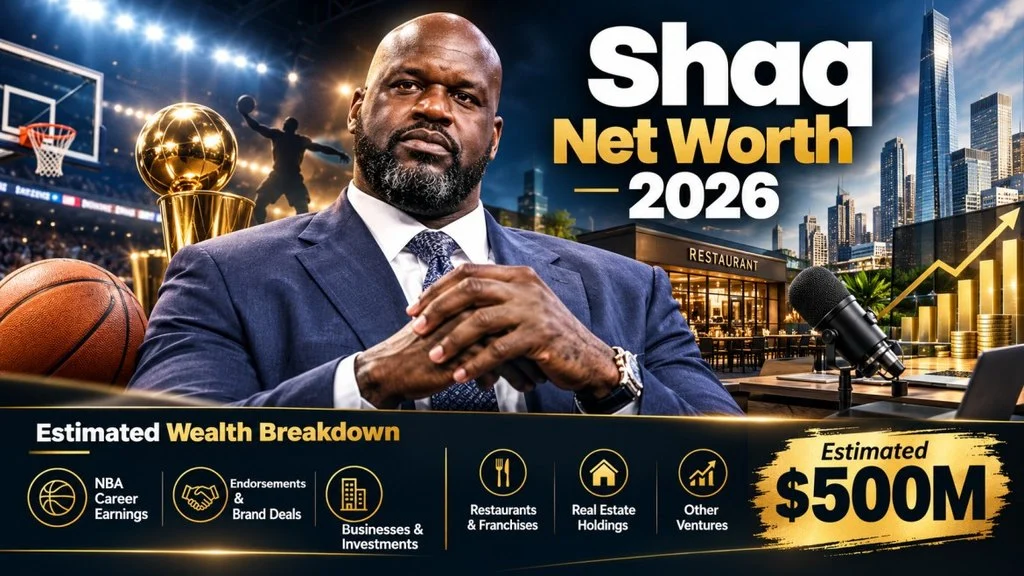
Shaq’s estimated net worth in 2026 is approximately $500 million, supported by nearly $300 million in reported NBA salary, decades of endorsements, brand licensing, franchise ownership, investments, real estate and other business interests, although his exact personal balance sheet is not publicly verified.
Shaquille O’Neal turned being one of basketball’s most dominant centers into something much bigger than an NBA career. The former No. 1 overall draft pick won four championships, earned three Finals MVP awards, became a league MVP, built a global advertising profile and then transformed his fame into restaurants, franchises, investments, licensing partnerships, media work and real estate.
That combination is why Shaq net worth remains one of the most searched financial topics surrounding a retired athlete.
The 2026 estimate is particularly interesting because Shaq’s biggest financial story is no longer his NBA salary. He retired from professional basketball in 2011, but his earning power continued through endorsements, business ownership, media, brand licensing and investments. Forbes has documented major deals involving Papa John’s, Authentic Brands Group and other companies, while Shaq’s current business portfolio includes Big Chicken and an infrastructure investment platform.
Public sources commonly place Shaq’s wealth around $500 million. Fortune also reported a roughly $500 million estimate in May 2026, while other public net-worth sources use similar figures.
That number should still be treated as an estimate. Shaq has not published a complete personal balance sheet showing every investment, liability, property, private-company interest, tax obligation and business expense.
The more important financial lesson is how he converted basketball income into ownership and long-term commercial value.
Bio Data Table
| Field | Details |
|---|---|
| Full Name | Shaquille Rashaun O’Neal |
| Date of Birth | March 6, 1972 |
| Age as of 2026 | 54 |
| Place of Birth | Newark, New Jersey, United States |
| Nationality | American |
| Height | 7 ft 1 in / 2.16 m |
| Weight | 325 lb / 147 kg |
| Health Conditions | Not publicly verified |
| Religion | Not publicly verified |
| Education | Louisiana State University; earned a bachelor’s degree and later additional graduate-level degrees, including a Master of Liberal Arts from LSU in 2026 |
| Sports / Profession / Industry | Former NBA player, basketball analyst, entrepreneur, investor, franchise owner and media personality |
| Zodiac Sign | Pisces |
| Marriage / Relationship Status | Not publicly verified as currently married |
| Children | Six |
| Net Worth | Estimated approximately $500 million |
| Social Media Accounts | Public social-media presence; specific account values are not used in the net-worth calculation |
| Still Alive | Yes |
| Famous For | NBA career, four championships, business ventures, endorsements, media work and entrepreneurship |
The NBA’s official player profile lists O’Neal at 7 feet 1 inch, 325 pounds, born March 6, 1972, drafted first overall by Orlando in 1992 and a 19-year NBA veteran.
The same NBA profile records his four championships, 15 All-Star selections, three Finals MVP awards and regular-season MVP award.
In May 2026, LSU confirmed that O’Neal received a Master of Liberal Arts degree at the university’s commencement ceremony. LSU also notes that he played three seasons there before entering the NBA Draft as the No. 1 pick.
Who Is Shaquille O’Neal? Background & Early Life
Shaquille O’Neal was born in Newark, New Jersey, on March 6, 1972. He grew into one of the most physically imposing athletes in basketball history and developed into an elite center before reaching the NBA.
His professional basketball career began when the Orlando Magic selected him with the first overall pick of the 1992 NBA Draft.
The financial importance of that moment was enormous. O’Neal entered the NBA during an era when elite players could command substantial contracts, and his combination of size, athleticism and personality quickly made him one of the league’s biggest stars.
He spent time with the Orlando Magic, Los Angeles Lakers, Miami Heat, Phoenix Suns, Cleveland Cavaliers and Boston Celtics during his 19-season career. The NBA lists him as a four-time champion, 15-time All-Star, three-time Finals MVP and one-time regular-season MVP.
His most commercially important period came with the Lakers.
Alongside Kobe Bryant, O’Neal helped Los Angeles win three consecutive championships from 2000 through 2002. The Lakers’ official historical profile notes that O’Neal won the 1999-2000 MVP, the scoring title that season and Finals MVP during the championship run.
But basketball was only the beginning of his financial story.
During and after his playing career, O’Neal became a recognizable advertising personality, television figure, restaurant investor, franchise owner and entrepreneur.
His business philosophy became increasingly focused on ownership rather than simply collecting endorsement checks.
That distinction is one of the biggest reasons his post-playing wealth has remained so substantial.
Shaq Net Worth Overview 2026 Estimate
The most widely cited 2026 estimate places Shaq net worth at approximately $500 million.
Fortune reported in May 2026 that O’Neal had an estimated net worth of roughly $500 million. Celebrity Net Worth also lists his fortune at approximately $500 million. These figures are estimates rather than audited statements.
There is strong evidence supporting the general scale of his wealth.
His NBA salary alone was enormous. Public career-earnings databases put his basketball salary at roughly $286 million, while other historical calculations have cited totals closer to $292 million depending on methodology and contract accounting.
That figure does not include his endorsement income.
Forbes reported that O’Neal earned approximately $15 million from promotional deals in 2010 alone, while historical Forbes coverage also documented major income from brands including Pepsi, Reebok, Icy Hot, The General and other companies.
His commercial activity subsequently became even more diversified.
In 2019, O’Neal joined Papa John’s board, invested in nine Atlanta-area restaurants and entered a three-year marketing agreement. Forbes reported the broader arrangement at roughly $8.25 million in cash and stock, with O’Neal investing around $840,000 and holding approximately 30% of those restaurant units.
He has also built restaurant and franchise interests through Big Chicken. The company’s official site identifies O’Neal as a founder and owner, with Authentic Brands Group and JRS Hospitality among its partners.
Another important piece is his relationship with Authentic Brands Group.
Forbes reported that ABG and O’Neal became equal partners in the Shaq brand, with O’Neal receiving a significant equity stake in ABG. Forbes described him as ABG’s second-largest individual shareholder in a later Jacmel Partners profile.
Therefore, the $500 million estimate is not based simply on adding up NBA salaries. It reflects a long period of earnings plus business ownership, brand value, investments and assets.
Net Worth Growth Timeline
Before Fame
Before becoming a professional basketball player, O’Neal’s personal wealth was relatively modest compared with what came later.
His financial transformation began with the 1992 NBA Draft.
Being selected first overall gave him access to professional salary income, endorsements and national exposure.
At this stage, his income was primarily salary-based, with endorsement opportunities emerging rapidly as his fame increased.
Breakthrough Phase
The Orlando Magic years established O’Neal as an NBA superstar.
His move to the Los Angeles Lakers took his earning power to another level.
During the late 1990s and early 2000s, his NBA contracts became increasingly valuable, while his championship success expanded his commercial appeal.
Forbes reported that by the 2007-08 period, O’Neal had earned approximately $250 million in NBA salary and that his Dunkman and Shaq sneaker brands had sold more than 70 million pairs since 1996.
This was a major transition point because his income was no longer tied exclusively to basketball contracts.
His public image became a commercial asset.
Peak / Recent Years
The biggest shift happened after his playing career.
O’Neal increasingly pursued businesses in restaurants, consumer products, licensing, real estate and investments.
His 2019 Papa John’s deal illustrated the strategy particularly well. He was not simply paid to appear in commercials. He invested capital in restaurant locations, joined the company’s board and participated in marketing.
Big Chicken took the same concept further.
The company describes itself as a fast-casual restaurant brand founded in 2018 with O’Neal, JRS Hospitality, Authentic Brands Group and other partners.
In 2025, O’Neal also became a founding partner of Jacmel Infrastructure, an investment platform focused on transportation, energy, social and digital infrastructure across the United States.
This means his current wealth strategy is increasingly ownership- and investment-based, rather than salary-dependent.
Main Sources of Income
NBA Salary and Career Earnings
The foundation of Shaq’s fortune was his NBA salary.
Public records and career salary databases put his total NBA compensation at roughly $286 million to $292 million across 19 seasons. The difference between published figures comes from methodology and data sources.
That money represents gross career salary, not current net worth.
Taxes, agents, advisers, living expenses, investments, real estate purchases and other costs reduce the amount that ultimately becomes retained wealth.
Still, nearly $300 million in career basketball salary gave O’Neal an unusually large capital base for his later business activities.
Brand Endorsements and Sponsorships
Endorsements have been a major part of O’Neal’s financial success.
His advertising portfolio has included brands such as Icy Hot, Reebok, The General, Pepsi and Papa John’s. NBA.com has described him as having one of the strongest athlete-pitchman portfolios in sports.
The key difference between Shaq and many athletes is that he has often approached sponsorships as partnerships rather than simple advertising arrangements.
The Papa John’s relationship is a clear example. He combined board membership, restaurant investment and endorsement income.
That structure can potentially provide more long-term value than a one-time advertising campaign.
Franchise and Restaurant Ownership
Restaurants have become one of O’Neal’s most visible business categories.
Big Chicken is his signature restaurant venture. Its official website identifies O’Neal as part of the ownership group and describes the brand as founded in 2018.
The company’s franchise strategy has expanded significantly. Big Chicken says O’Neal is a franchisee of more than 30 quick-service restaurants and has continued expanding the brand through multi-unit agreements.
The company has announced development agreements across multiple states, including a 50-unit Texas agreement.
Restaurant ownership involves real operating costs, including labor, rent, food, insurance, equipment, maintenance and franchise fees. Therefore, restaurant revenue is not equivalent to Shaq’s personal income.
Brand Licensing
One of the most important parts of Shaq’s wealth strategy is licensing.
Forbes reported that Authentic Brands Group manages the Shaquille O’Neal brand and that a lifetime deal involving ABG and Shaq’s brand could generate between $230 million and $270 million for O’Neal.
Forbes later reported that O’Neal became an equal partner with ABG in the Shaq brand and held a significant equity stake in the company.
This matters because licensing allows a celebrity to monetize a brand across products without personally manufacturing every item.
It can generate recurring revenue while allowing commercial partners to handle much of the operational work.
Investments and Ownership Stakes
O’Neal has repeatedly emphasized the importance of owning businesses rather than simply being a paid spokesperson.
His investments have included restaurants, technology, real estate, entertainment, hospitality and other businesses. Forbes has reported his investments in companies and sectors including Google, Apple, Ring, restaurants and sports.
In October 2025, he expanded into infrastructure investment by joining Jacmel Infrastructure as a founding partner.
Jacmel’s current team page describes him as a co-founding partner of the infrastructure platform and the second-largest individual shareholder of Authentic Brands Group.
The exact value of these private holdings is not publicly verified.
Business Strategy Behind the Wealth
Shaq’s business strategy can be summarized in one word: ownership.
During his playing career, he learned that celebrity attention could generate enormous endorsement income. But instead of relying exclusively on advertising checks, he increasingly tried to participate in the businesses behind the brands.
The Papa John’s deal demonstrated this approach.
He became a board member, invested his own money into restaurant locations and became a marketing ambassador.
Big Chicken follows a similar model.
Instead of simply endorsing someone else’s restaurant, Shaq helped build a restaurant brand around his own identity. The company says its concept combines his childhood food influences with a modern fast-casual format.
His ABG relationship takes the strategy further.
Rather than simply licensing his name, O’Neal gained an ownership interest in the company managing and commercializing his brand. Forbes reported that the value of the Shaq business and his ABG stake had grown substantially after the partnership was established.
This is a classic athlete-to-entrepreneur transition:
Fame → endorsements → partnerships → equity → ownership → long-term wealth
His basketball career created the audience. His business decisions allowed him to continue monetizing that audience after retirement.
Awards & Achievements and Financial Impact
Shaq’s basketball achievements created the credibility that powered his commercial career.
His verified basketball résumé includes:
- Four NBA championships
- Three NBA Finals MVP awards
- One NBA regular-season MVP
- 15 NBA All-Star selections
- 14 All-NBA selections
- Three All-Defensive Team selections
- 1992-93 NBA Rookie of the Year
- Two NBA scoring titles
- Naismith Memorial Basketball Hall of Fame induction
These accomplishments are documented by the Shaquille O’Neal Foundation and NBA records.
Their financial value is indirect but significant.
Championships and individual awards strengthened his credibility with consumers. That credibility helped him sell products, negotiate partnerships and maintain a recognizable brand long after his final NBA game.
His four championships were especially important because Shaq himself has explained that winning provided the validation behind his commercial identity. NBA.com has documented his view that his championships were central to the credibility of the Shaq brand.
His Hall of Fame status further protects that brand value.
Assets & Lifestyle
Real Estate
Real estate has been an important part of Shaq’s financial history.
One of his best-known properties was his enormous Florida estate, which he purchased in the 1990s and later sold in 2021.
He has also owned properties in Miami, California, Nevada, Georgia and Texas.
Realtor.com documented his Texas home purchased in 2022, describing a roughly 5,269-square-foot property with five bedrooms and 5.5 bathrooms.
Recent real-estate reporting has identified additional holdings, but the exact number and current market value of every property cannot be confirmed from public information.
Real estate should therefore be treated as an important asset category without assigning a precise combined value to Shaq’s current property portfolio.
Cars & Luxury
Shaq is well known for owning and customizing vehicles capable of accommodating his 7-foot-1 frame.
However, the complete current value of his vehicle collection is not publicly verified.
It would be inappropriate to add internet-reported vehicle values directly to his net worth without reliable ownership records and current valuations.
Fashion, Investments and Business Assets
Shaq’s more important financial assets appear to be business interests rather than luxury goods.
These include his involvement with:
- Big Chicken
- Authentic Brands Group
- Papa John’s-related restaurant interests
- Infrastructure investments
- Franchise businesses
- Media and entertainment
- Consumer products
- Real estate
Big Chicken’s official franchise materials currently identify Shaq as a franchisee of more than 30 quick-service restaurants.
His Jacmel role adds another investment category focused on infrastructure.
The precise market value of his private-company ownership interests remains not publicly verified.
Net Worth Comparison with Peers / Industry
Shaq’s estimated $500 million fortune places him among the wealthiest retired NBA stars, but he is not currently in the same wealth category as the athlete billionaires who have built enormous equity portfolios.
For example, Forbes estimated Michael Jordan’s real-time net worth at approximately $4.3 billion in September 2026. Forbes attributes Jordan’s wealth largely to corporate partnerships, investments and his former ownership stake in the Charlotte Hornets, noting that his lifetime corporate-partner earnings reached approximately $2.4 billion before taxes.
Forbes estimated LeBron James at approximately $1.4 billion in 2026, with more than $1 billion in pretax off-court earnings and more than $500 million in pretax playing salary.
Magic Johnson was also estimated by Forbes at approximately $1.6 billion in 2026. Forbes attributes much of his wealth to investments and ownership in businesses ranging from entertainment and real estate to healthcare and sports.
Shaq’s estimated $500 million is therefore substantial, but his wealth remains below these three former NBA stars according to Forbes’ 2026 estimates.
The comparison also reveals something important about athlete wealth.
The biggest fortunes generally come from equity and ownership, not salary alone.
Shaq has followed that principle successfully, even though his estimated wealth remains below the billionaire tier.
Controversies, Challenges & Financial Risks
Shaq’s financial career has been remarkably diversified, but diversification does not eliminate risk.
Business Operating Risk
Restaurants require significant capital and ongoing operating expenses. Labor costs, food prices, rent, insurance, equipment and franchise economics can affect profitability.
Big Chicken’s rapid expansion can create opportunities for brand growth but also increases operational complexity.
Investment Risk
Private-company investments are difficult to value because they do not trade on public stock exchanges.
An ownership stake may be highly valuable on paper while remaining difficult to sell quickly.
Real Estate Risk
Real estate values can fluctuate depending on interest rates, local markets, property taxes and demand.
Shaq’s history of buying and selling large properties illustrates both the potential and risks of celebrity real estate.
Brand and Reputation Risk
Shaq’s commercial value depends heavily on his public image.
Endorsement relationships can be affected by reputation, consumer sentiment and changes in brand strategy.
However, his decades-long career and broad family-oriented commercial positioning have helped him maintain relationships across multiple industries.
Taxes and Professional Expenses
NBA salary and endorsement income are generally gross figures before taxes and professional expenses.
Agents, attorneys, accountants, business managers, travel, property costs and other expenses reduce actual retained wealth.
This is one reason career earnings should never be treated as equivalent to net worth.
Philanthropy & Social Impact
Shaq’s philanthropic work is a significant part of his post-NBA public identity.
He founded The Shaquille O’Neal Foundation in 2019. The foundation’s mission is to create pathways for underserved youth and provide resources and opportunities that help young people reach their potential.
The foundation works primarily with organizations including Boys & Girls Clubs of America and Communities in Schools.
Its annual programs include Shaq-to-School and Shaq-a-Claus.
The foundation says Shaq-a-Claus has provided tens of thousands of toys, clothing, meals and other resources to underserved youth since 1997. It also reports that a 2019 Shaq-to-School effort benefited nearly 5,000 children and distributed another 250,000 school supplies through Communities in Schools sites, with an estimated economic impact of $10 million.
The foundation also supports capital projects and youth-oriented community initiatives.
This philanthropic activity is financially separate from Shaq’s personal net worth. Donations made through a charitable foundation should not be interpreted as personal expenses unless specific personal contributions are independently documented.
How Shaq Makes Money Outside His Core Profession
Shaq’s core profession was basketball, but his current financial model is overwhelmingly post-basketball.
Endorsements
Brand partnerships remain an important source of income and visibility.
His long-running commercial relationships have included food, consumer products, insurance, health products and retail brands.
Restaurants
Big Chicken is a major entrepreneurial venture, while his history includes ownership or investment in multiple restaurant franchises.
Big Chicken’s official materials currently describe Shaq as a franchisee of more than 30 QSR restaurants.
Brand Licensing
The Shaq brand is commercialized across consumer products, footwear, entertainment and other categories.
His relationship with Authentic Brands Group is especially important because it gives him an ownership position in the company behind the broader brand platform.
Investments
O’Neal has invested in technology, restaurants, real estate, entertainment and infrastructure.
His 2025 move into Jacmel Infrastructure demonstrates that his investment strategy is still evolving.
Media
Shaq has maintained a television career after retirement and has been a longtime analyst on Inside the NBA. The Shaquille O’Neal Foundation also identifies him as an analyst on the program.
Media work provides both direct compensation and continued brand exposure.
Franchise Ownership
Franchising allows Shaq to participate in business operations without necessarily building every location himself.
The model combines his personal brand with established operating systems and local franchise partners.
Future Net Worth Projection
Unlike a retired athlete whose wealth depends mainly on old investments, Shaq remains commercially active.
That makes his future wealth trajectory more interesting.
His potential growth factors include:
- Expansion of Big Chicken
- Additional franchise investments
- Growth in brand licensing
- Authentic Brands Group equity
- Infrastructure investments
- Real estate appreciation
- Media and entertainment work
- New endorsements
- Consumer products
- Private-company investments
Big Chicken continues to pursue franchise expansion, with agreements covering numerous U.S. markets. Its official materials identify active development opportunities across states including Texas, California, Florida, Illinois, Nevada and others.
His new infrastructure role also provides exposure to a different investment category. Jacmel Infrastructure targets transportation, energy, social and digital infrastructure.
However, projections remain uncertain.
Private-company valuations can fall as well as rise. Restaurants face operating risk. Real estate markets fluctuate. Consumer brands can lose relevance. Public appearances and endorsement demand can change.
For those reasons, a precise future net worth number would be speculative.
A reasonable expectation is that Shaq’s wealth could continue increasing if his businesses, equity stakes, investments and licensing portfolio perform well. His strategy increasingly resembles that of an entrepreneur and investor rather than a retired athlete simply living from accumulated NBA earnings.
Frequently Asked Questions
What is Shaq’s net worth in 2026?
Shaq’s net worth is estimated at approximately $500 million in 2026. Fortune and Celebrity Net Worth both report figures around this level, although no complete audited personal balance sheet has been published.
How much did Shaq make in the NBA?
Public career salary records estimate that Shaquille O’Neal earned roughly $286 million to $292 million in NBA salary during his 19-season career. Different databases report slightly different totals based on their methodology.
How does Shaq make money after basketball?
Shaq earns or has earned money through endorsements, media, restaurant franchises, brand licensing, investments, real estate and business ownership. His current ventures include Big Chicken and an infrastructure investment platform with Jacmel.
Does Shaq own Big Chicken?
Shaq is a founder and member of the ownership group behind Big Chicken. The company’s official website identifies Shaquille O’Neal alongside JRS Hospitality and Authentic Brands Group among the partners backing the restaurant brand.
Is Shaq a billionaire?
No. Forbes’ 2026 estimates put Shaq’s wealth around $500 million, substantially below billionaire status. For comparison, Forbes estimates Michael Jordan at $4.3 billion, Magic Johnson at $1.6 billion and LeBron James at $1.4 billion.
Is Shaq’s net worth confirmed?
No. The approximately $500 million figure is an estimate based on publicly available information about his NBA earnings, endorsements, investments, businesses, real estate and brand interests. His exact personal assets and liabilities are not fully public.
Conclusion
Shaquille O’Neal’s financial success is a textbook example of how an elite athlete can turn sports fame into long-term business wealth.
A reasonable Shaq net worth estimate for 2026 is approximately $500 million. His wealth began with a hugely successful NBA career that generated roughly $286 million to $292 million in reported salary, but his post-playing strategy has been even more important to his financial legacy.
Endorsements, brand licensing, restaurant franchises, real estate, media work and investments have allowed Shaq to remain financially active decades after entering the NBA.
His Papa John’s investment demonstrated his preference for combining endorsement work with ownership. His Big Chicken venture turned his personal brand into a scalable restaurant business. His Authentic Brands Group relationship gave him exposure to the economics of brand ownership, while his Jacmel Infrastructure role shows that his investment interests continue to expand.
Shaq’s story also demonstrates why career earnings and net worth are different. Nearly $300 million in NBA salary does not mean he retained $300 million, and business revenue does not equal personal profit. Taxes, expenses, investment gains and losses, debt, ownership percentages and private-company valuations all affect the final figure.
The estimated $500 million fortune should therefore be viewed as a reasonable public estimate rather than a confirmed financial statement.
Read More Related Articles:
- Rihanna Net Worth, Career Milestones & Wealth | From Music Star …
- Tyrese Gibson Net Worth | Salary, Acting Career, Music …