
Quick Answer:
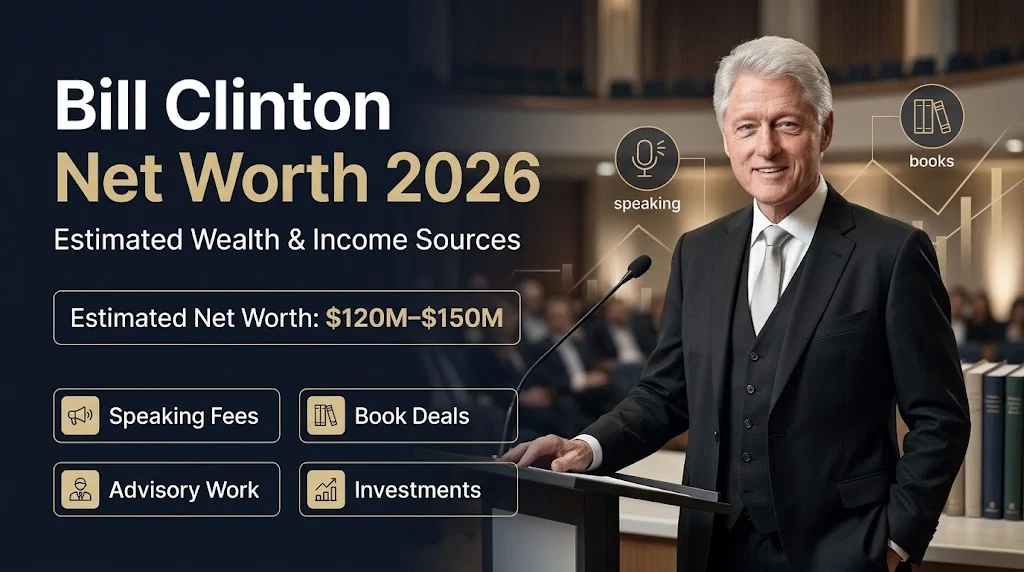
Bill Clinton’s net worth in 2026 is estimated at approximately $120 million to $150 million, based on reported post-presidential speaking fees, book deals, consulting and public appearances, and household financial activity, although his complete personal finances have not been publicly verified.
Bill Clinton’s financial story is different from that of a typical celebrity or business founder. After serving as the 42nd president of the United States from 1993 to 2001, he built a substantial post-presidential career through paid speeches, publishing agreements, public engagements, and work associated with the Clinton Foundation. His wealth is therefore connected not only to his years in politics but also to the commercial opportunities that followed his presidency.
Interest in Bill Clinton net worth remains strong in 2026 because readers want to understand how a former president earns money after leaving the White House. However, reported speaking fees and book advances do not reveal his complete financial position. Taxes, professional expenses, household assets, investments, liabilities, and charitable activities can all affect the final calculation. The estimate in this article is a reasoned range, not an officially confirmed net worth figure.
Bio Data Table
| Field | Details |
|---|---|
| Full Name | William Jefferson Clinton |
| Date of Birth | August 19, 1946 |
| Age as of 2026 | 80 years old |
| Place of Birth | Hope, Arkansas, United States |
| Nationality | American |
| Height | Approximately 6 feet 2 inches; commonly reported |
| Weight | Not publicly verified |
| Health Conditions | Not publicly verified as a complete medical profile |
| Religion | Baptist background; personal beliefs should not be inferred beyond public statements |
| Education | Georgetown University; University College, Oxford, as a Rhodes Scholar; Yale Law School |
| Profession / Industry | Former president, attorney, author, public speaker |
| Zodiac Sign | Leo |
| Marriage / Relationship Status | Married to Hillary Rodham Clinton |
| Children | One daughter, Chelsea Clinton |
| Net Worth | Estimated at $120 million to $150 million in 2026; not officially confirmed |
| Social Media Accounts | Public-facing accounts and updates are associated with his official website and established social platforms |
| Still Alive | Yes |
| Famous For | Serving as the 42nd president of the United States from 1993 to 2001 |
Who Is Bill Clinton? Background & Early Life
Bill Clinton was born William Jefferson Blythe III on August 19, 1946, in Hope, Arkansas. His father died in a car accident before his birth, and his mother later married Roger Clinton. Bill adopted his stepfather’s surname during his youth, eventually becoming known as William Jefferson Clinton.
Clinton showed an early interest in public affairs and developed ambitions that led him toward law and politics. He attended Georgetown University, studied at the University of Oxford as a Rhodes Scholar, and earned a law degree from Yale Law School in 1973. His education provided the foundation for a career in public service and helped him build relationships within political and academic circles.
After returning to Arkansas, Clinton taught law and entered electoral politics. He was elected Arkansas attorney general in 1976 and became governor in 1978. Although he lost his bid for reelection in 1980, he returned to the governorship in 1982 and remained in the role until 1992, apart from the earlier interruption.
Clinton won the 1992 presidential election and took office in January 1993. He was reelected in 1996 and served as the 42nd president of the United States until January 2001. His administration included major domestic policy debates, international diplomatic activity, and a period of economic expansion. His presidency also included significant political controversies, which continued to influence public discussion of his legacy.
Leaving the White House marked a turning point in Clinton’s financial life. A former president can earn income from books, speeches, consulting, media appearances, and other professional activities. Clinton entered this market with a globally recognized name, decades of political experience, and access to audiences that might be difficult for other speakers or authors to reach.
His memoir, My Life, was published in 2004 and became a major publishing project. He also delivered paid speeches to corporate, professional, academic, and international audiences. Over time, his post-presidential career became an important part of his family’s financial story.
Clinton’s work after office has also included humanitarian initiatives and the Clinton Foundation, which supports projects in areas such as public health, economic opportunity, and climate-related issues. The foundation is a nonprofit organization, however, and its donations or operating revenue should not be confused with Clinton’s personal income.
Understanding Bill Clinton’s wealth therefore requires separating three areas: his public-sector career, his post-presidential commercial work, and his charitable or public-service activities. They overlap in public visibility, but they have different financial purposes and accounting rules.
Bill Clinton Net Worth 2026 Estimate
Bill Clinton’s net worth in 2026 is estimated in this article at $120 million to $150 million, but this range should be treated as an approximation rather than a verified personal balance sheet. Public estimates frequently discuss the Clintons’ combined household wealth, making it difficult to isolate Bill Clinton’s individual net worth from assets, income, and obligations shared with his wife, Hillary Rodham Clinton.
One of the strongest indicators of his post-presidential earning capacity is his speaking income. Financial disclosures and established news reporting from earlier years documented substantial payments for speeches after he left office. These historical records demonstrate that paid speaking became a significant source of income, although they cannot establish his present net worth by themselves.
Publishing has also contributed to the Clinton family’s earnings. Bill Clinton’s memoir, My Life, attracted a major advance and strong public interest. His later book, Giving, added another publishing project to his career. Book advances, royalties, and related sales revenue are different forms of income, and the final amount retained depends on contract terms, taxes, expenses, and sales performance.
The estimate also needs to account for assets and liabilities. The Clintons have held investments and other financial assets, and publicly reported information has described significant income from professional engagements. However, current valuations of all investments, properties, debts, and other holdings are not available in one comprehensive public statement.
Why Estimates Differ
Net worth estimates vary for several reasons:
- Some reports estimate Bill Clinton’s personal wealth, while others refer to the combined wealth of Bill and Hillary Clinton.
- Historical disclosures show income over specific periods, not necessarily current assets.
- Speaking fees and book advances are gross earnings before taxes and other costs.
- Public reporting may not include all liabilities, private investments, or changes in asset values.
- Different publishers use different assumptions when converting known earnings into an estimated net worth.
For these reasons, the range should not be interpreted as a confirmed amount. A more precise figure would require comprehensive information about current assets, debts, ownership arrangements, and liabilities.
Career Earnings Are Not the Same as Net Worth
Bill Clinton’s financial history illustrates why income and wealth must be distinguished.
Gross earnings are payments received before expenses and taxes. Career earnings refer to the income generated over a period of professional activity. A speaking fee is compensation for a particular appearance, while book revenue may involve advances and later royalties under a publishing agreement. Neither figure automatically equals personal profit.
Personal net worth is the value of assets minus liabilities. It can include cash, investments, property, and ownership interests, but it must also account for debts, taxes due, costs, and shared ownership. Even a person who has earned tens of millions of dollars may have a substantially different net worth after decades of spending, investment changes, charitable activity, and financial obligations.
In Clinton’s case, publicly documented speaking fees and book deals are useful indicators of earning power. They are not a complete record of how much wealth he retains in 2026.
Net Worth Growth Timeline
Before Fame
Before entering national politics, Clinton worked in education, law, and state government. His early professional income came from conventional employment and public service rather than the large speaking fees and publishing opportunities that later became available to him.
As attorney general and governor of Arkansas, he earned public-sector compensation. Those positions provided a stable professional path, but there is no reason to treat a government salary as comparable to the commercial opportunities available to a former president with global name recognition.
During this period, Clinton’s financial profile was primarily connected to his career in law and politics. His public standing grew over time, but the major post-presidential income streams had not yet developed.
Breakthrough Phase
Clinton’s election as president in 1992 was a major career milestone. He served two terms, gaining international recognition and building a public profile that continued after his presidency ended in 2001.
The presidency itself was a salaried public office, not a private business. The larger financial change came after he left office, when organizations began inviting him to deliver paid speeches and publishers sought his memoirs. His political experience, international contacts, and familiarity with public policy made him an appealing speaker for corporate and professional audiences.
Early post-presidential earnings were significant, but Clinton also faced reported legal expenses connected with matters arising from his years in public life. This is an important reminder that high income does not necessarily translate immediately into high net worth.
Peak and Recent Years
In the years following his presidency, Clinton earned substantial income from speaking engagements. Historical financial disclosures and media investigations reported tens of millions of dollars in speech payments over particular periods. These records provide evidence of his commercial success on the speaking circuit.
Publishing added another revenue source. His memoir and subsequent books created opportunities for advances, royalties, and promotional appearances. The actual income from a book depends on its agreement, sales, and other terms, so a reported advance should not be treated as the same thing as long-term net profit.
Clinton also continued public and philanthropic work through initiatives associated with the Clinton Foundation. Some speaking appearances have been paid, while others have been connected with charitable purposes or have involved no personal fee. These categories should not be combined without checking the nature of each engagement.
By 2026, the most defensible explanation of his wealth is a long period of post-presidential professional activity rather than his presidential salary alone. Speaking and publishing helped create the earning capacity associated with modern estimates, while private investments, expenses, and household financial arrangements determine how much wealth remains.
Main Sources of Income
1. Paid Speaking Engagements
Paid speeches have been one of Bill Clinton’s most prominent post-presidential income sources. Businesses, professional organizations, conferences, and international groups have sought former presidents for their experience, public visibility, and ability to attract an audience.
Historical reports documented large speaking fees during the years after Clinton left office. Some individual appearances reportedly paid hundreds of thousands of dollars, while financial disclosure analyses found that speaking income accumulated to substantial totals over time.
These historical figures demonstrate that speaking can be highly lucrative for a former president. They should not be used to assume that Clinton receives the same fee today or that every appearance is paid. Fees vary with the event, organizer, audience, timing, and terms of the agreement. Some appearances may be unpaid or linked to charitable purposes.
The personal amount retained from a speech is also lower than its gross fee after taxes, professional expenses, and other obligations. Current annual speaking income is not publicly verified in a comprehensive breakdown.
2. Book Deals and Publishing Income
Publishing has been another important source of income. Clinton’s memoir My Life attracted extensive attention when it was published in 2004. The book described his life and presidency, offering readers a personal account of major events and decisions.
A substantial book advance can provide income before all copies have been sold, but the contract may include conditions involving royalties, sales thresholds, and other terms. The publisher’s revenue from a book is not the same as the author’s income, and an advance is not necessarily additional to all royalties. Depending on the agreement, later royalty payments may first be applied against the advance.
Clinton also published Giving, which explored philanthropy and the role individuals and organizations can play in addressing social problems. The financial contribution of each book depends on its contract and sales history. Exact current royalty income is not publicly verified.
3. Consulting and Advisory Work
Clinton’s political experience and international network have also been associated with advisory and consulting opportunities. Public reporting from earlier years described payments connected with business advisory roles and related professional activities.
Such arrangements can vary widely. Compensation might involve a fixed fee, a retainer, or another agreed structure, depending on the work and the organization involved. A public figure’s association with a company does not automatically establish ownership or equity in that business.
Because the full details of Clinton’s current private arrangements are not publicly available, consulting should be treated as a historically reported category rather than a verified source with a known annual value in 2026.
4. Investments and Financial Assets
Investments can contribute to wealth through interest, dividends, capital gains, and changes in asset values. Public financial disclosures from earlier periods described investment holdings and partnership income associated with the Clinton household.
However, historical disclosures cannot establish the present value of every investment. Asset values can change, and the ownership of an investment may be individual, joint, or held through a trust or other structure. The specific composition and current value of Bill Clinton’s complete portfolio are not publicly verified.
Investment income is also different from the underlying value of an asset. A portfolio might increase in market value without generating an equivalent amount of cash income, while dividends or interest may be received even when asset prices fluctuate.
5. Media Appearances and Public Events
Clinton’s reputation as a former president can create opportunities for interviews, conferences, moderated conversations, and special events. Some may involve compensation, while others are connected to public service or charitable activities.
It would be inaccurate to assume that every appearance generates income. Fees and terms are often private, and public visibility alone does not establish a payment. Any estimate of income from media appearances should therefore remain cautious.
Business Strategy Behind the Wealth
Bill Clinton’s post-presidential financial success reflects the commercial value of experience, public recognition, and a professional network built over decades. His career offers an example of how former political leaders may convert their expertise into publishing, speaking, and advisory opportunities after leaving elected office.
Reputation and Professional Positioning
A former president occupies a distinctive position in the public-speaking market. Clinton can discuss government, international relations, economics, leadership, and political history from the perspective of someone who held the country’s highest elected office.
That experience can make an appearance valuable to conference organizers and corporate audiences. His public identity provides a clear professional proposition: an audience is paying to hear a former president’s perspective, not simply a general motivational speaker.
However, reputation is not a guarantee of a particular fee. Demand changes over time, and the terms of each engagement depend on the organizer, subject, audience, and event.
Publishing as a Long-Term Asset
Books can extend a public figure’s influence beyond speeches and media appearances. A memoir can remain available for years, while later editions, translations, or other publishing arrangements may create additional opportunities.
Clinton’s books have also strengthened his position as a public commentator and author. Yet publishing economics are complex. Advances, royalties, printing and distribution costs, agent commissions, taxes, and sales performance all affect the financial result. The public profile of a book does not reveal the author’s net earnings.
Using Experience Across Different Markets
Clinton’s career has included government, public speaking, writing, international engagement, and charitable initiatives. These activities expose him to different audiences and create multiple opportunities for professional work.
The boundaries between these roles matter. A charitable event, a paid speech, a foundation initiative, and a private advisory arrangement may have different financial purposes. Foundation donations and operating funds are not personal wealth, and a nonprofit’s revenue should never be added to an individual’s net worth.
Long-Term Financial Management
Preserving wealth after a high-earning period requires managing taxes, spending, investments, liabilities, and changing income. A former president’s earnings may be irregular rather than salary-based, because fees depend on appearances, book agreements, and other engagements.
Clinton’s exact current financial strategy is not publicly verified. His estimated wealth should therefore be understood through the income categories that have been reported, rather than assumptions about undisclosed investments or private arrangements.
Awards & Achievements and Financial Impact
Bill Clinton’s most significant public achievement is serving as the 42nd president of the United States from 1993 to 2001. His two terms gave him international recognition that continued long after he left office.
Presidency and National Recognition
The presidency established Clinton as a prominent figure in American political history. Former presidents may benefit from strong name recognition when publishers, conference organizers, and media companies seek participants with substantial public experience.
This recognition can support demand for speeches and books, but it does not produce a fixed financial reward after leaving office. Income depends on actual agreements and work undertaken.
Publishing Achievements
Clinton’s memoir My Life became a major publishing project, bringing his personal account of his life and presidency to a broad audience. Its commercial profile illustrates how a former president’s experiences can become the basis for a book deal.
Publishing success may generate advances and royalties, but sales figures alone do not establish an author’s personal profit. Contract terms, publishing expenses, and tax obligations remain important.
Public Service and Philanthropic Work
Clinton’s post-presidential initiatives have included the Clinton Foundation and related public-health, economic-development, and humanitarian efforts. This work has contributed to his continued international profile.
Charitable recognition may strengthen a public figure’s reputation, but donations to a nonprofit are not personal income. Likewise, a foundation’s fundraising totals should not be counted as the founder’s wealth. The financial value of Clinton’s public achievements is therefore best considered indirectly, through professional opportunities and public recognition, rather than as a direct monetary award.
Assets & Lifestyle
A reliable net worth estimate requires information about assets and liabilities, not just income. In Bill Clinton’s case, public reporting offers some historical details about household finances, but it does not provide a complete current inventory of every asset and debt.
Real Estate
The Clinton family has been associated with residential property, including a home in Chappaqua, New York. Publicly reported property information can help explain the household’s assets, but the current market value of a home is not equivalent to the owner’s equity.
Equity depends on the property’s value minus any outstanding mortgage or other liabilities. Ownership arrangements, renovations, property taxes, maintenance, and transaction costs can also affect the financial picture. The complete current value of Bill Clinton’s real estate interests is not publicly verified.
Cars and Luxury
As a former president, Clinton has access to public attention and security arrangements that are different from those of a typical private citizen. However, specific claims about his personal vehicle collection, luxury purchases, or total lifestyle spending should not be treated as established facts without reliable confirmation.
Security, travel, staff, and professional expenses can be relevant to the finances of a high-profile public figure. Their exact personal costs to Clinton are not publicly verified, and public or foundation-related spending should not automatically be treated as his private expense.
Investments and Business Assets
Historical financial reporting has discussed investments and partnership income associated with the Clinton household. Such information provides evidence that financial assets beyond speaking and publishing have been part of the broader wealth picture.
However, investments change in value, and past disclosures do not establish today’s holdings. The complete details of Clinton’s private investment portfolio, ownership interests, and liabilities are not publicly verified. Assigning precise values to undisclosed assets would create a false sense of certainty.
Net Worth Comparison with Peers and the Political Industry
Bill Clinton’s financial profile is best compared with other former U.S. presidents and senior political figures who have earned income through books, speaking engagements, and post-office activities. These comparisons provide context, but they should not be treated as exact rankings because reported estimates may include different assets and household arrangements.
| Public Figure | Relevant Post-Office Income Channels | Financial Context |
|---|---|---|
| Bill Clinton | Paid speeches, books, advisory work, investments | His post-presidential earnings have been closely associated with speaking fees and publishing. |
| Barack Obama | Books, speaking engagements, media and production projects | His post-presidential profile includes major publishing agreements and media work. |
| George W. Bush | Books, speaking engagements, public appearances | His income opportunities include writing and paid appearances after leaving office. |
| Jimmy Carter | Books and public engagements during his lifetime | His legacy also became strongly associated with humanitarian work and public service. |
Each former president has a different financial history, contract structure, family situation, and approach to public engagement. Their reported wealth figures may also combine individual and household assets differently.
Bill Clinton’s case is notable because historical reporting documented substantial speaking fees soon after he left office. Those payments help explain how a former president can generate significant private income after years of public service. They do not, by themselves, establish a precise current net worth.
Controversies, Challenges & Financial Risks
Clinton’s public career has included significant political and legal controversies. These matters are relevant to his public legacy, but their financial implications should be discussed only where there is a clear connection to documented expenses, professional opportunities, or public trust.
Legal Expenses After the Presidency
Reports from the early 2000s described substantial legal bills associated with matters arising from Clinton’s years in public life. These obligations formed part of the financial context when he and Hillary Clinton left the White House.
Legal expenses can reduce personal wealth even when a person later earns substantial income. Payments to lawyers, accountants, and other advisers may represent significant costs, and gross earnings do not show how much money remains after those obligations are settled.
Historical reporting also documented that the Clintons’ income from speeches and books helped them address financial obligations. This history demonstrates why net worth must be considered over time rather than inferred from one year’s earnings.
Political Reputation and Speaking Demand
Paid speeches may create financial opportunities, but they can also attract scrutiny when an event’s sponsor has political, commercial, or international interests. Public figures may face questions about transparency, conflicts of interest, and the relationship between paid appearances and public service.
Such scrutiny can affect reputation and the types of engagements an individual accepts. It does not, on its own, establish wrongdoing or prove that a particular payment was improper. Any assessment should rely on verified records and the circumstances of the specific engagement.
Income Fluctuations and Market Risks
Speaking fees and publishing income are not guaranteed. Demand for a former president’s appearances can change with public interest, political developments, health, travel schedules, and the availability of new projects.
Investments and property values also fluctuate. Taxes, professional expenses, and household obligations can reduce wealth even during periods of strong earnings. Because Clinton’s complete current financial position is not publicly verified, the scale of these risks cannot be calculated precisely.
Philanthropy & Social Impact
Bill Clinton’s post-presidential public work has included the Clinton Foundation, an organization involved in initiatives related to global health, economic opportunity, climate issues, and community development. The foundation has worked with public, private, and nonprofit partners on a range of projects.
It is important to distinguish this work from Clinton’s personal finances. A nonprofit organization may receive donations, grants, and other funding to support its programs, but that money is not automatically income or personal property belonging to its founder. Foundation finances must be evaluated separately from an individual’s net worth.
Clinton has also participated in public-service initiatives and charitable events during his post-presidential career. Some speaking engagements have been connected with fundraising or charitable causes, while others have been commercial appearances. The terms and financial treatment vary by event.
His social impact is therefore part of his public legacy, but it should not be assigned an unsupported dollar value. Where the amount of a personal donation or the terms of an engagement are not documented, those details are not publicly verified.
How Bill Clinton Makes Money Outside His Core Profession
Bill Clinton’s core professional identity is rooted in politics and public service, but much of his post-presidential income has come from activities outside elected office.
Writing and Publishing
Clinton’s books provide a way to share his experiences and perspectives with readers. Publishing income may include an advance, royalties, and payments connected with particular editions or rights. The value of each agreement depends on its terms and sales performance.
His memoir and other writing projects have contributed to his commercial career, although his exact current annual publishing income is not publicly verified.
Public Speaking and Appearances
Speaking remains one of the most clearly documented categories of Clinton’s post-presidential earnings. Organizations may pay for his participation at conferences, corporate events, and other gatherings.
The fee for an individual engagement depends on the event and its terms. Some appearances may be unpaid or linked to charitable purposes, so it would be inaccurate to assume that every public appearance adds to his personal wealth.
Advisory and Professional Relationships
Clinton’s experience in government and international affairs may create opportunities to provide advice or participate in professional initiatives. Historical reporting has described business-related advisory work, but current agreements and compensation are not comprehensively available.
No particular private company ownership stake or current consulting payment should be assumed without reliable evidence.
Investments and Real Estate
Investments and property may contribute to the Clinton household’s wealth outside direct professional income. Returns can come from dividends, interest, capital gains, or changes in property values. However, the current details of Bill Clinton’s personal portfolio are not publicly verified.
These categories may influence his net worth, but the most clearly documented drivers of his post-presidential earning capacity remain speaking and publishing.
Future Net Worth Projection
Bill Clinton’s financial outlook beyond 2026 depends on his existing assets, investment performance, future professional engagements, and household expenses. Since he is a former president with a long-established public profile, his earning opportunities differ from those of someone still building a career.
Continued Speaking and Publishing Opportunities
His experience as president may continue to create demand for appearances, interviews, and commentary. However, speaking schedules and fees can change, and no particular future income level is guaranteed. New publishing projects could also generate income, but no future advance or book deal should be assumed without confirmation.
Investment Performance and Asset Values
Investment returns and property values can influence net worth even when a person is not actively earning large fees. Favorable market conditions may increase asset values, while downturns, expenses, or liabilities may reduce them.
The specific allocation of Clinton’s current assets is not publicly verified, so it is not possible to calculate a reliable investment-based projection.
A Cautious Long-Term Outlook
Clinton’s established reputation, publishing history, and professional network may continue to support income opportunities. Nevertheless, future wealth will depend on private financial decisions, taxes, spending, and market conditions.
The estimated range of $120 million to $150 million presented in this article is not a guarantee of future wealth. It is an approximate assessment based on reported earning history and public estimates, with uncertainty around the distinction between Bill Clinton’s personal finances and the combined household wealth of the Clintons.
Frequently Asked Questions
1. What is Bill Clinton’s net worth in 2026?
Bill Clinton’s net worth is estimated in this article at approximately $120 million to $150 million in 2026. This is an estimate rather than an officially confirmed figure, and some public estimates refer to the combined wealth of Bill and Hillary Clinton.
2. How did Bill Clinton make most of his money after the presidency?
Paid speaking engagements and book deals have been major sources of Bill Clinton’s post-presidential earnings. Historical reporting documented substantial speaking fees, while his memoir and other books created additional publishing income.
3. How much did Bill Clinton earn from speaking fees?
Historical financial disclosures and media investigations reported tens of millions of dollars in speaking payments during particular periods after his presidency. Those figures describe past earnings, not his current annual income or personal net worth.
4. Did Bill Clinton make money from books?
Yes. Clinton’s memoir My Life and his book Giving are among his published works. Book advances and royalties can provide income, but exact current earnings depend on contract terms and sales and are not publicly verified in a complete breakdown.
5. Is Bill Clinton’s net worth separate from Hillary Clinton’s?
Some estimates discuss Bill Clinton’s personal wealth, while others describe the combined household wealth of Bill and Hillary Clinton. Because they have shared financial interests and separate professional earnings, the distinction matters. Their complete current individual and joint balance sheets are not publicly verified.
6. Is Bill Clinton’s net worth officially confirmed?
No publicly available comprehensive financial statement confirms the exact estimate used here. Public reporting on speeches, books, and investments provides useful context, but it does not reveal every asset, liability, tax obligation, or private financial arrangement.
Conclusion
Bill Clinton net worth in 2026 is estimated at $120 million to $150 million, with paid speaking engagements, publishing deals, and reported financial investments forming important parts of the broader picture. His years as president established the public recognition that later helped create commercial opportunities in speaking and writing.
His financial history also demonstrates why career earnings should not be confused with personal wealth. Large speaking fees and book advances represent income before taxes, professional costs, liabilities, and other deductions. In addition, some widely reported figures refer to the combined finances of Bill and Hillary Clinton rather than Bill Clinton alone.
Discover More Post:
- Kodak Black Net Worth, Career Earnings & Wealth Breakdown
- Caitlin Clark Net Worth | The WNBA Star’s Rise From College …
- Sam Altman Net Worth | The Billion-Dollar Investment Empire …