

Quick Answer:
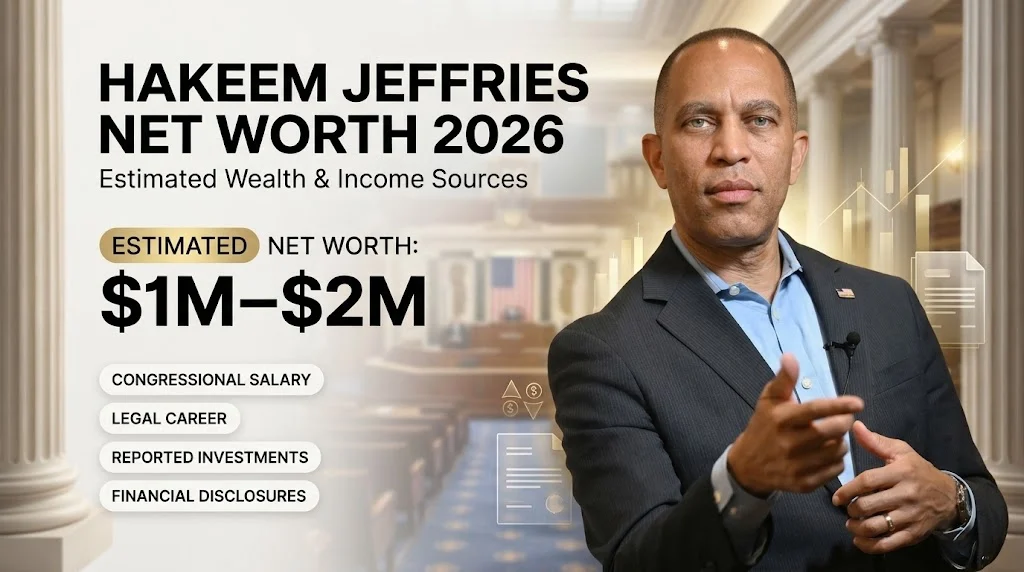
Hakeem Jeffries’s net worth in 2026 is estimated at approximately $1 million to $2 million, based on his congressional salary, previous legal career, and publicly reported financial disclosures, although his exact personal wealth has not been independently verified.
Hakeem Jeffries is a prominent American politician who serves as the House Democratic Leader. His financial profile differs from that of entertainers and business founders because much of his publicly documented income comes from government service, while his earlier legal career also contributes context to his financial background. Understanding his wealth requires looking beyond his salary to the assets, liabilities, and other financial interests disclosed under congressional reporting rules.
Interest in Hakeem Jeffries net worth in 2026 reflects his national political influence and his position in the U.S. House of Representatives. However, a politician’s financial disclosures do not necessarily reveal an exact net worth. Reporting thresholds, valuation ranges, jointly held assets, liabilities, and the timing of disclosures can all affect estimates. Any figure should therefore be treated as an approximation rather than an officially confirmed total.
Bio Data Table
| Field | Details |
|---|---|
| Full Name | Hakeem Sekou Jeffries |
| Date of Birth | August 4, 1970 |
| Age as of 2026 | 56 years old |
| Place of Birth | Brooklyn, New York City, New York, United States |
| Nationality | American |
| Height | Not publicly verified. |
| Weight | Not publicly verified. |
| Health Conditions | Not publicly verified. |
| Religion | Not publicly verified. |
| Education | Binghamton University, Georgetown University Law Center, and New York University School of Law |
| Profession / Industry | Politician, attorney, and public service |
| Zodiac Sign | Leo |
| Marriage / Relationship Status | Married to Kennisandra Arciniegas Jeffries |
| Children | Two sons |
| Net Worth | Estimated at $1 million to $2 million in 2026; not officially confirmed |
| Social Media Accounts | Public accounts and official congressional communications are available through major social platforms |
| Still Alive | Yes |
| Famous For | Serving as House Democratic Leader and representing New York’s 8th congressional district |
Who Is Hakeem Jeffries? Background & Early Life
Hakeem Sekou Jeffries was born on August 4, 1970, in Brooklyn, New York. He grew up in the Crown Heights neighborhood and attended New York City public schools. His background in Brooklyn later became an important part of his political identity, particularly as he represented communities in the borough throughout his career.
Jeffries studied political science at Binghamton University, where he graduated with honors. He then earned a master’s degree in public policy from Georgetown University and a law degree from New York University School of Law, graduating magna cum laude and serving on the law review. This academic path gave him a foundation in government, policy, and legal analysis before he entered elected office.
After law school, Jeffries clerked for federal judge Harold Baer Jr. in the U.S. District Court for the Southern District of New York. He later practiced law at Paul, Weiss, Rifkind, Wharton & Garrison and worked in the litigation department at Viacom and CBS. He also served as of counsel at the New York law firm Godosky & Gentile.
His legal experience matters when examining his financial history. Before becoming a full-time member of Congress, Jeffries had professional experience in private law, where compensation structures can differ significantly from government salaries. However, the exact total he earned across his legal career is not publicly verified in a single comprehensive figure.
Jeffries entered elected office in the New York State Assembly in 2007. He represented a Brooklyn district in Albany before winning election to the U.S. House of Representatives in 2012. He took office in January 2013 and has represented New York’s 8th congressional district since then.
His influence grew as he took on leadership roles within House Democrats. He served as chair of the House Democratic Caucus and became House Democratic Leader after his colleagues selected him in 2023, with his leadership subsequently reaffirmed. He became the first Black lawmaker to lead a major party in either chamber of Congress.
His political prominence makes his financial disclosures a subject of public interest. Unlike the finances of a private business owner, a member of Congress must file disclosures under federal ethics rules. These documents offer useful information about certain income sources, assets, and liabilities, but they do not function as a complete, audited personal balance sheet.
Hakeem Jeffries Net Worth 2026 Estimate
Hakeem Jeffries’s net worth is commonly estimated in the low millions of dollars, with public estimates differing according to the assets and liabilities included. A reasonable editorial range for 2026 is approximately $1 million to $2 million, but it should not be interpreted as an officially established figure.
One reason for the uncertainty is that congressional financial disclosures report many assets and liabilities in broad value ranges instead of exact balances. Some assets may be jointly owned with a spouse, while certain pension interests and other holdings may be reported with undetermined values. Rules also distinguish between personal-use property and assets that must be disclosed.
Jeffries’s financial history includes earnings from his legal career, his time in the New York State Assembly, and his continuing service in Congress. His congressional salary provides a comparatively predictable source of annual income. His earlier private-sector legal work is also relevant, although it does not establish how much wealth he retained after taxes, living costs, debt repayment, and other expenses.
Why Published Estimates Differ
Financial websites may produce different results because they use different methods. One may calculate the midpoint of disclosed asset ranges, another may count only publicly valued liquid assets, and another may incorporate property, pension estimates, or reported career earnings. These approaches can lead to significantly different totals.
A disclosure listing assets worth a certain amount does not mean that the person has the same amount in net wealth. Liabilities must also be considered, and some holdings may be jointly owned. In addition, a politician’s annual salary is an income figure, not an asset that can simply be added to net worth every year.
For these reasons, the $1 million to $2 million range is a cautious estimate rather than a confirmed accounting of Jeffries’s finances. Publicly verified information is limited, and a precise figure cannot be established from headline salary figures alone.
Congressional Salary and Personal Wealth
Members of Congress receive a statutory salary. Leadership positions can involve different compensation rules, but the annual salary still represents income earned for public service rather than accumulated wealth.
Jeffries’s congressional pay is only one part of his financial picture. His household’s overall position also depends on other reported income, investment performance, property-related liabilities, pension interests, and expenses. A salary can support savings and asset growth over time, but it does not show how much someone has retained.
Career Earnings Versus Net Worth
The distinction is particularly important for public officials:
- Gross earnings: Income before taxes and deductions.
- Career earnings: Total income received over a professional lifetime, not necessarily the amount retained.
- Salary: Regular compensation for a role, such as service in Congress.
- Investment income: Income generated by financial assets, where applicable.
- Assets: Items of financial value, such as bank balances, investments, and qualifying property interests.
- Liabilities: Debts and other financial obligations.
- Personal net worth: The estimated value of assets minus liabilities.
Jeffries’s career earnings may be substantial when viewed across legal practice and public service, but they should not be treated as a direct measure of his current wealth. Taxes, household spending, education expenses, loan repayments, and investment changes can all influence the final result.
Net Worth Growth Timeline
Before Fame
Before becoming a public figure, Jeffries focused on education and law. His university studies, postgraduate public policy training, and legal education prepared him for professional work in both the private and public sectors.
During this period, his income would have depended on education-related circumstances and early professional employment rather than congressional compensation. The exact value of his assets and liabilities during his student years is not publicly verified.
Breakthrough Phase
Jeffries’s first major political breakthrough came when he won election to the New York State Assembly in 2006 and began serving in 2007. The position brought a regular public-service salary and established his career in elected office.
His legal career overlapped with his early political life, giving him experience in both private-sector law and government. Reported earnings from legal work during this period help explain why his financial background cannot be attributed solely to his congressional salary.
In 2012, Jeffries won election to the U.S. House of Representatives. His congressional service began in January 2013, replacing the state-level role with a federal public-service position and a new salary structure.
Peak and Recent Years
Jeffries’s rise through House Democratic leadership increased his political influence. His selection as House Democratic Leader in 2023 made him the highest-ranking Democrat in the House and placed him at the center of national legislative strategy.
Leadership does not automatically translate into a dramatic increase in personal wealth. The financial effect is more directly connected to the salary associated with the office, retirement benefits, and the ability to continue saving or investing over time. His net worth may also be affected by household financial decisions that are not fully visible in public disclosures.
Recent financial reports provide a more detailed view of certain assets and liabilities, but their broad valuation ranges make it difficult to calculate an exact year-by-year total. The most responsible interpretation is that Jeffries has built financial resources through a combination of legal work, public service, and reported financial holdings, while the precise rate of wealth growth remains uncertain.
Main Sources of Income
1. Congressional Salary
Jeffries’s primary publicly identifiable current income source is his salary as a member of the U.S. House of Representatives and Democratic leader. Congressional salaries are set by law rather than negotiated as private-sector compensation.
The salary provides a relatively predictable stream of income while he remains in office. Unlike business revenue, it does not depend on selling products or attracting customers. However, the amount of salary earned in a year is not equivalent to savings or net worth because taxes and household expenses must be paid from it.
The exact amount he retains annually after deductions and personal expenses is not publicly verified.
2. Previous Legal Career
Jeffries worked in private practice and corporate legal roles before and during his early political career. His professional history includes work at Paul, Weiss, Rifkind, Wharton & Garrison, Viacom and CBS, and Godosky & Gentile.
Legal work can provide a source of salary, professional fees, or other compensation depending on the role. Public reporting has discussed earnings from Jeffries’s legal work before he entered Congress, including income connected to cases handled at a law firm. Those historical earnings are relevant to his financial background, but they should not be added directly to his present net worth.
Some income may have been spent, taxed, or used to meet other obligations. A complete record of his cumulative legal earnings and how much he retained is not publicly verified.
3. Investment and Savings Income
Jeffries’s financial disclosures include bank accounts and investment-related holdings. Depending on the account, assets may generate interest, dividends, or changes in market value. Those returns can contribute to household finances, although the exact income from every holding may not be disclosed as a single total.
Investment values can fluctuate. A fund may rise or fall with market conditions, and the amount held in an account at one point does not establish the amount earned during the year. Financial disclosures also use value ranges, which limits the precision of outside calculations.
4. Book-Related Income
Jeffries’s 2025 financial disclosure lists a book-related asset connected to ABC’s of Democracy, with reported royalties in a stated range. This is a documented additional income category, though the disclosure does not establish that it will generate the same amount every year.
Book income can vary with sales, publication arrangements, contract terms, and the timing of payments. Royalties reported for one period should not be assumed to continue at an identical rate in future years.
5. Pension and Retirement Interests
Jeffries’s career in government and prior employment may be relevant to retirement benefits. Financial disclosures can include pension interests, but their reported values may not represent a readily accessible cash balance. Pension benefits are often calculated using service history, plan rules, salary formulas, and eligibility requirements.
A pension’s long-term value should not be treated as if it were a bank account available for immediate spending. The exact future benefits and their value in today’s dollars depend on the applicable plan rules and individual circumstances.
6. Other Income and Financial Interests
Federal disclosures require certain types of income, assets, liabilities, gifts, and agreements to be reported. They do not necessarily show every detail of a household’s financial position in one simple total.
Any additional source should be included only when supported by a disclosure or credible public report. Speculative claims about private businesses, undisclosed consulting work, or large endorsement deals should not be used to inflate Jeffries’s estimated net worth.
Business Strategy Behind the Wealth
Hakeem Jeffries’s financial path is based primarily on professional employment and public service, rather than ownership of a large commercial enterprise. His career combines legal training, elected office, and political leadership. Each stage has shaped his earning capacity and professional reputation.
Professional Reputation and Career Positioning
Jeffries built his career on legal expertise and political experience. His education in public policy and law provided credentials for work in the legal sector before he entered elected office. His progression from state legislator to member of Congress and then party leader reflects long-term professional advancement.
In a public-service career, reputation can influence leadership opportunities, committee responsibilities, public visibility, and the ability to shape legislation. Those benefits are not equivalent to private business ownership, but they help explain his position within American politics.
Predictable Income Through Public Service
An elected position provides a statutory salary while the officeholder remains in the role. This differs from entrepreneurial income, which may depend on profits, sales, or investment performance.
Predictable compensation can help a household plan expenses and savings. Yet a congressional salary alone does not establish wealth. The effect on net worth depends on living costs, debt, taxes, savings habits, and investment returns.
Financial Disclosure and Accountability
Jeffries’s financial activities are subject to congressional disclosure requirements. These rules make selected financial information publicly available and help provide transparency around assets, liabilities, and certain income sources.
However, disclosure forms are not designed to provide an exact personal net worth calculation. Reported values often fall within broad ranges, and some interests may be listed with undetermined values. This makes careful interpretation essential.
Long-Term Financial Position
Jeffries’s financial outlook depends on continued public service, any future professional work permitted under applicable rules, investment performance, retirement benefits, and household expenses. His political prominence may affect future professional opportunities after public office, but predicting specific future earnings would be speculative.
His documented career illustrates a path in which professional credentials and steady employment can contribute to financial stability. It does not justify assuming he has unreported business interests or unusually large private income streams.
Awards & Achievements and Financial Impact
Political achievements are not usually measured in the same way as entertainment awards or business milestones. For Jeffries, the most relevant achievements are elected offices, leadership roles, and his influence on congressional policy and party strategy.
Election to the New York State Assembly
Jeffries won election to the New York State Assembly in 2006 and began serving in 2007. The position established his career as an elected official and provided a public-service salary.
The financial effect was direct but limited: elected office became a source of regular income. It also created a path toward later public roles, though political advancement does not automatically produce a substantial increase in personal wealth.
Election to the U.S. House of Representatives
Jeffries was elected to Congress in 2012 and began representing New York’s 8th congressional district in January 2013. Federal service brought a different salary structure and a longer-term career in national politics.
His years in Congress also contribute to retirement and pension considerations under applicable rules. The value of any future benefits depends on eligibility and plan formulas, not simply on the number of years served.
House Democratic Leadership
Jeffries became House Democratic Leader in 2023, becoming the first Black lawmaker to lead a major party in either chamber of Congress. The role increased his national visibility and placed him in a central position in House Democratic strategy.
The achievement is significant politically and historically. Its direct financial impact is less dramatic than the value of a successful business sale or commercial product. Compensation remains governed by public salary rules, while greater visibility should not be treated as proof of private financial gain.
Legal and Academic Credentials
Jeffries’s degrees from Binghamton University, Georgetown University, and New York University School of Law supported his entry into legal practice and politics. His legal work at established organizations provided professional experience before his congressional career.
These credentials can influence career opportunities and earning capacity, but they do not have a separate monetary value that can be added to his net worth.
Assets & Lifestyle
A reliable assessment of Hakeem Jeffries’s wealth must distinguish disclosed financial holdings from assumptions about his private lifestyle. His congressional financial disclosures provide information about certain assets and liabilities, but they do not reveal every detail of household wealth.
Real Estate
Jeffries has been associated with residential property in Brooklyn and Washington, D.C. Public reporting has discussed property and related borrowing as part of his household’s financial position. However, the current market value of each property, any outstanding mortgage balance, ownership shares, and transaction costs must be considered before estimating net equity.
A home’s full market value is not the same as the owner’s wealth in that property. If a residence is financed, the mortgage reduces the owner’s equity. Property taxes, maintenance, insurance, and changes in the housing market can also affect its financial value.
A complete, independently verified calculation of Jeffries’s current real estate equity is not publicly available.
Cars and Luxury
There is no sufficiently verified public inventory establishing the current value of Jeffries’s cars or luxury possessions. His political position and public visibility are not evidence of expensive personal purchases.
It would be inappropriate to assign a value to vehicles, watches, clothing, or other items without credible documentation. Such possessions should not be used to inflate a net worth estimate.
Investments and Financial Assets
Jeffries’s disclosures list financial holdings such as bank accounts, investment funds, insurance policies, and retirement-related interests. These assets may contribute to household financial security, but the disclosure ranges do not provide exact balances for every item.
Investments can gain or lose value, while insurance and pension interests may have different valuation rules from liquid savings. Some assets may belong to his spouse or be jointly owned, so they should not automatically be counted as assets owned solely by Jeffries.
The most accurate conclusion is that his public disclosures reveal a range of financial interests, but not a complete, exact statement of net worth.
Net Worth Comparison with Peers and the Political Industry
Comparing Hakeem Jeffries with other congressional leaders can offer context, but politicians’ estimated wealth is especially difficult to compare. Financial disclosure rules allow broad valuation ranges, and different estimates may treat real estate, retirement benefits, debts, and jointly held assets differently.
| Political Figure | Industry Role | Financial Context |
|---|---|---|
| Hakeem Jeffries | House Democratic Leader | Financial profile includes congressional income, earlier legal work, and disclosed household assets and liabilities. |
| Mike Johnson | Speaker of the House | Financial estimates depend on disclosed holdings, liabilities, and the treatment of property and retirement interests. |
| Chuck Schumer | Senate Democratic Leader | Long-term public service and disclosed financial interests shape estimates of his household wealth. |
| John Thune | Senate Republican Leader | Congressional income and disclosed assets provide context, but do not independently establish exact net worth. |
Public estimates for these figures vary, and the figures should not be treated as audited comparisons. Even when two politicians disclose similar categories of assets, their liabilities, pension arrangements, and property equity may differ substantially.
Jeffries’s estimated wealth is best understood in the context of a long career that combines legal employment with elected office. Unlike a business owner whose wealth may depend on a company’s valuation, his financial position is more directly linked to professional income, disclosed holdings, retirement benefits, and household financial decisions.
Controversies, Challenges & Financial Risks
Political leaders face financial and professional risks that differ from those of entertainers or entrepreneurs. For Jeffries, the most relevant considerations are the limits of public disclosure, the predictability of public-sector compensation, and the way financial obligations can affect household wealth.
Limits of Financial Disclosures
Congressional reports are designed to disclose specified financial interests, not to provide a complete balance sheet. Broad asset ranges make precise calculations difficult, while some property and pension details may require additional information to value accurately.
As a result, a reported estimate may be higher or lower depending on which holdings and liabilities an analyst includes. A difference between estimates does not automatically indicate that one figure is deliberately misleading; it may reflect different assumptions and methods.
Debt and Household Expenses
Loans and other liabilities reduce net worth even when a household has substantial assets. Mortgage obligations, home-equity borrowing, student loans, and other debts may affect a person’s financial position, depending on the outstanding balance and terms.
Jeffries’s financial disclosures have included liabilities, but public records do not necessarily establish every current balance in a single figure. Any estimate that ignores debt risks overstating his wealth.
Salary and Career Risks
Public-service salaries are generally more predictable than business profits, but political careers depend on elections, leadership decisions, and continued eligibility to hold office. If an officeholder leaves Congress, the salary associated with the position ends.
Future employment opportunities can change after public service, but they cannot be treated as guaranteed income. Potential earnings from future legal or other professional work should not be included in a current net worth estimate unless they have already been earned or are otherwise properly reflected in public records.
Investment and Property Risks
Financial assets may lose value as markets change. Property can also decline in value or require expensive repairs and maintenance. Interest rates and borrowing costs may affect the cost of outstanding debt.
These are general financial risks, not evidence of wrongdoing or financial distress. There is no basis for using unsupported allegations to explain Jeffries’s wealth.
Philanthropy & Social Impact
Hakeem Jeffries’s public career has included advocacy on civil rights, criminal justice reform, economic opportunity, and other policy issues. His legislative work has shaped his public profile and his role in national political debates.
Public-service advocacy should be distinguished from personal charitable giving. A politician’s support for a policy or government program does not establish that the politician personally donated money to a charity. Specific donations, amounts, and ongoing private commitments should only be included when they are documented by reliable sources.
Publicly verified philanthropy information is limited. His political influence and legislative activity are more readily documented than a complete record of personal charitable contributions.
How Hakeem Jeffries Makes Money Outside Core Profession
Jeffries’s core profession is public service, with a background in law. Any additional income should be considered only where supported by public disclosures or reliable reporting.
Book-Related Income
His financial disclosure includes a book-related asset associated with ABC’s of Democracy. Reported royalties may provide income outside his congressional salary, although the amount can change with sales and contractual terms.
Book income should not be treated as a guaranteed recurring payment. The amount reported for a particular period does not establish future sales or annual royalties.
Investment Income
Bank accounts and investment holdings may generate interest, dividends, or capital gains. These returns can supplement salary income, but their value depends on the size and composition of the holdings and on market conditions.
The exact amount of Jeffries’s investment income in a given year is not publicly verified as a single total.
Retirement Benefits
Pension and retirement interests may contribute to long-term financial security. However, their value depends on plan rules, service history, eligibility, and other factors. A future pension should not be treated as equivalent to cash currently available for spending.
Other Professional Opportunities
After leaving public office, former members of Congress may pursue private-sector, legal, academic, speaking, or advisory work. Such opportunities vary widely and may be subject to ethics requirements and restrictions.
Jeffries’s future outside income is not guaranteed, and potential opportunities should not be counted as present wealth. There is insufficient verified information to assign a specific value to additional private income streams beyond those documented in his financial disclosures.
Future Net Worth Projection
Hakeem Jeffries’s financial outlook beyond 2026 will depend on his congressional career, household spending, investment performance, retirement benefits, and any future professional activities. Because his finances are not fully disclosed in a single balance sheet, a precise forecast would be speculative.
Continued Public Service
As long as Jeffries remains in Congress, his salary provides a relatively predictable source of income. Continued service may also affect retirement benefits under applicable federal rules. However, the salary earned in future years cannot be treated as wealth already accumulated.
Changes in political leadership or election results could affect his role and compensation. Any increase in pay associated with a future leadership position would depend on the position actually held and the relevant salary rules.
Investments and Financial Assets
Bank accounts, investment funds, and other disclosed financial interests may contribute to future wealth through interest, dividends, or changes in market value. Returns are not guaranteed, and investments can decline as well as increase.
The value of retirement interests may also change with service, plan rules, and eligibility. These factors make long-term financial planning relevant but prevent an exact forecast from being established using public data alone.
Future Professional Opportunities
Jeffries’s legal background and national political experience could create professional opportunities after public office. Former elected officials sometimes pursue legal, academic, advisory, or speaking work, but there is no certainty about which opportunities an individual will choose or how much they might pay.
Potential future income should not be counted as part of his current net worth. It becomes relevant only when supported by an actual engagement, earned income, or another documented financial interest.
Overall Outlook
Jeffries may continue building wealth through salary income, savings, investments, and retirement benefits. However, household expenses, liabilities, market conditions, and changes in professional circumstances could affect the result.
The estimated $1 million to $2 million range is a cautious approximation for 2026, not a guarantee of future financial growth. Any projection beyond that range would require more complete information about his assets, debts, and future income.
Frequently Asked Questions
1. What is Hakeem Jeffries’s net worth in 2026?
Hakeem Jeffries’s net worth is estimated at approximately $1 million to $2 million in 2026. The range reflects his public-service career, previous legal work, and reported financial holdings. His exact net worth has not been independently verified.
2. What is Hakeem Jeffries’s main source of income?
His primary publicly identifiable current income source is his congressional salary. His earlier legal career, disclosed investment-related holdings, and reported book royalties also contribute context to his financial profile.
3. How did Hakeem Jeffries make his money?
Jeffries built his professional career through legal work, service in the New York State Assembly, and election to the U.S. House of Representatives. His current financial position also depends on savings, assets, liabilities, and investment performance.
4. What is Hakeem Jeffries’s congressional salary?
Members of Congress receive salaries set by federal law. Jeffries’s compensation is governed by the applicable salary rules for his position. His salary is income, not a direct measure of his net worth, and the amount he retains depends on taxes, expenses, and financial decisions.
5. Does Hakeem Jeffries have income outside Congress?
Public financial disclosures identify a book-related asset associated with ABC’s of Democracy and certain investment-related holdings. These may generate income outside his congressional salary, but exact totals and future earnings are not publicly verified.
6. Is Hakeem Jeffries’s net worth officially confirmed?
No. His financial disclosures provide information about specified assets, liabilities, and income in prescribed categories, but they do not establish a single, exact net worth figure. Published estimates can differ because analysts use different valuation methods and assumptions.
Conclusion
Hakeem Jeffries net worth in 2026 is estimated at $1 million to $2 million, based on his congressional career, earlier legal work, and publicly reported financial interests. As House Democratic Leader, he holds a prominent role in American politics, but his financial profile is shaped more by professional income and disclosed assets than by the business ownership or commercial ventures often associated with wealthy entrepreneurs.
His legal background and years in public service provide context for how he built his financial position. His salary, reported investments, retirement-related interests, and book income may all contribute to household wealth, while taxes, expenses, and liabilities affect the amount ultimately retained.
The estimate remains uncertain because congressional disclosures use valuation ranges and do not provide a complete, audited personal balance sheet. Net worth figures are estimates based on publicly available data and may vary.
Discover More Post:
- Kodak Black Net Worth, Career Earnings & Wealth Breakdown
- Caitlin Clark Net Worth | The WNBA Star’s Rise From College …
- Sam Altman Net Worth | The Billion-Dollar Investment Empire …