

Quick Answer:
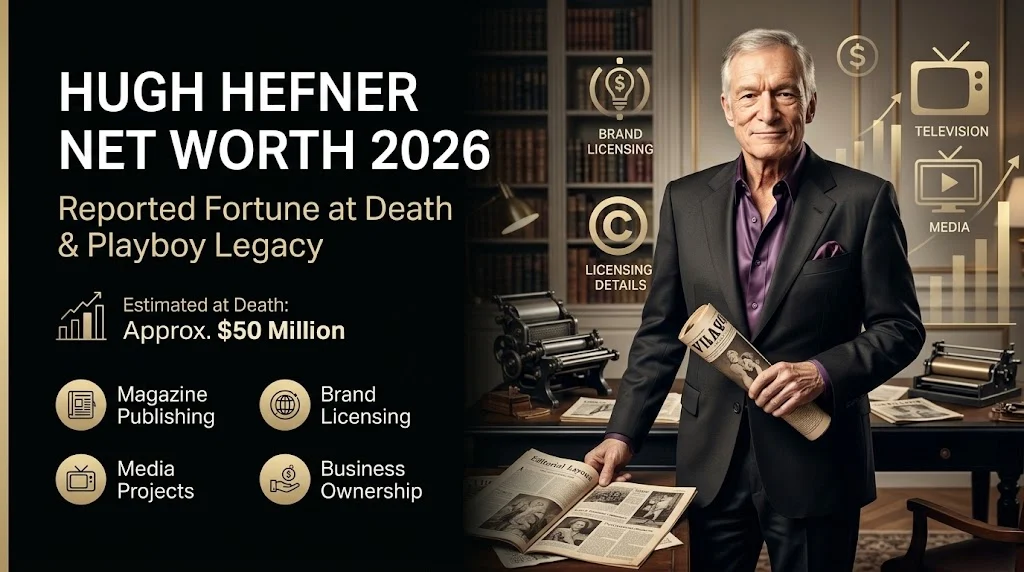
Hugh Hefner’s net worth at the time of his death in 2017 was widely estimated at approximately $50 million, while the value of his estate and the assets distributed after his death require separate consideration; a verified 2026 personal net worth does not exist because he is deceased.
Hugh Hefner was an American magazine publisher, entrepreneur, and media personality who built the Playboy brand into an internationally recognized business. His wealth came from publishing, brand licensing, television and media projects, and ownership interests connected to Playboy Enterprises. His financial story is more complicated than the image of a wealthy magazine founder: the company changed ownership structures, the value of its assets shifted over time, and Hefner’s personal fortune was not the same as the total value of the Playboy business.
Searches for Hugh Hefner net worth in 2026 often focus on how much he was worth, how he built his fortune, and what happened to his wealth after his death. Because he died in 2017, this article examines his reported wealth at that time, the business interests behind it, and the estate-related questions that followed. Public estimates vary, and a complete, independently verified account of his assets and liabilities is not publicly available.
Bio Data Table
| Field | Details |
|---|---|
| Full Name | Hugh Marston Hefner |
| Date of Birth | April 9, 1926 |
| Date of Death | September 27, 2017 |
| Age at Death | 91 years old |
| Age as of 2026 | Not applicable; deceased |
| Place of Birth | Chicago, Illinois, United States |
| Nationality | American |
| Height | Commonly reported at approximately 5 feet 10 inches; not independently verified here |
| Weight | Not publicly verified |
| Health Conditions | Reported health issues in later life; a complete medical history is not publicly verified |
| Religion | Not publicly verified |
| Education | University of Illinois Urbana-Champaign; studied psychology and earned a degree |
| Profession / Industry | Publisher, entrepreneur, and media personality |
| Zodiac Sign | Aries |
| Marriage / Relationship Status | Married three times: Mildred Williams, Kimberley Conrad, and Crystal Harris |
| Children | Four children |
| Net Worth | Widely reported estimate of approximately $50 million at the time of his death; not an audited figure |
| Social Media Accounts | Not applicable as a current personal presence; official brand accounts are separate |
| Still Alive | No |
| Famous For | Founding Playboy magazine and building the Playboy media brand |
Who Was Hugh Hefner? Background & Early Life
Hugh Marston Hefner was born on April 9, 1926, in Chicago, Illinois. He grew up in a family with a relatively conservative background. His parents, Grace and Glenn Hefner, were associated with a strict religious environment, a contrast with the public image and publishing philosophy he later developed.
Hefner served in the United States Army during World War II. After his military service, he attended the University of Illinois Urbana-Champaign, where he studied psychology. He also worked on the university’s student newspaper and developed an interest in writing, illustration, and publishing. These experiences helped establish the skills and professional interests that shaped his later career.
Before launching Playboy, Hefner worked in publishing and advertising. He gained experience at Esquire magazine, where he worked as a copywriter. His time in the publishing industry exposed him to magazine production, editorial presentation, advertising, and the commercial relationship between content and readership.
His public image also became closely connected to the Playboy Mansion, celebrity gatherings, and a distinctive personal lifestyle. Television appearances and reality programming introduced him to audiences who may not have followed the magazine itself. His celebrity status became part of the brand’s visibility, although personal fame and corporate ownership were not the same thing.
Hefner died on September 27, 2017, at the age of 91. His death marked the end of his personal involvement in the business, but the Playboy name and related commercial interests continued under different ownership and management arrangements.
Hugh Hefner Net Worth 2026: Reported Fortune and Estate Estimate
Hugh Hefner’s net worth is commonly reported at approximately $50 million at the time of his death in 2017. This is a historical estimate, not a verified 2026 personal net worth. Since Hefner died in 2017, he did not have personal earnings or a living net worth in 2026. Any discussion of his wealth today must distinguish between the reported value of his fortune at death, the administration of his estate, and the later commercial value of the Playboy brand.
The often-repeated $50 million figure should be treated cautiously. Public reporting has offered different descriptions of Hefner’s financial position, and estimates may include different combinations of property interests, investments, cash, personal assets, and business holdings. Without a complete public balance sheet, it is not possible to establish an exact total.
Why Hugh Hefner’s Wealth Was Complicated
Hefner was the founder and public face of Playboy, but he did not personally own every part of the company throughout his career. Playboy Enterprises went through changes in ownership and corporate structure. The business also operated in different markets, including publishing, licensing, entertainment, and digital media.
A company’s brand value is not the same as its founder’s personal wealth. Even when a founder has an ownership stake, the value of that stake depends on the company’s financial position, debt, market conditions, and the terms of the ownership arrangement.
Hefner’s connection to the Playboy Mansion also requires careful explanation. The property was closely associated with his public image, but it was not simply a personal asset that can automatically be added to his individual net worth. The mansion was owned by Playboy Enterprises and was sold in 2016 to Daren Metropoulos, with an arrangement that allowed Hefner to continue living there for the remainder of his life.
Business Revenue Versus Personal Net Worth
Several financial concepts help explain why public estimates of Hefner’s fortune differ:
- Gross revenue: The total money a company generates before expenses and deductions.
- Business valuation: An estimate of what a company or its ownership interests may be worth.
- Career earnings: Income received over a person’s professional life, before accounting for all personal costs and financial obligations.
- Ownership income: Money received through shares, distributions, licensing rights, or other ownership arrangements.
- Estate value: The value of assets and liabilities considered during estate administration.
- Personal net worth: The estimated value of an individual’s assets minus debts and other liabilities.
Playboy’s historic commercial success does not mean all of its revenue belonged to Hefner. The company had employees, operating costs, investors, business partners, and ownership arrangements. Hefner also had personal expenses, taxes, legal and professional fees, and other financial obligations.
What Can Be Said About His Estate?
Hefner’s estate became a subject of public interest after his death. Reports discussed the distribution of his assets among family members and other beneficiaries. However, a complete public accounting of every asset, liability, trust arrangement, and final distribution is not readily available.
The reported $50 million figure is therefore best understood as an approximate estimate of his wealth at death. It should not be presented as the confirmed value of his estate in 2026, nor should it be confused with the value of the modern Playboy brand.
Net Worth Growth Timeline
Before Fame
Before founding Playboy, Hefner worked in publishing and advertising and was developing the editorial and commercial skills that would later define his business. His early employment provided professional experience, but there is no reliable public record establishing a precise personal net worth for this period.
His financial position changed significantly when he decided to launch a magazine of his own. The project required startup funding, printing, distribution, editorial work, and advertising support. At this stage, the business carried considerable risk because its commercial success was not guaranteed.
The early financial model depended on magazine sales and the ability to attract advertisers. Unlike a salaried career, publishing required capital, planning, and the willingness to accept the possibility of losses.
Breakthrough Phase
The launch of Playboy in 1953 was the central turning point in Hefner’s financial life. The first issue attracted attention, and the magazine developed a growing readership. As circulation and advertising opportunities expanded, the business gained a more stable commercial foundation.
The magazine’s editorial identity helped it stand out in the publishing market. It combined photography with interviews, fiction, lifestyle content, and commentary. This approach gave the publication a broader identity than a single-content magazine and helped it attract readers and advertisers.
As the brand grew, Hefner’s financial interests became more closely tied to the value and profitability of the business. His wealth during this period was influenced by publishing revenue, ownership interests, and the expansion of Playboy into additional commercial activities.
Peak and Later Years
Playboy became a widely recognized international brand. Its commercial reach extended beyond the original magazine into television, licensing, clubs, merchandise, and other forms of entertainment. This expansion created opportunities for revenue that were not limited to magazine subscriptions and newsstand sales.
Hefner’s public profile also increased. His appearances, interviews, and association with the Playboy Mansion made him a recognizable media personality. His personal image became a marketing asset for the brand, although it is difficult to assign a separate financial value to that influence.
The company later experienced changes as the publishing industry evolved. The rise of the internet, changing consumer habits, competition for advertising, and shifts in magazine readership affected the traditional print business. Playboy’s ownership structure also changed, meaning Hefner’s personal financial relationship with the company was not constant throughout his life.
In his later years, Hefner remained associated with the Playboy name and continued to appear in media projects. By the time of his death in 2017, public estimates placed his personal fortune at around $50 million. This figure was far below some popular assumptions about the wealth of the founder of such a recognizable brand, illustrating why company fame and individual net worth should not be treated as interchangeable.
Main Sources of Income
1. Playboy Magazine and Publishing
The original foundation of Hefner’s wealth was Playboy magazine. The publication generated revenue through circulation, subscriptions, newsstand sales, and advertising. As readership grew, the magazine became a significant publishing property and helped establish the commercial identity of Playboy Enterprises.
Advertising was an important part of the magazine business. Advertisers paid to reach a defined readership, while circulation and brand recognition helped support the publication’s appeal. Subscription revenue and individual magazine sales also contributed to the business.
However, publishing revenue was not pure profit. Printing, paper, distribution, editorial salaries, photography, marketing, administration, and other expenses all affected the company’s financial performance. Hefner’s personal income depended on his ownership and compensation arrangements rather than the magazine’s entire revenue.
2. Playboy Enterprises and Ownership Interests
Hefner’s wealth was closely linked to his role as founder and his ownership interests in Playboy Enterprises. The company developed a range of commercial activities around the Playboy name, creating value beyond the magazine itself.
The ownership structure changed over time. Playboy Enterprises went private in 2011 in a transaction involving Rizvi Traverse Management. Public reporting at the time described Hefner as retaining an ownership stake and continuing to exercise significant influence over the brand’s editorial direction. The precise value of his private interests and the financial terms of later arrangements are not fully established through public information.
This distinction matters because owning part of a company is different from receiving all of its revenue. An ownership stake can increase or decrease in value, and the amount a shareholder receives depends on the company’s performance, capital structure, and agreements with other investors.
3. Licensing and Brand Partnerships
The Playboy name became one of the company’s most recognizable commercial assets. Licensing allowed the brand to be used in products, entertainment, and other commercial categories through agreements with outside businesses.
Brand licensing can generate revenue without requiring the original company to manufacture every product or operate every business itself. A licensee may pay fees or royalties for the right to use a brand under specified conditions. The arrangement can expand brand visibility while creating income for the rights holder.
For Hefner, the financial importance of licensing was connected to his relationship with Playboy Enterprises and its ownership structure. The exact amount of licensing income personally received by him is not publicly verified.
4. Television and Media Projects
Playboy expanded into television and other media formats, helping the brand reach audiences beyond magazine readers. The company developed entertainment content, while Hefner also became a recognizable personality through interviews, appearances, and reality programming.
One of the best-known examples was The Girls Next Door, a reality television series that offered viewers a glimpse into life at the Playboy Mansion. The show brought renewed attention to Hefner and the brand during a period when traditional magazine publishing faced significant changes.
Television projects can generate income through production agreements, distribution, advertising, and licensing. However, the exact personal compensation Hefner received from individual programmes is not publicly verified.
5. Playboy Clubs and Related Businesses
Playboy’s business history included clubs and hospitality-related ventures. These businesses helped turn the magazine’s identity into a physical entertainment experience. The clubs became part of the brand’s public image and created additional commercial opportunities.
Their financial contribution varied across periods and locations. Operating hospitality venues involves significant costs, including property, staffing, security, maintenance, marketing, and compliance. The success of a club business cannot be measured only by its public visibility.
Hefner’s personal financial benefit depended on the ownership and management arrangements in place at the time. It would be inaccurate to treat all revenue from every Playboy club as his personal income.
6. Books, Appearances, and Personal Media Profile
Hefner’s career and public image made him a subject of interviews, documentaries, books, and television coverage. His status as the founder of Playboy gave him opportunities to discuss publishing, popular culture, relationships, and the brand’s history.
Media appearances can generate fees, promote related projects, or support a person’s wider public profile. However, not every appearance is paid, and the compensation for individual projects is often private. There is no reliable public breakdown of Hefner’s total income from appearances or personal media work.
Business Strategy Behind the Wealth
Hefner’s most important business decision was turning a magazine into a recognizable lifestyle brand. Instead of treating Playboy as a publication with a limited commercial purpose, he developed an identity that could be extended into entertainment, licensing, clubs, and media.
Building a Distinctive Brand
A clear brand identity helped Playboy stand out in a competitive publishing market. Its visual presentation, editorial mix, and cultural positioning made it recognizable to readers and advertisers. Brand recognition can be commercially valuable because it gives a business an identity that consumers can remember and licensees can use.
Hefner’s public persona became closely connected to that identity. His appearance, interviews, and association with the Playboy Mansion reinforced the company’s image. This connection helped maintain public attention, although it also meant that the brand’s reputation was closely tied to his personal conduct and public statements.
Diversifying Beyond Print
The company expanded into television, clubs, licensing, and other entertainment activities. Diversification gave Playboy additional ways to generate revenue and reach consumers. It also created opportunities to use the brand in different markets.
However, diversification brings operational complexity. Each business requires management, investment, and oversight. A brand may be valuable, but individual ventures can perform differently and may not all produce consistent profits.
Using Licensing to Extend Brand Reach
Licensing allowed Playboy to reach product categories and markets without directly operating every business. This approach can be financially attractive because the brand owner receives payments under agreed terms while licensees handle much of the production or distribution.
The model depends on protecting the brand’s reputation and maintaining consumer interest. If a brand loses relevance or faces reputational problems, licensing demand may weaken. The long-term value of Playboy therefore depended on more than its historical recognition.
Managing Ownership and Control
Hefner’s role changed as Playboy Enterprises went through ownership and corporate transitions. His influence over the brand was not always equivalent to full ownership of the company. This is an important part of understanding his personal wealth: control, public recognition, and financial ownership are separate concepts.
His strategy helped create a major media brand, but later corporate changes affected how much of that business value could be attributed to him personally.
Awards & Achievements and Financial Impact
Hefner’s most significant achievement was founding Playboy and building it into an internationally recognized publishing and entertainment brand. His career also attracted attention from media, cultural institutions, and organizations interested in publishing history and popular culture.
Founding Playboy Magazine
The launch of Playboy in 1953 established Hefner as a major figure in American publishing. The magazine became known for its interviews, fiction, lifestyle features, and photography. Its success helped create the commercial foundation for Playboy Enterprises.
The achievement had a direct business impact because it established a publication that could generate circulation and advertising revenue. It also created a recognizable brand that could later be extended into other areas.
Expanding into International Markets
Playboy developed an international presence through editions, licensing, and related business arrangements. International expansion increased the brand’s potential audience and created opportunities for additional commercial partnerships.
The financial impact depended on the terms of local agreements, operating costs, and market demand. International recognition did not mean that every market produced the same level of profit.
Becoming a Media Personality
Hefner’s public profile became an achievement in its own right. His interviews, appearances, and participation in television projects kept him visible beyond the publishing industry. This exposure helped maintain interest in Playboy and its history.
Media visibility can support commercial value, but it is not the same as a measurable financial award. No precise amount should be attributed to Hefner’s public profile without verified contractual information.
Assets & Lifestyle
Hefner’s lifestyle became a prominent part of his public image, particularly through his association with the Playboy Mansion. However, his personal assets must be separated from property and business assets owned by Playboy Enterprises.
Real Estate: The Playboy Mansion
The Playboy Mansion in Los Angeles became one of the most recognizable properties associated with Hefner. It was frequently featured in media coverage and television programming and became closely linked to the Playboy brand.
The mansion was owned by Playboy Enterprises rather than being a straightforward personal property asset belonging entirely to Hefner. In 2016, the property was sold to Daren Metropoulos for a reported $100 million. The agreement allowed Hefner to continue living there until his death.
This sale is important when assessing his net worth. The reported sale price should not be added to his personal wealth as though he received the full amount. The transaction involved a company-owned property, and its proceeds belonged according to the relevant corporate ownership and transaction arrangements.
Other Real Estate
Hefner was associated with other residential properties during his lifetime, but a complete, independently verified list of his personal real estate holdings and their final values is not publicly available.
Property estimates can also be misleading. Purchase prices do not necessarily reflect later market values, and mortgages, ownership structures, taxes, and transaction expenses affect the equity an individual holds.
Cars and Luxury Lifestyle
Hefner’s public image included luxury surroundings, tailored clothing, parties, and high-profile social events. These elements contributed to his celebrity identity and the image of Playboy.
Specific claims about his complete car collection or the current value of personal luxury possessions should be treated cautiously unless supported by reliable documentation. A famous lifestyle does not establish the value of an individual’s assets.
Investments and Business Assets
Hefner’s most important business-related asset was his connection to Playboy Enterprises and the brand’s commercial activities. His precise investment portfolio, cash holdings, debts, and other financial assets at death are not fully publicly verified.
The value of a business interest can change significantly over time. It depends on ownership percentages, company performance, liabilities, and the terms of any sale or restructuring. This uncertainty is one reason public estimates of Hefner’s fortune vary.
Net Worth Comparison with Peers and the Publishing Industry
Hefner’s financial career is best compared with other major publishing and media entrepreneurs rather than with entertainers whose wealth came primarily from acting or music. The following examples provide context for the different ways media founders built businesses.
| Media Figure | Industry Connection | Wealth-Building Model |
|---|---|---|
| Hugh Hefner | Magazine publishing and entertainment | Built Playboy through publishing, licensing, clubs, and media projects. |
| Rupert Murdoch | Publishing and media ownership | Developed a large media business through newspaper, television, and other corporate holdings. |
| Martha Stewart | Publishing and lifestyle media | Built a commercial brand through books, magazines, television, products, and licensing. |
| Bob Guccione | Magazine publishing | Founded Penthouse and developed related publishing and media ventures. |
These individuals operated at different scales and had different ownership structures. Their reported fortunes should not be treated as directly comparable financial statements. In particular, a founder’s wealth depends on the percentage of a business they own, how much debt it carries, and whether they have sold or transferred shares.
Hefner’s estimated $50 million fortune at death illustrates the difference between building a famous brand and retaining the full value of a large company. Playboy’s public recognition was much greater than the amount that can confidently be assigned to Hefner’s personal wealth.
Controversies, Challenges & Financial Risks
Hefner’s career was surrounded by public debate about the cultural influence of Playboy, its portrayal of women, and the relationship between the magazine’s editorial identity and its business interests. These issues affected the brand’s public reputation and formed part of the wider discussion about its place in American culture.
Public Debate About Playboy’s Content
The magazine attracted both criticism and support throughout its history. Supporters sometimes described it as part of broader discussions about personal freedom, publishing, and sexual expression. Critics raised concerns about its portrayal of women and the commercial treatment of sexuality.
These debates were relevant to the business because a media brand depends on public perception, advertiser relationships, distribution opportunities, and consumer demand. Reputational challenges can affect commercial partnerships and the long-term value of a brand.
Changing Publishing Economics
The traditional magazine business faced significant pressure as audiences moved online. Digital media changed how people consumed content and how advertisers reached consumers. Print publishers had to adapt to lower circulation in some markets, new competitors, and changing revenue models.
Playboy’s historical strength in print did not automatically guarantee success in the digital environment. The company had to reconsider its publishing strategy, brand positioning, and commercial activities as consumer habits changed.
Corporate Ownership and Financial Complexity
Changes in Playboy Enterprises’ ownership and corporate structure made it more difficult to determine the exact value of Hefner’s personal business interests. A founder may retain influence or a public role even after selling a significant portion of a company.
This distinction is central to understanding Hefner’s finances. The value of Playboy as a brand cannot be treated as the value of his personal estate, and the company’s revenue cannot be counted as his individual income.
Personal and Estate-Related Costs
Estate administration can involve taxes, legal fees, professional services, debts, and the costs of transferring assets. The final amount received by beneficiaries may therefore differ from a reported estimate of wealth at death.
The full details of Hefner’s estate administration are not publicly available in a complete financial statement. It would be inappropriate to assign exact values to private distributions or liabilities without supporting records.
Philanthropy & Social Impact
Hefner’s public legacy includes charitable and cultural activity, although a complete financial record of his personal donations is not publicly verified. He was associated with support for organizations and causes involving civil liberties, arts, education, and social issues.
His name was also connected with the Hugh M. Hefner Foundation, which supported causes related to civil rights and civil liberties. The foundation’s activities should be distinguished from personal donations because an organization’s funding, grants, and operations do not automatically represent the founder’s individual charitable spending.
Hefner also had a cultural impact through the publishing industry. Playboy published interviews with prominent figures and contributed to debates about media, sexuality, popular culture, and freedom of expression. Its influence remains contested, and any assessment should recognize both its cultural visibility and the criticism directed at its content and business model.
How Hugh Hefner Made Money Outside His Core Profession
Hefner’s core profession was publishing, but his financial interests extended into related areas of entertainment and brand development. Because he is deceased, these activities should be understood as historical sources of wealth and possible continuing sources of value for the Playboy business or its rights holders, not as current personal income.
Television and Entertainment
Playboy-related television programming expanded the brand’s reach beyond magazine readers. Hefner also appeared in documentaries, interviews, and reality television. These projects helped maintain his public profile and could generate compensation or promotional value under individual agreements.
Brand Licensing
Licensing was one of the most important ways Playboy extended its identity into other commercial categories. The business could earn revenue through agreements allowing third parties to use the brand under defined conditions. Any income from these arrangements after Hefner’s death belongs to the relevant rights holders and business entities, not to him personally.
Books and Media Appearances
Hefner’s career made him a subject of books, documentaries, and interviews. Such projects could provide fees or other commercial opportunities, although the exact amounts associated with his individual appearances are not publicly verified.
Investments and Property
Hefner’s personal investments and property interests may have contributed to his wealth. However, the complete details of those holdings at death are not publicly available. Any later gains or losses associated with estate assets would depend on the estate’s ownership, management, and distribution arrangements.
Estate and Playboy Legacy: What Happened After Hugh Hefner’s Death?
Hugh Hefner’s death in September 2017 shifted attention from his personal fortune to the administration of his estate and the future of the Playboy brand. These are related subjects, but they are not financially identical.
Estate Distribution
Hefner was survived by his four children and his third wife, Crystal Harris. Public reporting discussed arrangements involving his estate and beneficiaries, but the complete final inventory of assets, liabilities, and distributions is not publicly verified.
Reports about inheritances and trust arrangements should be treated carefully. A reported gift, property arrangement, or beneficiary relationship does not provide a complete picture of the estate’s value. Without full estate records, it is not possible to calculate exactly how much each beneficiary received.
Playboy’s Business After Hefner
The Playboy brand continued after Hefner’s death under corporate ownership and management arrangements separate from his personal estate. The company and brand have continued to evolve through licensing, media, and other commercial activities.
Any revenue generated by Playboy after 2017 belongs to the relevant company, rights holders, and business partners under their agreements. It should not be described as Hugh Hefner’s personal posthumous income unless a specific estate-owned right or financial arrangement is documented.
Legacy Value Versus Estate Value
Hefner’s cultural influence and the continuing recognition of Playboy may have lasting commercial significance. However, legacy value is not the same as estate value. A brand can remain commercially active even when its founder’s personal wealth has been distributed or transferred.
The most responsible way to discuss his finances in 2026 is to refer to the widely reported estimate of approximately $50 million at the time of his death, while acknowledging that the complete estate value and later distributions are not publicly verified.
Frequently Asked Questions
1. What was Hugh Hefner’s net worth when he died?
Hugh Hefner’s net worth was widely estimated at approximately $50 million when he died in September 2017. This figure is an estimate rather than an independently verified final accounting of his assets and liabilities.
2. What was Hugh Hefner’s main source of wealth?
His main source of wealth was Playboy. The business began as a magazine and expanded into advertising, licensing, television, clubs, and other entertainment-related activities. Hefner’s personal financial benefit depended on his ownership interests and business arrangements.
3. Did Hugh Hefner own the Playboy Mansion?
The Playboy Mansion was owned by Playboy Enterprises, not simply as Hefner’s personal property. It was sold in 2016 to Daren Metropoulos for a reported $100 million, with Hefner retaining the right to live there for the rest of his life.
4. Who inherited Hugh Hefner’s money?
Hefner was survived by his four children and his wife, Crystal Harris. Public reports discussed his estate arrangements, but a complete verified breakdown of every beneficiary’s inheritance is not publicly available.
5. Did Hugh Hefner continue earning money after his death?
Hefner could not personally earn income after his death. The Playboy brand continued operating through its owners and business partners, and any income from its later commercial activities belongs to the relevant rights holders or entities under their agreements.
6. Is Hugh Hefner’s $50 million net worth confirmed?
No. The approximately $50 million figure is a widely reported estimate of his wealth at death, not a confirmed audited total. The complete value of his assets, debts, private investments, and estate distributions is not publicly verified.
Conclusion
Hugh Hefner’s net worth was widely estimated at approximately $50 million when he died in 2017. His fortune came primarily from founding Playboy and developing it into a recognizable publishing, entertainment, and licensing brand. Magazine sales, advertising, company ownership, television projects, and brand licensing all contributed to his financial success.
His story also demonstrates why a famous company’s value should not be confused with its founder’s personal wealth. Playboy’s commercial reach extended far beyond Hefner’s individual holdings, and changes in corporate ownership affected his financial connection to the business over time.
In 2026, Hugh Hefner has no current personal net worth because he is deceased. The historical estimate of his wealth at death remains useful context, but the exact value of his estate and the full details of its distribution are not publicly verified.
Discover More Post:
- Henry Winkler Net Worth 2026 | Career Earnings, Iconic Roles …
- Cassidy Hutchinson Net Worth, Career & Financial Journey
- Rob Reiner Net Worth | Career, Fortune and the Legacy Behind His …