

Quick Answer:
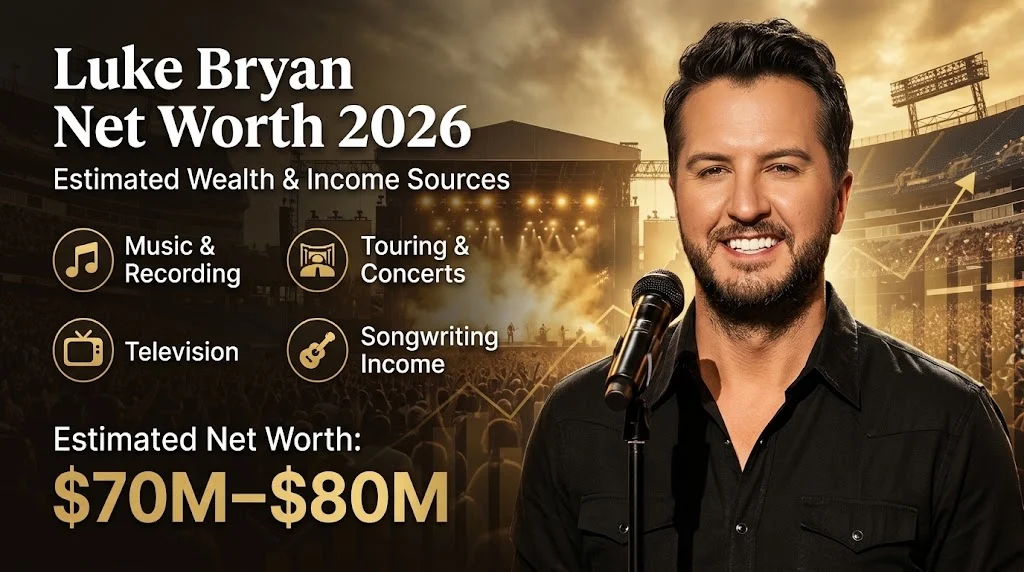
Luke Bryan’s net worth in 2026 is estimated at approximately $70 million to $80 million, based on his country music career, touring income, recording royalties, television work, and business activities, although his exact personal wealth has not been publicly verified.
Luke Bryan has built a long-running career in country music through hit songs, successful albums, sold-out concerts, and a strong connection with mainstream country audiences. His financial profile extends beyond recording music: touring, television appearances, songwriting, and commercial partnerships have all contributed to his public career.
Interest in Luke Bryan net worth continues because he has remained a visible figure in country music while balancing recording projects, live performances, and television work. His career demonstrates how a successful country artist can generate income from several connected areas of entertainment. However, reported earnings and gross concert revenue do not reveal how much an artist personally keeps. Taxes, management fees, touring expenses, record-label arrangements, investments, and other liabilities all affect personal wealth. The estimate in this article is therefore a cautious range, not a confirmed financial statement.
Bio Data Table
| Field | Details |
|---|---|
| Full Name | Thomas Luther Bryan |
| Date of Birth | July 17, 1976 |
| Age as of 2026 | 50 years old |
| Place of Birth | Leesburg, Georgia, United States |
| Nationality | American |
| Height | Approximately 6 feet 0 inches; commonly reported |
| Weight | Not publicly verified |
| Health Conditions | Not publicly verified |
| Religion | Not publicly verified |
| Education | Attended Georgia Southern University |
| Profession / Industry | Country music singer and songwriter; television personality |
| Zodiac Sign | Cancer |
| Marriage / Relationship Status | Married to Caroline Boyer |
| Children | Two sons; he has also helped raise his nephew and nieces following a family tragedy |
| Net Worth | Estimated at $70 million to $80 million in 2026; not officially confirmed |
| Social Media Accounts | Official accounts include Instagram, Facebook, X, and YouTube |
| Still Alive | Yes |
| Famous For | Country hits including “Country Girl (Shake It for Me),” “Play It Again,” “Drunk on You,” and “That’s My Kind of Night”; television work on American Idol |
Who Is Luke Bryan? Background & Early Life
Thomas Luther Bryan, professionally known as Luke Bryan, was born on July 17, 1976, in Leesburg, Georgia. He grew up in a family environment connected to farming and small-town life. His upbringing in the American South later became an important influence on the themes and storytelling in his country music.
Bryan developed an interest in music at a young age and learned to play guitar as a teenager. He listened to country artists and began writing songs while developing his own musical style. His early interests eventually led him toward a professional career in Nashville, Tennessee, one of the central locations of the American country music industry.
A major family tragedy changed the timing of his career plans. Before moving to Nashville, Bryan’s older brother, Chris, died in a car accident. Bryan remained close to his family and delayed his move to pursue music. He later attended Georgia Southern University, where he graduated with a degree in business administration. After completing his education, he moved to Nashville and began working toward a career as a songwriter and recording artist.
His first opportunities in the music business came through songwriting. Writing songs for established country performers helped him build professional connections and understand the commercial side of the industry. This early work provided a foundation for his own recording career.
Bryan signed a recording deal with Capitol Nashville and released his debut album, I’ll Stay Me, in 2007. The album introduced his sound to country radio audiences, while songs such as “All My Friends Say” helped establish him as a rising performer.
Luke Bryan Net Worth 2026 Estimate
Luke Bryan’s net worth in 2026 is estimated at $70 million to $80 million. This is an approximate range based on his long career in country music, commercial recordings, live performances, television work, and related business activity. Bryan has not publicly released a complete personal balance sheet, so the figure should not be treated as officially confirmed.
His career includes several albums that achieved substantial commercial success, hit singles that received extensive radio and streaming exposure, and tours that reached large audiences. These achievements suggest a long period of income generation across recording and live entertainment.
Touring is particularly important to the financial profile of an established country music star. Concerts can generate revenue through ticket sales, VIP packages, merchandise, and related arrangements. However, gross tour revenue is not the same as the artist’s personal earnings. Promoters, venues, production companies, musicians, crew members, transportation providers, insurance, and other operating costs all affect the final amount.
Bryan’s television work also contributes to his earning potential. Serving as a judge on American Idol gave him a prominent role in a nationally recognized entertainment programme. Television compensation can be significant for established personalities, but the specific terms of Bryan’s contracts have not been publicly verified.
His early songwriting work and continued involvement in music may also generate publishing or royalty income, depending on the rights he holds in individual compositions and recordings. The amount he receives from these sources depends on songwriting credits, publishing agreements, recording contracts, and licensing arrangements.
Why His Net Worth Is an Estimate
The $70 million to $80 million range should be understood as an informed estimate, not an audited figure. Public reporting can provide information about career milestones, tours, album performance, television roles, and certain business activities. It does not reveal all of Bryan’s private investments, debts, property interests, contractual obligations, or personal expenses.
Different publications may also use different methods. Some estimates focus on reported career earnings, while others attempt to calculate assets and subtract liabilities. Some may count the gross revenue of a tour or television programme without having access to the artist’s actual compensation. These differences can produce widely varying figures.
A responsible estimate must account for the fact that a successful performer does not retain every dollar generated by a concert, album, or television appearance. Taxes, agents, managers, lawyers, business costs, and reinvestment can reduce the amount that becomes personal wealth.
Career Earnings Versus Personal Net Worth
Several financial terms are important when evaluating Bryan’s fortune:
- Gross earnings: Total revenue generated before expenses and deductions.
- Career earnings: Income associated with his professional work over many years.
- Performance fees: Compensation paid for specific concerts, appearances, or engagements.
- Business revenue: Money generated by a business before operating expenses.
- Royalties and publishing income: Payments connected to the use of recordings or musical compositions, subject to ownership and contract terms.
- Personal net worth: The estimated value of assets after subtracting liabilities.
For example, a tour may generate substantial ticket revenue, but that total must cover the costs of staging the shows and fulfilling contractual obligations. Similarly, a hit song can generate revenue for multiple rights holders, not just the performer. These distinctions explain why public career earnings cannot be treated as a direct measurement of Bryan’s current wealth.
Net Worth Growth Timeline
Before Fame
Before establishing himself as a recording artist, Bryan was building the skills and connections needed to enter the country music industry. His education at Georgia Southern University gave him a business background, while his interest in songwriting helped him develop material for a professional career.
His early financial position was not publicly documented. Like many aspiring musicians, he likely faced the uncertainty that comes with trying to establish a career in a competitive industry. At this stage, income from music would have been limited and inconsistent compared with the opportunities he later gained.
The decision to move to Nashville was a turning point. The city offered access to songwriters, publishers, recording professionals, labels, and performers. For an emerging country artist, building relationships in this environment can be essential to securing songwriting opportunities and a recording contract.
Breakthrough Phase
Bryan’s move into professional songwriting helped him gain experience and industry contacts. He wrote songs that were recorded by established country performers, including “Good Directions,” which was recorded by Billy Currington. Songwriting credits can provide both professional recognition and potential publishing income, depending on the rights and agreements involved.
His own recording career began with I’ll Stay Me in 2007. The album and its singles helped him build an identity as a performer rather than remaining behind the scenes as a songwriter.
The next stage brought greater commercial attention. Albums such as Doin’ My Thing and Tailgates & Tanlines expanded his audience. As radio success and public recognition increased, Bryan gained access to larger concerts, stronger promotional opportunities, and more valuable recording projects.
Income during this phase likely became more substantial, but it would still have varied according to album cycles, touring schedules, and the terms of his music agreements.
Peak and Recent Years
The release of Crash My Party in 2013 marked a major commercial milestone. It included several successful singles and reinforced Bryan’s position as one of the leading names in mainstream country music. Further releases, including Kill the Lights and What Makes You Country, helped sustain his profile.
His touring career also became an important part of his financial development. Large-scale country tours can produce significant gross revenue, although production costs and contractual arrangements determine how much the artist receives.
Joining American Idol in 2018 added another source of professional income and visibility. Television work can offer a different financial structure from music: compensation may be negotiated for a season or contract period rather than generated through album sales or ticket revenue.
In later years, Bryan continued releasing music and performing for audiences. His career has become a combination of recording, live entertainment, television, and related commercial opportunities. This diversified professional activity helps explain why his estimated wealth is higher than that of many artists whose careers depend mainly on occasional releases.
Main Sources of Income
1. Music Sales and Recording Income
Recorded music is one of the foundations of Luke Bryan’s career. His albums and singles have reached country music audiences through physical sales, digital downloads, and streaming platforms. Successful recordings can generate income over extended periods, particularly when songs remain popular on radio, playlists, and streaming services.
Albums such as Tailgates & Tanlines, Crash My Party, and Kill the Lights helped establish his commercial position. Hit singles also supported his visibility and encouraged listeners to explore his wider catalog.
The amount Bryan personally receives from recorded music depends on his recording agreements, distribution arrangements, ownership interests, and the revenue-sharing structure for each release. Streaming services generally distribute revenue among several parties, so total platform revenue cannot be treated as the artist’s personal income.
2. Songwriting and Music Publishing
Bryan began his Nashville career as a songwriter, and songwriting remains an important part of understanding his music-industry background. A songwriter may receive publishing income when a composition is performed, recorded, streamed, broadcast, or licensed, depending on the rights involved.
His songwriting work includes “Good Directions,” recorded by Billy Currington, as well as songs written or co-written for his own releases. Songwriting credits can provide long-term financial value because a successful composition may continue to be used after its original release.
However, not every song performed by an artist is entirely owned by that artist. Co-writers, publishers, labels, and other rights holders may share revenue. Bryan’s exact annual publishing income and the complete ownership structure of his catalog are not publicly verified.
3. Touring and Live Performances
Touring is one of the most important potential income sources for a major country music performer. Bryan has built a reputation as a live entertainer and has performed across the United States and other markets.
Concert revenue can include ticket sales, VIP experiences, merchandise, and negotiated performance compensation. Popular artists may also benefit from festival appearances and major event bookings. The amount earned from each engagement depends on venue capacity, ticket prices, promoter agreements, production costs, and the artist’s contract.
Large tours require considerable spending. Stage construction, lighting, sound equipment, transportation, accommodation, security, musicians, technicians, and crew all contribute to operating costs. A tour’s reported gross revenue therefore does not equal the singer’s personal profit.
Bryan’s sustained concert activity is a significant factor in his estimated net worth, but a complete breakdown of his personal touring income is not publicly available.
4. Television Earnings
Bryan became a judge on American Idol in 2018, joining Katy Perry and Lionel Richie. The position introduced him to a broad television audience and expanded his work beyond the country music market.
Television judging can provide compensation through season-based or contract-based arrangements. It may also increase an artist’s visibility, supporting music sales, concert interest, and other professional opportunities.
The exact amount Bryan has earned from American Idol has not been publicly verified through a complete contract disclosure. Reports about television salaries should therefore be treated carefully, especially when they do not identify whether a figure represents a season’s compensation, total contract value, or an estimate.
5. Brand Partnerships and Sponsorships
A well-known country music artist can attract partnerships with companies seeking access to a loyal audience. Bryan’s public image, music fan base, and television visibility may create opportunities for promotional campaigns and commercial relationships.
However, a brand appearance does not necessarily establish a long-term endorsement contract. Payments, campaign terms, exclusivity arrangements, and the duration of partnerships are often private.
Only confirmed agreements should be counted as established income. The total amount Bryan earns from sponsorships and endorsements is not publicly verified, so this category should be viewed as a possible contributor rather than assigned an invented figure.
6. Merchandise and Music-Related Products
Merchandise can provide an additional source of income for touring musicians. Products such as clothing, accessories, and tour-related items may be sold at concerts or through official online stores.
The financial contribution depends on product demand, manufacturing costs, distribution, licensing, and revenue-sharing agreements. Merchandise sales can strengthen an artist’s business model because they allow fans to purchase products connected to the music and live experience.
Bryan’s exact merchandise revenue and profit margins are not publicly verified. It would be inaccurate to estimate his personal income from merchandise without reliable sales and cost information.
7. Business Interests and Investments
Bryan has been associated with business activity beyond recording and performing, including involvement in the entertainment and hospitality space. However, the full value of any private business interests, investment holdings, and ownership arrangements is not publicly established.
A celebrity’s public association with a business does not automatically mean that the individual owns the entire company or receives all of its revenue. Ownership percentage, operating costs, financing, and other partners determine the actual financial benefit.
For this reason, private investments may influence Bryan’s overall wealth, but they should not be assigned a precise value without verified records.
Business Strategy Behind the Wealth
Luke Bryan’s financial success is connected to a career model that combines music, touring, television, and a recognizable public identity. Rather than relying on a single album or one successful period, he has maintained a presence across several areas of country entertainment.
Building a Mainstream Country Music Identity
Bryan’s music blends contemporary country production with themes that appeal to a broad audience. Songs about relationships, celebrations, summer experiences, and everyday life have helped him reach listeners beyond a narrow country music audience.
A consistent musical identity can support long-term brand recognition. Fans who connect with an artist’s sound may follow new releases, attend concerts, purchase merchandise, and watch television appearances.
Developing a Strong Live Performance Business
Touring allows a successful recording artist to turn audience interest into live entertainment revenue. Bryan’s established catalog gives concert audiences familiar songs, while new releases can keep performances relevant.
A strong live reputation may also help an artist negotiate better opportunities with promoters and event organizers. However, the actual financial benefit depends on attendance, ticket pricing, expenses, and contractual terms.
Expanding into Television
His role on American Idol gave Bryan access to a different audience from the one reached through country radio and touring. Television increased his public visibility and provided a professional activity that did not depend entirely on releasing new music.
This type of career diversification can help an entertainer remain visible between album cycles. It can also strengthen an artist’s commercial profile, although the financial value depends on contract terms and the wider performance of the programme.
Using Industry Relationships
Songwriting, recording, touring, and television all depend on professional partnerships. Artists work with publishers, labels, managers, promoters, producers, networks, and other industry participants.
Bryan’s career has developed through these relationships. His early songwriting experience likely helped him understand the business structure of country music before becoming a widely recognized recording performer.
Maintaining Long-Term Audience Demand
A large catalog of recognizable songs can help an artist maintain demand even when no new album is being promoted. Radio play, streaming, live performances, and media appearances can keep older releases in public awareness.
This long-term visibility is an important part of Bryan’s wealth-building story. It does not guarantee future income, but it provides several ways to remain commercially active.
Awards & Achievements and Financial Impact
Luke Bryan’s career has received recognition from major country music organizations. Awards do not directly establish a person’s net worth, but they can strengthen reputation, increase industry visibility, and support demand for recordings and live performances.
Academy of Country Music Awards
Bryan has received major recognition from the Academy of Country Music, including Entertainer of the Year honors. This category recognizes artists with broad influence and success across the country music industry.
An award of this kind can support an artist’s professional reputation and may strengthen their position when negotiating tours, performances, and commercial opportunities. The financial impact is indirect rather than a guaranteed payment.
Country Music Association Awards
Bryan has also received recognition from the Country Music Association, including major entertainer-level honors. Such recognition reflects his standing within the country music community and helps reinforce his public identity.
Awards can increase media attention around an artist and their releases. They may also introduce the artist to new listeners, although the resulting financial effect depends on audience demand and commercial activity.
Billboard Chart Success
Bryan has achieved significant chart success with albums and singles in the country music market. Chart performance can help demonstrate audience demand and support the commercial value of a recording career.
Successful songs may generate revenue through sales, streaming, radio-related royalties, and licensing opportunities. However, chart positions alone do not reveal how much an artist personally earns because revenue is shared according to rights and contractual arrangements.
Television Recognition
His role as a judge on American Idol has added another notable achievement to his career. The programme is a major entertainment platform, and his presence has helped connect his country music identity with a wider television audience.
The position may contribute to brand visibility and professional opportunities, but the exact financial impact cannot be measured without contract and compensation details.
Overall, Bryan’s awards and achievements support the conclusion that he has maintained a commercially significant career. They are evidence of professional recognition, not direct proof of a particular personal net worth.
Assets & Lifestyle
Luke Bryan’s success has led to public interest in his homes, lifestyle, vehicles, and personal assets. However, celebrity coverage does not always provide enough information to establish current ownership, market value, or outstanding debt. A careful net worth analysis should avoid treating every reported purchase as a verified asset.
Real Estate
Bryan has been publicly associated with residential property in Tennessee and Georgia. His connection to rural Georgia is also part of his public identity, and he has spoken about his family background and life away from the stage.
Property reporting can provide useful context, but a reported purchase price is not necessarily the property’s current value. Renovations, market changes, financing, ownership structures, and maintenance costs can all affect the amount of equity an owner holds.
The complete current value of Bryan’s real estate holdings, including any mortgages or shared ownership arrangements, is not publicly verified. Therefore, no precise property portfolio total should be added to his estimated net worth.
Cars and Luxury
As a successful touring artist and television personality, Bryan has the financial capacity to maintain a comfortable lifestyle. However, specific claims about his current vehicle collection, luxury purchases, or the value of individual items require reliable confirmation.
Celebrity articles sometimes repeat vehicle lists without establishing whether a person owns, leases, borrows, or has simply been photographed using a particular car. These claims should not be treated as verified assets.
The total value of Bryan’s cars and luxury possessions is not publicly verified.
Fashion and Personal Spending
Stage clothing, award-show outfits, and television appearances form part of Bryan’s public image. Such clothing may be personally owned, supplied for an event, or provided through a stylist or brand arrangement. Wearing a particular designer label does not establish ownership or a personal financial investment.
Like other touring entertainers, Bryan may have expenses related to travel, security, staff, and professional presentation. The exact amounts are private and should not be guessed.
Business and Investment Assets
Business interests and investments can contribute to personal wealth if an artist holds an ownership stake or receives income from those assets. Bryan’s complete private investment portfolio is not publicly disclosed.
A responsible estimate should recognize that he may have financial assets beyond music and television without assigning unsupported values to undisclosed holdings.
Net Worth Comparison with Peers and the Country Music Industry
Luke Bryan’s estimated wealth places him among the financially successful performers in modern country music. Comparing him with other established country artists provides context for his career, although celebrity net worth figures are estimates rather than audited financial statements.
| Country Artist | Main Career Strength | Financial Context |
|---|---|---|
| Luke Bryan | Recording, touring, television | His financial profile combines country music, major live performances, and television work. |
| Blake Shelton | Music, touring, television | His career includes country recordings, live performances, and long-running television work. |
| Jason Aldean | Recording and touring | His commercial profile is strongly connected to country albums, hit singles, and concert performances. |
| Eric Church | Songwriting, recording, and touring | His income opportunities include recorded music, songwriting, and live performances. |
| Kenny Chesney | Recording and large-scale touring | His long career and major concert business make touring a central part of his financial profile. |
These comparisons should not be treated as an exact wealth ranking. Each artist has different recording agreements, songwriting ownership, touring costs, business interests, property holdings, and personal financial obligations.
Bryan’s career stands out because he has maintained activity in both music and television. Some country performers concentrate more heavily on touring, while others expand into business ventures or media projects. These differences can affect how their wealth develops over time.
His estimated net worth of $70 million to $80 million reflects the combination of a successful recording career, live entertainment, television work, and potential additional business income. Figures reported for his peers also vary by publication and methodology, so comparisons are best used as general industry context.
Controversies, Challenges & Financial Risks
Luke Bryan’s financial position is influenced by the same commercial risks that affect other major recording artists. A successful career can generate substantial income, but it also involves expenses, changing audience preferences, contractual obligations, and uncertainty about future opportunities.
Touring Costs and Operational Risk
Touring can be profitable for established artists, but it requires significant investment. Production equipment, transportation, accommodation, musicians, technicians, security, insurance, and venue arrangements all add to operating costs.
A concert tour can also face cancellations, scheduling problems, weather disruptions, or lower-than-expected ticket demand. Even when an artist has a strong fan base, the financial result of a tour depends on how well revenue covers expenses.
Changes in Music Consumption
Country music audiences increasingly discover songs through streaming platforms, digital media, playlists, and social networks. These channels can help an established artist reach new listeners, but they also create competition for attention.
Streaming revenue is distributed through complex licensing and contractual systems. An increase in listening does not necessarily produce a proportional increase in an artist’s personal income. Bryan’s future recording income may therefore depend on platform policies, audience behavior, and the rights associated with his catalog.
Dependence on Television Opportunities
Television work can diversify an entertainer’s income, but programmes and judging arrangements are subject to changes in production, networks, contracts, and audience demand.
Bryan’s American Idol role has been an important part of his public profile. However, television compensation should not be treated as a permanent or guaranteed income stream. Future contracts and professional decisions may change the role television plays in his finances.
Taxes and Professional Fees
High-profile entertainers face taxes and professional expenses that can reduce gross earnings. Agents, managers, attorneys, accountants, publicists, and other advisers may receive fees or compensation under different arrangements.
Touring and recording also create business expenses. The amount an artist retains after these obligations can be substantially different from the headline revenue associated with a project.
Reputation and Commercial Relationships
Artists depend on public trust, audience interest, and relationships with promoters, networks, brands, and business partners. Public controversies or changes in reputation can sometimes affect commercial opportunities.
Any discussion of a specific controversy should be based on verified reporting rather than speculation. No unsupported claim about a private financial dispute should be used to explain Bryan’s net worth.
Philanthropy & Social Impact
Luke Bryan’s public life includes a connection to charitable work and community causes. His family has experienced personal loss, and that history has influenced some of his public charitable activity.
Bryan and his wife, Caroline, established the Brett’s Barn project through the Brett Boyer Foundation. The foundation honors their niece, who died after being diagnosed with a congenital heart condition. Its work has included support connected to congenital heart disease awareness and related causes.
Bryan has also participated in charitable events and fundraising activities associated with his career. Artists can use concerts, public appearances, and their audience reach to bring attention to causes that might otherwise receive less visibility.
The financial value of charitable contributions should not be guessed. Public announcements may describe an event or initiative without revealing the complete amount donated by an individual. His total lifetime charitable giving is not publicly verified.
His broader social impact also comes through country music. Bryan’s popularity has helped maintain the visibility of contemporary country entertainment, while his television work has introduced him to audiences outside the genre.
How Luke Bryan Makes Money Outside His Core Profession
Although music remains the foundation of Luke Bryan’s career, his professional activities extend into several related areas.
Television and Entertainment Appearances
His work as a judge on American Idol is the clearest example of an income source outside recording and touring. Television contracts can provide compensation for appearing in a programme, while the exposure may also support an artist’s wider career.
Other entertainment appearances may offer additional opportunities, but individual fees and contract details are not always disclosed. It would be inaccurate to assign a specific amount to appearances without reliable information.
Commercial Partnerships
Established musicians may work with brands through promotional campaigns, sponsorships, and event partnerships. Bryan’s country music audience and television visibility may make such opportunities commercially valuable.
However, the existence and value of individual agreements must be verified before they are included in a financial calculation. His complete endorsement income is not publicly verified.
Merchandise
Tour merchandise and official products can create income connected to an artist’s fan base. Clothing and other branded items may be sold at concerts or through official retail channels.
The amount of profit depends on product demand, manufacturing costs, distribution arrangements, and any revenue-sharing agreements. Bryan’s personal merchandise income has not been publicly disclosed in a complete breakdown.
Business and Investment Activity
Private investments and business interests may contribute to his overall financial position. Yet the value of those assets, the ownership percentages involved, and any income they generate are not fully available to the public.
These activities should be considered possible components of his broader finances, not treated as confirmed sources of a particular annual income. His most clearly established professional earnings continue to come from music, touring, and television.
Future Net Worth Projection
Luke Bryan’s financial outlook beyond 2026 will depend on his continued activity in country music, television opportunities, audience demand, and the performance of his existing catalog.
Continued Music Releases
New albums and singles could create additional revenue through sales, streaming, radio exposure, and songwriting-related income. A successful release may also support future concert bookings and merchandise demand.
However, the commercial performance of new music is never guaranteed. Competition, changes in listening habits, and audience preferences can affect the income generated by future projects.
Touring and Live Entertainment
Live performances are likely to remain an important part of Bryan’s professional profile while he continues performing. His established catalog gives audiences familiar songs, while new releases can help maintain interest in future tours.
The financial outcome of touring will depend on ticket demand, production budgets, venue agreements, and the number of performances. Large gross revenues do not automatically translate into equivalent personal profit.
Television and Media Work
Television opportunities may continue to diversify his income. If Bryan remains involved in established entertainment programmes or takes on other media projects, those activities could support his earnings outside music.
The duration and value of future television contracts are not publicly verified. Any projection should therefore avoid assuming that current arrangements will continue indefinitely.
Investments and Long-Term Assets
Property, savings, and investments may influence his future wealth, but their values can change with market conditions. Taxes, expenses, liabilities, and private financial decisions will also affect his overall net worth.
Overall Outlook
Bryan’s established audience, recording catalog, touring history, and television experience provide a foundation for continued financial strength. His net worth could increase if he maintains strong commercial demand and manages expenses effectively. It could also remain relatively stable or change because of market conditions, career decisions, and investment performance.
The estimated $70 million to $80 million range for 2026 should not be treated as a guaranteed starting point for future growth. Without a verified personal balance sheet, a precise forecast would be speculative.
Frequently Asked Questions
1. What is Luke Bryan’s net worth in 2026?
Luke Bryan’s net worth is estimated at approximately $70 million to $80 million in 2026. This estimate reflects his music career, touring, songwriting-related income, television work, and other potential business activities. His exact personal wealth has not been publicly verified.
2. How does Luke Bryan make most of his money?
His main income sources are country music recordings, live performances, touring, and television work. Songwriting royalties, publishing income, merchandise, and commercial partnerships may also contribute to his overall earnings.
3. How much does Luke Bryan earn from American Idol?
The exact amount Luke Bryan receives for judging American Idol has not been publicly verified through a complete contract disclosure. Reported salary figures should be treated as estimates unless supported by reliable information about the agreement.
4. Does Luke Bryan earn money from songwriting royalties?
Yes, songwriting can generate publishing income when a composition is used, performed, recorded, streamed, broadcast, or licensed. The amount Bryan receives depends on his songwriting credits, ownership rights, co-writers, publishers, and contractual arrangements.
5. Is Luke Bryan married, and does he have children?
Luke Bryan is married to Caroline Boyer. They have two sons. The couple has also been involved in raising family members following the death of Bryan’s sister and the loss of her husband.
6. Is Luke Bryan’s net worth officially confirmed?
No. The estimated $70 million to $80 million figure is not an officially confirmed personal financial statement. Public information about his career and professional activities provides context, but his complete assets, liabilities, investments, and expenses are not publicly available.
Conclusion
Luke Bryan net worth in 2026 is estimated at $70 million to $80 million, reflecting his success as a country music singer, songwriter, touring performer, and television personality. His career has developed through hit recordings, songwriting opportunities, major concerts, and his role on American Idol.
Touring and recorded music remain central to his financial profile, while television work has expanded his professional reach. Songwriting income, merchandise, commercial partnerships, and private investments may also contribute, although their exact financial value is not publicly verified.
Bryan’s career demonstrates how country artists can build long-term wealth by combining music with live entertainment and related media opportunities. Still, gross career earnings are not the same as personal net worth. Taxes, management fees, production costs, contractual arrangements, investments, and liabilities all affect the final calculation.
The $70 million to $80 million range should therefore be viewed as an estimate rather than a confirmed figure. Net worth figures are estimates based on publicly available data and may vary.
Discover More Post:
- Pauly D Net Worth 2026 | From DJ Stardom to Building a …
- Crystal Hefner Net Worth 2026 | Inside Her Financial Journey …